

Summary
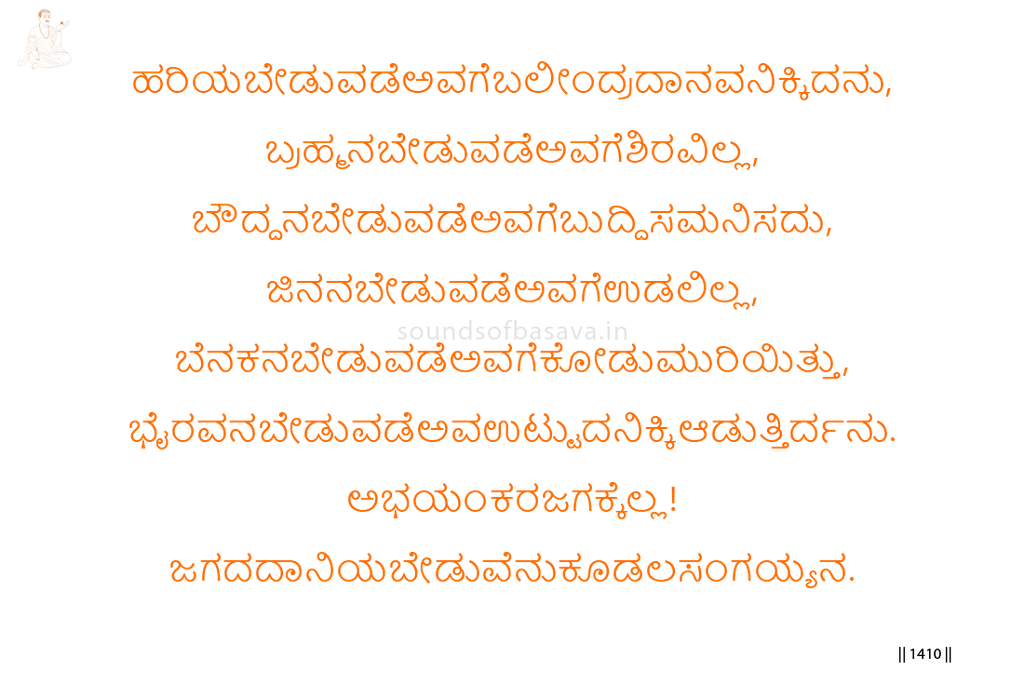
Basavanna considers a succession of celebrated Divine and spiritual figures: Hari, Brahma, Buddha, Jina, Ganapati, and Bhairava.
Each is recalled through a particular story, condition, bodily sign, or distinguishing characteristic. Hari is remembered through Bali; Brahma through the loss of a head; Buddha through his particular state of understanding; Jina through the absence of bodily possession; Ganapati through the broken tusk; and Bhairava through his stark ascetic form.
Basavanna’s seeking does not come to rest in any one of these particularised figures.
He seeks Kudalasangayya—the Abhayankara of the whole world, the giver of fearlessness to all, and the Jagadāni, the great giver to the world.
The Aikya movement is one-pointed and decisive: the seeker no longer moves among several possible Divine centres. Every alternative falls away, and Kudalasangama Deva alone becomes the final refuge sought.
Imagery & Symbolic Relevance
The Vachana is built through the repeated movement:
“If I seek…”
Each repetition opens a possible refuge and then immediately identifies the particular condition through which that figure is known.
Basavanna does not remain in any of them. The sequence prepares the final declaration that Kudalasangayya alone is the One he seeks.
“If I Seek Hari”
Hari is first recalled through Bali.
The reference brings Hari into a particular sacred narrative concerning Bali and Divine giving. Basavanna does not expand that narrative. He names it briefly and moves onward.
Hari is therefore known here through a specific act and relationship. The reference has a defined narrative setting; it does not become the final ground of Basavanna’s seeking.
“If I Seek Brahma”
Brahma is recalled as being without a head.
The image marks Brahma through a remembered condition of loss. However great his creative position may be within traditional accounts, the figure presented here is still identified through a particular bodily and narrative circumstance.
Basavanna does not allow that position to become his final refuge.
“If I Seek the Buddha”
The Buddha is recalled through a particular condition of buddhi and inward composure.
The wording is concise and should remain so. Basavanna is not giving a complete judgment upon Buddhist teaching. He identifies the Buddha through a distinctive condition attributed to him and continues the search.
The line contributes to the larger sequence: each revered figure remains known through a particular quality, discipline, history, or state.
“If I Seek the Jina”
The Jina is recalled through the absence of bodily possession.
This may suggest renunciation and freedom from ordinary possession, but the Vachana does not stop to unfold a complete doctrine of Jina practice.
The Jina too is recognised through a particular condition. Basavanna’s longing continues beyond it.
“If I Seek Ganapati”
Ganapati is identified through his broken tusk.
The tusk is a visible and remembered sign through which Ganapati is commonly recognised. Basavanna uses that familiar mark without elaborating its mythology.
The line continues the pattern of particularisation. The Divine figure is named through a distinct bodily sign rather than through the universal fearlessness Basavanna finally seeks.
“If I Seek Bhairava”
Bhairava is recalled through his severe ascetic appearance and movement.
The image is striking, but it too belongs to a particular sacred form. Bhairava is identifiable through a distinctive outward condition.
Basavanna does not make that form the conclusion of his seeking.
The Accumulation of Particular Conditions
The six references should be read together.
Each figure has:
a name;
a remembered history;
a particular quality;
a bodily sign;
a recognisable mode of appearance.
Basavanna does not need to deny that these figures are revered. His question is more direct: Where shall his own seeking finally rest?
A refuge defined through one story, sign, function, or condition does not fulfil the longing expressed in this Vachana.
Abhayankara to the Whole World
The sequence turns through the declaration:
Abhayankara jagakkella—the giver of fearlessness to the whole world.
Basavanna now moves from particular figures to a Divine relation extending to the entire world.
Abhaya is fearlessness, protection, and freedom from fear.
Kara indicates the one who gives, establishes, or makes.
Kudalasangayya is therefore the one who gives fearlessness universally.
This fearlessness is not merely courage before one temporary danger. It arises from receiving Kudalasangama Deva as the final refuge, without another Divine centre competing within the heart.
Jagadāni
Basavanna calls Kudalasangayya Jagadāni.
The word presents Him as the giver or benefactor of the world.
The earlier figures are recalled through particular conditions. Kudalasangayya is named through giving that embraces the world.
Basavanna therefore does not seek merely one special gift from Him. He seeks the Giver Himself.
“I Seek Kudalasangayya”
The final statement is personal and direct.
Basavanna does not conclude with an abstract principle such as universal divinity or impersonal radiance. He names Kudalasangayya.
His seeking passes through consideration of several revered figures and becomes firmly established in one Lord.
The conclusion contains no uncertainty:
not one more comparison;
not another sacred alternative;
not a further theological classification;
Kudalasangayya alone.
The Aikya Movement
The Aikya condition here lies in the ending of divided refuge.
The Vachana does not say that all names and forms must be blended into one conceptual system. It shows Basavanna’s own searching movement becoming one-pointed.
As long as the mind continues to ask whether one or another figure should become its final refuge, inward division remains.
When Kudalasangayya alone is sought, the searching mind finds its sole centre.
Lingayoga
Lingayoga requires the seeker to examine where final reliance has been placed.
A person may know many sacred stories, honour many revered figures, and appreciate many forms of discipline. Yet inward allegiance cannot remain scattered among competing centres.
The Ishtalinga establishes a direct and living relation with Kudalasangama Deva. That relation must become the governing centre of remembrance, worship, conduct, and refuge.
The practical test is not whether other names are known, but whether another final dependence continues within the mind:
Does fear send the seeker toward another refuge?
Does desire create a second sacred centre?
Does uncertainty make worship move from one support to another?
Does admiration for a particular power weaken fidelity to the Linga?
Basavanna’s answer is to seek Kudalasangayya alone.
Fearlessness follows from such undivided refuge. The practitioner is no longer inwardly divided among several sources of protection, fulfilment, authority, or grace.
This is not hostility toward others. It is the establishment of one’s own sacred relationship without fluctuation.
Editorial Commentary
Bēḍuvade means “if I seek,” “if I ask for,” or “if I take as the object of my appeal.” Its repetition structures the Vachana.
Hari, Brahma, Buddha, Jina, Benaka or Ganapati, and Bhairava must remain distinct figures. Their individual references should not be merged into one generalized symbolism.
Benaka is a Kannada name for Ganapati.
Abhayankara means the giver or establisher of fearlessness.
Jagakkella means “to the whole world” or “for all the world.”
Jagadāni indicates the giver or great benefactor of the world.
The listed conditions should not be expanded into a complete comparative theology. Their function in the Vachana is to show that each named figure is recalled through a particular story, condition, or characteristic, while Basavanna seeks Kudalasangayya as the universal giver of fearlessness.
The conclusion concerns exclusive Divine refuge. Basavanna seeks Kudalasangayya Himself rather than a particular power, narrative benefit, outward sign, or limited blessing.
Related Vachana
Supporting Vachana
Sharana Sthala Vachana 751 — The Hollow Drum
Sharana Vachana 751 uses the image of rice placed upon a drum. Rice meant for nourishment becomes useless when placed upon a surface where it cannot fulfil its purpose.
The Vachana applies this image to religious action and divided devotion. Offering performed without right orientation becomes sound and display rather than nourishment. It concludes by declaring that no other deity should be spoken of apart from Kudalasangama Deva.
This prepares Vachana 1399 directly.
In Sharana Vachana 751, the seeker is disciplined not to scatter offering or create another Divine refuge. In Aikya Vachana 1399, that discipline has become settled discernment: Basavanna passes through Hari, Brahma, Buddha, Jina, Ganapati, and Bhairava and seeks Kudalasangayya alone.
What begins as refusal of divided devotion in Sharana Sthala matures into one-pointed Divine seeking in Aikya.
Advancing Vachana
Aikya Sthala Vachana 1402 — Ever Adorned with Remembrance
Vachana 1399 establishes whom Basavanna seeks: Kudalasangayya, the giver of fearlessness to the whole world.
Vachana 1402 advances that seeking into complete embodied fidelity.
The consecrated hand gives but does not receive for personal gain. The arm does not violate sacred relationship. The ears refuse Shiva-slander. The neck bows before no other deity. Through constant remembrance and worship of Kudalasangama Deva, Basavanna remains forever near the Lord.
The movement is precise:
Vachana 1399 chooses the sole Divine refuge.
Vachana 1402 brings every bodily faculty under that choice.
Seeking becomes remembrance.
Remembrance becomes conduct.
Conduct becomes uninterrupted nearness.
Thus the appeal for Kudalasangayya in Vachana 1399 matures into a whole life permanently adorned by His remembrance.
