

Summary
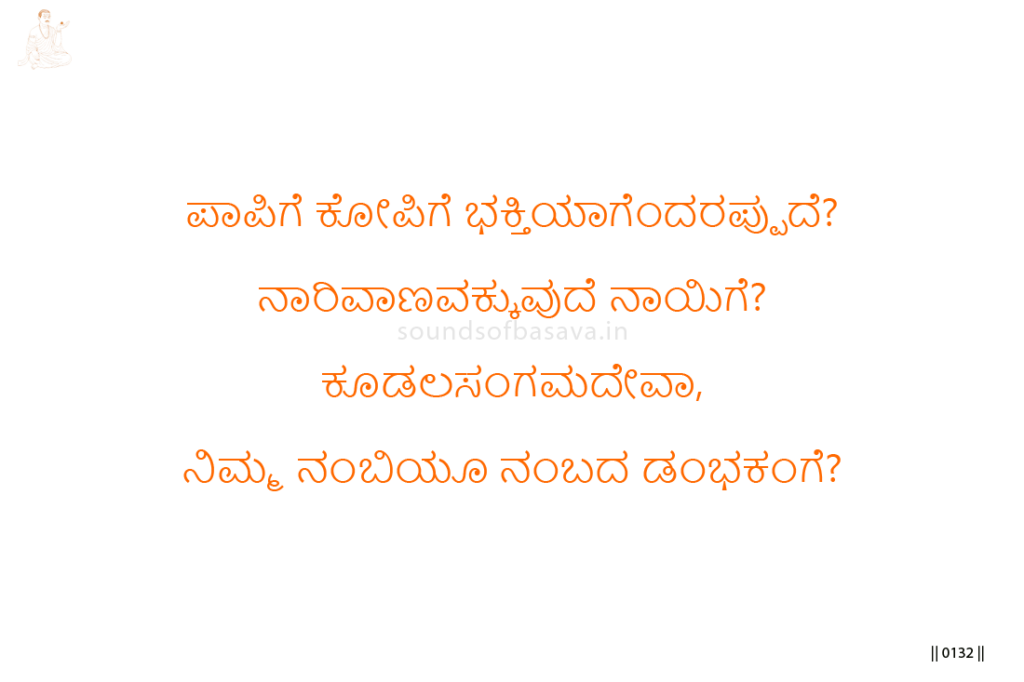
In this vachana, Basavanna asks whether bhakti can arise in one ruled by sin and anger.
Devotion cannot be produced by claim alone when the inner condition remains disturbed. A heart governed by corruption, rage, and falsehood cannot become devotional merely by using devotional language.
He then gives the image of a dog imagining the state of a noble steed. The image exposes the distance between desire and transformation. Basavanna finally turns to the hypocrite who says he trusts Kudalasangama Deva, yet does not truly trust. The vachana teaches that bhakti must become real within; it cannot be spoken into existence by pretense.
Imagery & Symbolic Relevance
The sinner and the angry person form the opening field of the vachana. Basavanna names an inner condition that is still unpurified.
The question is not whether such a person can ever change. The question is whether such a state can be called bhakti while it remains unchanged.
The dog and the steed give the central comparison. A dog does not become a noble horse by desire, imagination, or verbal claim.
The steed suggests discipline, direction, and trained strength. The dog represents a condition still ruled by impulse and habit.
Basavanna uses the contrast to expose false self-naming. Spiritual refinement cannot be borrowed. It must become actual in the nature of the seeker.
The final image is the dambhaka, the hypocrite. He says he trusts, yet inwardly does not trust. This divided condition is the opposite of bhakti.
The vachana therefore tests devotion by sincerity. Trust must be lived, not announced.
Lingayoga
In Lingayoga, the Anga must not hide behind the language of faith.
One may sit before the Linga, speak the name of Kudalasangama Deva, and claim trust. Yet if anger, sin, and hypocrisy remain active, the practice has not become whole.
Trust is not an outer statement. It is an inward surrender that changes the condition of awareness.
The seeker must therefore move from claim to transformation. Bhakti begins to become true when the heart is purified of rage, self-deception, and divided trust.
Practice matures when what is spoken before Linga is also true within.
Editorial Commentary
This vachana corrects false devotional claim.
Basavanna does not deny the possibility of transformation; he denies that transformation can be replaced by words, imagination, or performed trust.
Related Vachana
Supporting Vachana
Vachana 645 — The Straw Bull and the False Worshipper
Vachana 645 shows that Linga worship becomes false when sacred form hides deceit. Vachana 649 continues this by showing that even the claim of trust in Kudalasangama Deva becomes hollow when anger, sin, and hypocrisy remain within.
Advancing Vachana
Maheshwara Vachana 585 — The Fire That Becomes Enemy
Vachana 649 rejects false bhakti, imagined transformation, and trust that is spoken but not lived. Maheshwara Vachana 585 advances this into non-negotiable truth, where devotion can no longer be adjusted to accommodate hypocrisy before Kudalasangama Deva.
