

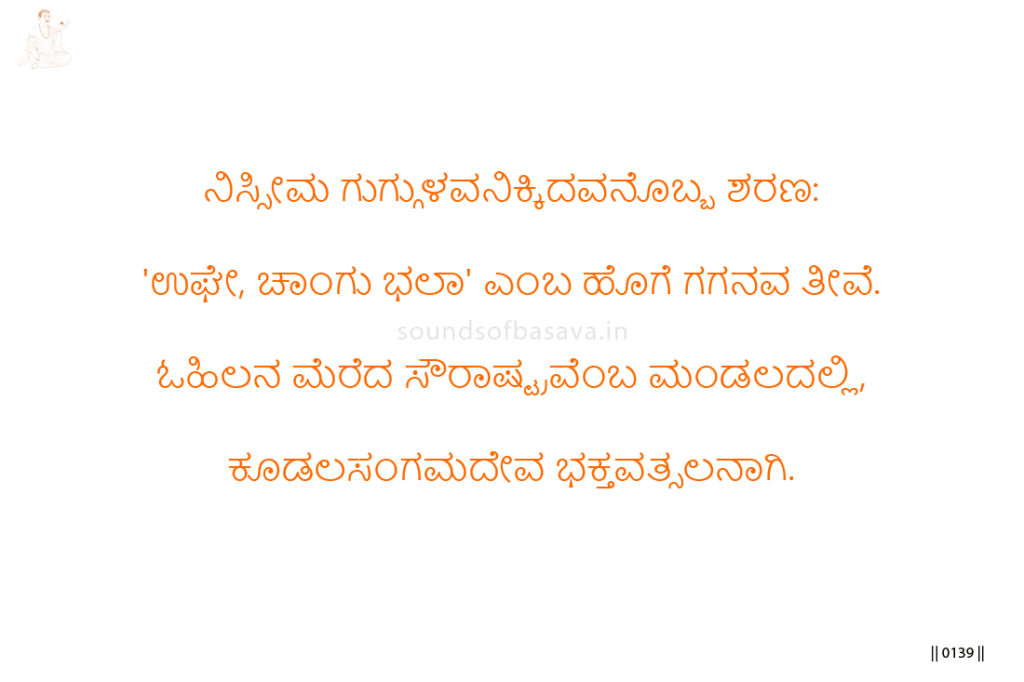
Basavanna exposes the futility of outward displays wealth, fragrance, status when inner truth is absent. Virtue must be cultivated like a field; without it, no spiritual fruit can grow. Pride, likened to riding a wild elephant, carries a person toward destruction. True substance is found only in living truthfully and knowing Kudalasangamadeva; otherwise, life becomes an empty shell shaped by ego and illusion.
Spiritual Context
Core Spiritual Principle: Spiritual attainment is an organic process of inner transformation, not an external acquisition. Outer displays of piety or power are spiritually worthless if they do not reflect an inner reality of truth (Satya) and cultivated virtue (Sadhana). Grace is the fruit that grows from the seeds of righteous action.
Cosmic Reality Perspective: The Linga is the ultimate truth and reality. To engage in empty ritual or display is to live in unreality (Asat), creating a life that is fundamentally out of alignment with the cosmic order. Pride (Ahamkara) is the force of this misalignment, violently separating the individual from the whole.
Historical Reality (Anubhava Mantapa context): This vachana is a direct critique of the ostentatious rituals and social hierarchies of orthodox religion. It establishes the Lingayat path as one of substance over form, where a person’s spiritual standing is determined by their character and inner realization, not by their wealth, caste, or ritual expertise.
Interpretation
1. The Hollow Symbols: “elephants, horses, musk…” : These represent the pinnacle of worldly power, status, and ritual purity in Basavanna’s time. He systematically dismisses them as “empty show,” severing the link between spirituality and social prestige.
2. The Law of the Harvest: “If no seeds of goodness are sown…” : This introduces the principle of Karma as a spiritual law. Grace (Prasada) is not a random gift but the natural and inevitable result (the “crop”) of virtuous thoughts, words, and deeds (the “seeds”). There is no shortcut.
3. The Metaphor of Pride: “the mad elephant of pride…” : This is a powerful image. An elephant is strong but controllable; a mad elephant is uncontrollable and self-destructive. Pride is not just a flaw but a destructive, runaway force that shatters relationships with others and with God, leading inevitably to spiritual “ruin.”
4. The Human Opportunity Lost: “Without knowing Kudalasangamadeva…” : The culmination is a statement of profound existential loss. A human birth is considered a rare opportunity for liberation. To squander it on hollow grandeur and ego is to transform this “precious vessel” into one that holds only the “suffering” of samsara.
Practical Implications: The seeker must constantly audit their motivations. Is my practice cultivating genuine humility and compassion, or is it reinforcing my self-image? The focus must be on the qualitative inner change, trusting that the external signs of grace will follow as a natural consequence of a life rightly lived.
The Cosmic Reality
Anga (Human Dimension): The individual as a field. The body and its adornments are the surface; the mind must be cultivated with the “seeds of goodness.”
Linga (Divine Principle): Kudalasangama Deva as the sun and rain of grace that causes the seeds to grow. The Linga is the ultimate truth that the seeker must come to “know.”
Jangama (Dynamic Interaction): The Jangama is the active process of sowing seeds through righteous living and uprooting the weeds of pride. It is the dynamic, ethical engagement with life that makes the Anga a fertile field for the Linga’s grace.
Shata Sthala
Primary Sthala: Bhakta. This vachana serves as a crucial warning for the Bhakta, ensuring their devotion does not become a superficial performance but remains a sincere process of inner purification.
Supporting Sthala: Maheshwara. The work of taming the “mad elephant of pride” is the fierce, disciplined work of the Maheshwara stage.
Practical Integration
Arivu (Awareness): Practice discerning the difference between substance and show in your own life. Notice when you are motivated by a desire to appear spiritual rather than to be spiritual.
Achara (Personal Discipline): Let your discipline be the conscious cultivation of one virtue at a time truthfulness, humility, generosity. Focus on the inner change, not the external recognition of it.
Kayaka (Sacred Action): Perform your work with integrity and as a service. Let the quality of your work be your adornment, not the title or the wealth it brings.
Dasoha (Communal Offering): Contribute to the Sangha not with showy donations, but with consistent, humble service. The substance of your contribution is the love and effort behind it, not its monetary value.
Modern Application
We live in a culture of “virtue signaling” and curated online personas, where appearing good is often valued more than being good. We also face spiritual consumerism, where exotic rituals, expensive retreats, and designer meditation gear are mistaken for the substance of practice. This leads to a culture of spiritual inauthenticity and burnout.
This vachana liberates by calling for radical authenticity. It frees us from the exhausting need to maintain a spiritual image. It simplifies the path: focus on being a good, honest, and humble person. Do the inner work, sow the seeds of goodness in your daily interactions, and trust that the grace and meaning you seek will grow naturally from that grounded foundation. It is the path from performance to presence.
Essence
The scented paste, the royal ride,
Can never truly fill the inside.
But sow a seed of truth each day,
And grace will grow along the way.
Metaphysically, this vachana distinguishes between Aropa (superimposition) and Svarupa (essential nature). The external displays are an Aropa, a false layer placed over the true Self. The “seeds of goodness” are Samskaras (mental impressions) that purify the mind and gradually reveal the Svarupa, which is one with the Linga. The “mad elephant of pride” is the Rajasic ego at its most destructive, fueled by Tamasic ignorance. The practice is to apply the Sattvic disciplines of truth and virtue to calm the Rajas and dispel the Tamas, allowing the essential nature to shine forth. This is the alchemy that turns the “vessel of suffering” into a vessel of divine consciousness.
A life built on image, status, and ego is a house built on sand. It may look impressive, but it cannot withstand the storms of life. A life built on integrity, humility, and service is a house built on rock. It may be simple, but it provides true shelter and peace. Your legacy will be the quality of your character, not the quantity of your possessions.

Views: 0