

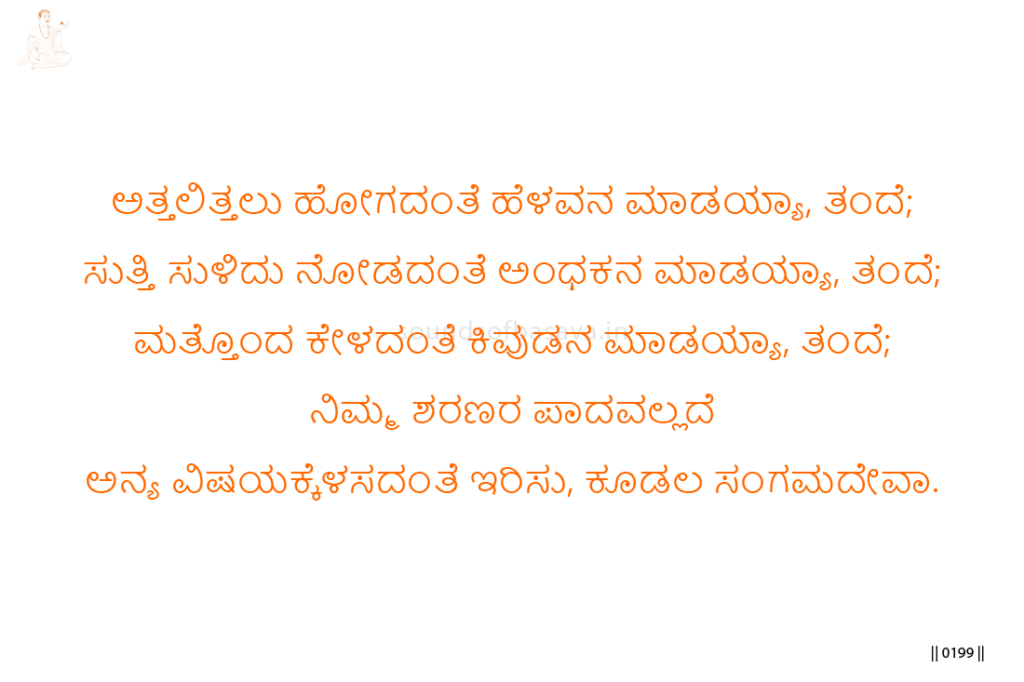
Summary
In this vachana, Basavanna asks Kudalasangama Deva to stop his wandering. He asks to be made unable to move here and there.
He then asks to be made blind to looking around and deaf to other hearing. The prayer is not for literal defect, but for protection from what scatters the senses.
The final request gives the reason. Apart from the feet of Kudalasangama Deva’s Sharanas, no other object should touch him. The senses must be held in one sacred direction.
Imagery & Symbolic Relevance
The first image is wandering here and there. It shows movement without steadiness.
The second image is being made unable to wander. Basavanna asks that outward movement be stopped before it carries him away.
The third image is blindness to looking around. Sight is guarded because the eyes can scatter attention among other objects.
The fourth image is deafness to other hearing. Hearing is guarded because the ear can receive what pulls the seeker away.
The fifth image is the feet of the Sharanas. They are the only place toward which the senses are to be allowed to turn.
The final image is protection from other objects. Basavanna asks that nothing apart from the Sharanas’ feet touch his senses.
Together, these images show guarded perception. Movement, sight, hearing, and sensory contact are restrained so that the seeker remains oriented toward the Sharanas of Kudalasangama Deva.
Lingayoga
In Lingayoga, this vachana teaches the guarding of movement, sight, hearing, and sensory contact. The seeker does not ask for the senses to be destroyed, but for them to stop scattering outward.
Movement must not wander. Sight must not roam. Hearing must not open itself to what divides attention.
The practical movement here is one-pointed orientation. Basavanna asks to be held only near the feet of Kudalasangama Deva’s Sharanas.
Editorial Commentary
This vachana should be read as a prayer for protective restraint. Basavanna does not trust unguarded movement, sight, hearing, or sensory contact. He asks Kudalasangama Deva to keep him from dispersion and hold him at the Sharanas’ feet.
Related Vachana
Supporting Vachana
Bhakta Sthala Vachana 103 — The Blind Who Seek with Open Eyes
Vachana 103 supports this teaching by warning against seeing only outward signs and remaining divided in devotion. There, the eye may recognize religious forms, yet still fail to discern the truth of undivided devotion to Kudalasangama Deva. Vachana 59 carries that Bhakta-stage correction into Maheshwara Sthala: the seeker asks that his movement, sight, hearing, and contact be restrained from all other objects and held only at the feet of Kudalasangama Deva’s Sharanas.
Advancing Vachana
Prasadi Sthala Vachana 511 — Practice Goes On, Yet Devotion Is Not Attained
Vachana 511 advances this teaching by showing that practice may continue, yet devotion is not attained unless the mind turns toward Kudalasangama Deva and is turned by His grace. It also bows to those in whom bodily qualities and tendencies have been removed.
Vachana 59 asks for movement, sight, hearing, and sensory contact to be guarded from outward dispersion and fixed at the feet of the Sharanas. Vachana 511 carries this into Prasadi Sthala by showing that restraint alone is not final; the mind must be turned by grace, and bodily tendencies must be removed before devotion becomes firm before Kudalasangama Deva.
