

Summary
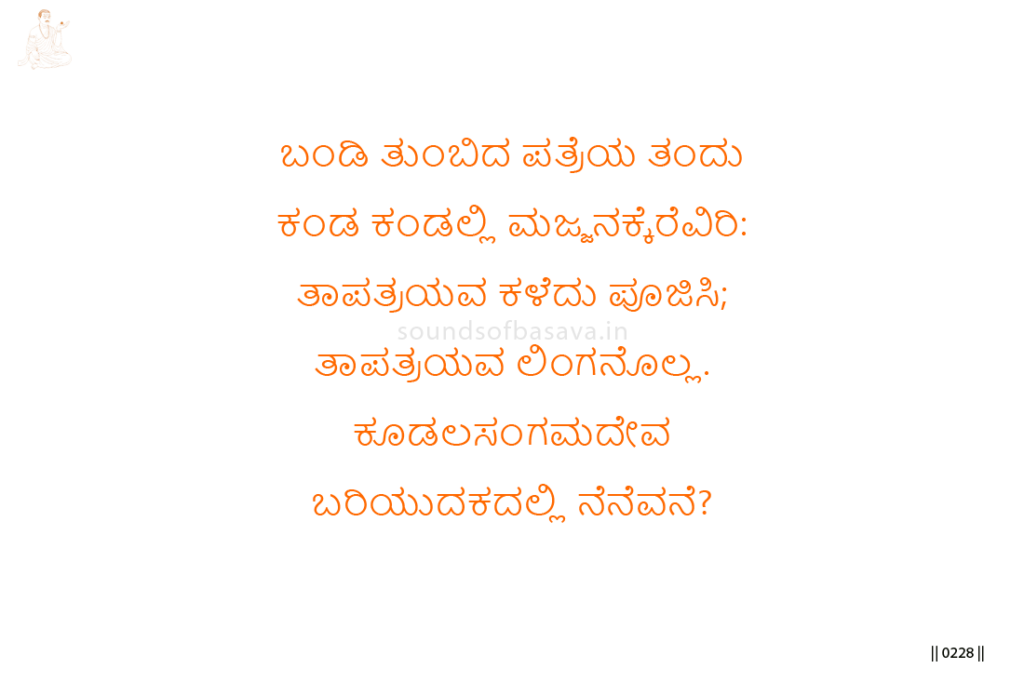
In this vachana, Basavanna shows worship performed as a bargain. Cartloads of leaves are brought, and water is poured again and again for worship.
The motive is to remove tāpatraya, the burning affliction of existence. The act is outwardly devotional, but inwardly it seeks relief as an exchange.
Basavanna says that the Linga does not accept tāpatraya-born worship. Kudalasangama Deva is not reached by bare water or quantity of offering, but by worship freed from bargaining.
Imagery & Symbolic Relevance
The first image is cartloads of leaves. The quantity is large, but Basavanna questions the motive behind the abundance.
The second image is repeated ablution. Water is poured again and again, yet repetition alone does not make worship true.
The third image is tāpatraya. The seeker is burning with affliction and tries to remove that suffering through worship.
The fourth image is worship performed to remove one’s own heat. The act becomes a transaction: worship is offered so that distress may be taken away.
The fifth image is the Linga not accepting such worship. The Linga is not moved by bargaining born from affliction.
The final image is bare water. Basavanna asks whether Kudalasangama Deva can be held or remembered merely through water poured outwardly.
Together, these images show the failure of transactional worship. Leaves may be brought in cartloads, water may be poured repeatedly, and worship may be performed, but if the hidden aim is only to bargain away suffering, the Linga does not accept it.
Lingayoga
In Lingayoga, this vachana tests the motive of worship. The issue is not the leaf, the water, or the act of worship itself, but the intention carried into it.
Worship becomes hollow when it is used only to remove one’s own burning. The Linga cannot be approached as a means of transaction.
The practical movement here is purification of offering. Basavanna asks the seeker to move from bargaining worship to truthful remembrance before Kudalasangama Deva.
Editorial Commentary
This vachana should be read as a warning against using worship as exchange. Basavanna does not reject offering, leaves, water, or worship. He rejects the condition in which they are used to bargain away suffering while the inner motive remains unchanged.
Related Vachana
Supporting Vachana
Bhakta Sthala Vachana 888 — The Futility of Hollow Offering
Bhakta Sthala Vachana 888 supports this vachana by showing that sacred acts such as foot-worship and Padodaka become hollow when the heart has not entered the truth of the Sharanas. Vachana 184 carries the same concern into Maheshwara Sthala: cartloads of leaves and repeated ablutions do not become true worship when the act is driven by bargaining.
Advancing Vachana
Prasadi Sthala Vachana 777 — The Offering That Is Not Giving
Prasadi Sthala Vachana 777 advances this movement by asking what true offering is when the giver still stands apart and claims, “I have offered.” Vachana 184 exposes worship performed to remove one’s own affliction. Vachana 777 carries this into Prasadi Sthala, where offering becomes real only when it is no longer claim, transaction, or separate ownership before Kudalasangama Deva.
