

Summary
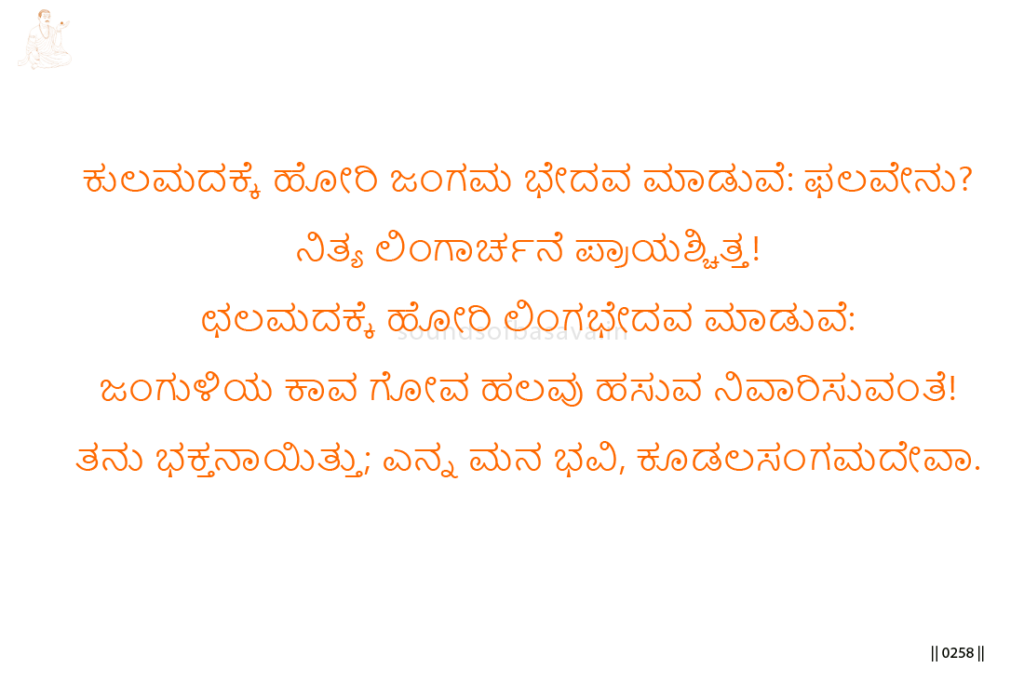
In this vachana, Basavanna asks what fruit can come if caste-pride causes division among Jangamas. If such division remains, daily Linga worship becomes only atonement.
He then asks what happens if arrogance creates division in the Linga itself. The body becomes like a cowherd restraining many cattle: active, occupied, and outwardly engaged.
Basavanna concludes with the deepest contradiction. The body has become bhakta, but the mind remains bhavi. Before Kudalasangama Deva, outward devotion is exposed as incomplete when caste-pride, Jangama-division, and Linga-division remain within.
Imagery & Symbolic Relevance
The first image is caste-pride. This is the beginning of division. Pride of birth or group causes the seeker to measure the Jangama through human distinction.
The second image is Jangama-bheda. To divide the Jangama is to divide the living sacred presence according to outer categories.
The third image is daily Linga worship becoming atonement. Worship continues, but because the mind remains divided, the worship no longer stands as pure devotion. It becomes compensation for the fault that remains.
The fourth image is Linga-bheda. This is an even deeper division. The Linga that should be received as undivided is split by arrogance.
The fifth image is the cowherd restraining many cattle. The body is busy like one managing a herd. It appears active and controlled, yet this activity does not prove inner realization.
The final image is the body as bhakta and the mind as bhavi. The body may carry devotional form, but the mind remains worldly and divided.
Together, these images show the failure of divided devotion. Caste-pride divides Jangama. Arrogance divides Linga. The body becomes outwardly devotional, but the mind remains outside the truth of devotion.
Lingayoga
In Lingayoga, this vachana tests whether the Linga worshipped inwardly is recognized in the living Jangama without division.
If the seeker worships Linga but divides Jangama by caste or status, practice becomes fractured. If the seeker speaks of Linga but creates division within Linga itself, worship has not become living awareness.
The practical movement here is undivided seeing. Basavanna asks the seeker to examine whether the body alone has become devotional while the mind still remains bhavi before Kudalasangama Deva.
Editorial Commentary
This vachana should be read as a warning against devotional division. Basavanna does not reject Linga worship. He rejects worship performed by a mind that still divides Jangama through caste-pride and divides Linga through arrogance.
Related Vachana
Supporting Vachana
Bhakta Sthala Vachana 412 — The Eyes That See One
Vachana 412 supports this teaching by warning against judging the Jangama by outward condition. If one Jangama comes clothed and honored, and another comes in worn or patched cloth, the seeker must not call one special and the other inferior.
Vachana 285 carries this Bhakta-stage correction into Maheshwara Sthala. There, the fault becomes caste-pride and Jangama-bheda. Both vachanas teach that sacred presence must not be divided by outer measure. Where such division enters, devotion loses its fruit before Kudalasangama Deva.
Advancing Vachana
Prasadi Sthala Vachana 777 — The Offering That Is Not Giving
Vachana 777 advances this teaching by showing that sacred offering is not completed by declaration or external giving alone. Giving to Guru or Linga must become lived, tasted, and practiced before it can be called true offering.
Vachana 285 exposes the divided state in which Linga worship continues while Jangama is divided by caste-pride and the mind remains bhavi. Vachana 777 carries this into Prasadi Sthala by showing that offering becomes complete only when it reaches Jangama and returns as Jangama-Prasada. The movement is from divided worship to lived offering before Kudalasangama Deva.
