

Summary
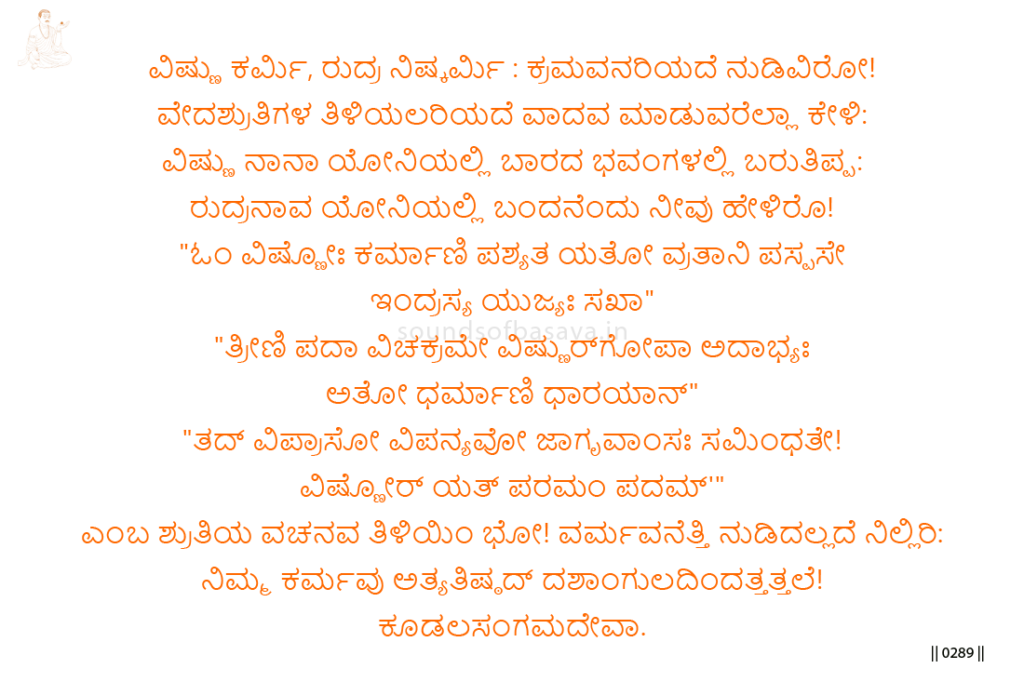
In this vachana, Basavanna corrects those who speak doctrinally without knowing the proper order. They say that Viṣṇu acts and Rudra is actionless.
He then addresses those who argue without understanding Veda and Śruti. Their speech may sound learned, but it has not touched the essence.
Basavanna asks them to stop speaking unless they have touched the marma. Without that contact, their karma remains confined within narrow measure before Kudalasangama Deva.
Imagery & Symbolic Relevance
The first image is the division between Viṣṇu and Rudra. One is called the doer, the other actionless. Basavanna exposes this as speech made without true order.
The second image is argument over Veda and Śruti. Scripture is invoked, but not understood. Debate becomes noise when it is not joined to realization.
The third image is Viṣṇu entering many births and wombs. This points to argument about divine forms, origins, and manifestations.
The fourth image is Rudra being assigned a birth or source. Basavanna does not accept such claims as final knowledge when they arise from surface understanding.
The fifth image is the marma, the essence. This is the decisive measure. Speech that has not touched the essence should stop.
The final image is karma confined within narrow bounds. Argument without essence does not free the speaker. It remains limited.
Together, these images show the failure of borrowed doctrine. To divide, classify, and argue about divine action and birth is not the same as touching the essence before Kudalasangama Deva.
Lingayoga
In Lingayoga, this vachana tests whether knowledge has become direct seeing. The seeker must not mistake argument for realization.
Scripture, doctrine, and speech must lead inward toward essence. If they remain at the level of classification, they do not complete the path.
The practical movement here is restraint before the unknown. Basavanna asks the seeker to stop speaking from borrowed certainty and turn toward the marma itself.
Editorial Commentary
This vachana should be read as a correction of speech without essence. Basavanna is not rejecting Veda, Śruti, or inquiry. He is rejecting argument that has not become inward knowing.
The distinction between Viṣṇu and Rudra becomes the example. When divine reality is reduced to categories of action, non-action, birth, and source, speech remains on the surface.
The word marma gives the vachana its center. Until the essence is touched, learning remains limited. Basavanna therefore asks for silence before hollow certainty.
Related Vachana
Supporting Vachana
Bhakta Sthala Vachana 652 — The Laughter That Awakens
Bhakta Sthala Vachana 652 supports this vachana by showing that reading, hearing, and sacred action remain fruitless when desire, anger, and the split between word and mind remain unchanged. Vachana 544 carries the same principle into doctrinal speech: argument over Veda, Śruti, Viṣṇu, and Rudra remains limited when it has not touched the essence.
Advancing Vachana
Prasadi Sthala Vachana 23 — When Devotion Burns the False Self
Prasadi Sthala Vachana 23 advances this movement by showing the limit of written learning. Vachana 544 warns against speaking without touching the marma. Vachana 23 carries this into Prasadi Sthala, where reading palm-leaf texts cannot bring the final seeing, and what cannot be learned is seen only through Kudalasangama Deva.
