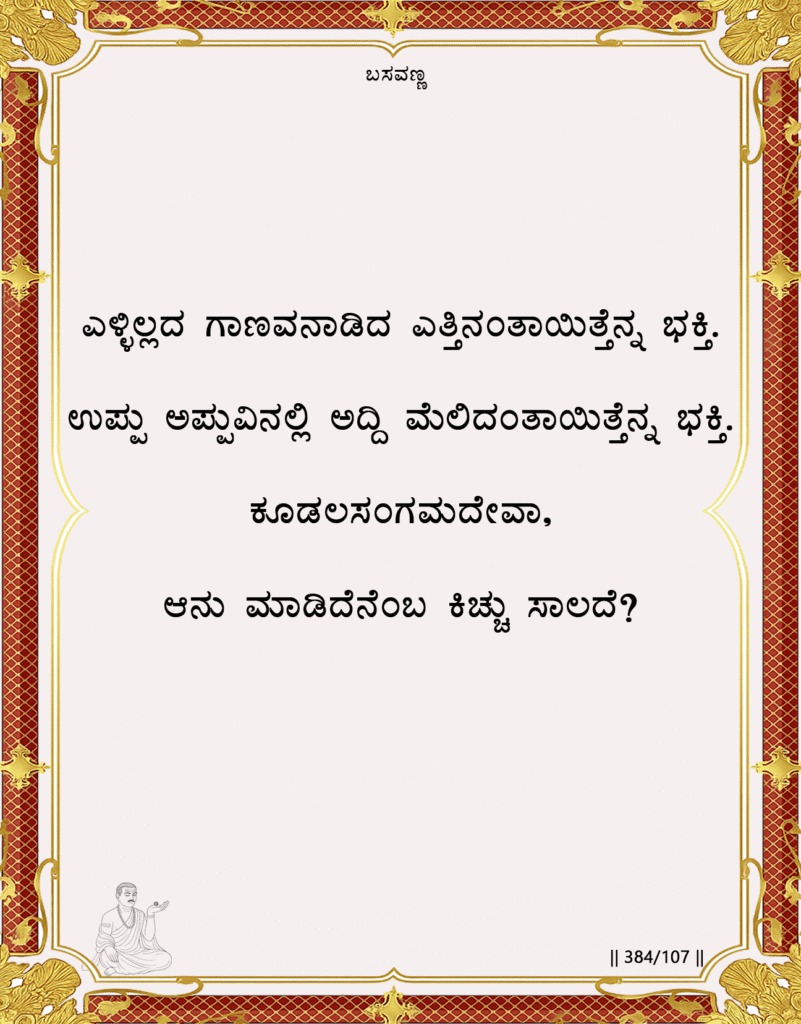
Poetic Rendering
My devotion is like an ox
circling an empty oil mill
round and round,
yet no sesame, no oil, no fruit.
It is like a thirsty man who eats salt:
the more he consumes,
the deeper the thirst claws at him.
So too, the fire of saying “I have done,
I have achieved”
only blazes higher,
burning me with my own ego.
Tell me, Koodalasangamadeva
what harvest can grow
from the field of “I”?
Basavanna confesses that spiritual effort driven by ego is futile. Like an ox circling an empty mill or a thirsty man eating salt, the seeker who claims “I do, I achieve” only intensifies his own suffering. True devotion begins when the fire of “I-consciousness” is extinguished and the self yields completely to the Divine.
Spiritual Context
Core Spiritual Principle: Spiritual practice aimed at self-glorification is not just ineffective; it is self-defeating. It reinforces the very ego that is the root of separation from the Divine. The path requires the sacrifice of the doer, not the accumulation of achievements.
Cosmic Reality Perspective: In the non-dual reality, there is only one Actor: the Divine (Linga). The sense of “I am the doer” (kartritva bhava) is the primary illusion of the individualized soul (Anga). Any action springing from this sense strengthens the illusion and deepens the bondage.
Historical Reality (Anubhava Mantapa Context): This is a warning to the spiritual community against the subtle trap of spiritual pride. Even within a revolutionary movement, individuals could fall into the trap of comparing their devotion or seeking recognition, thereby nullifying the very purpose of their practice.
Interpretation
1. “an ox circling an empty oil mill…”: The “ox” is the ego, diligently performing spiritual labor. The “empty mill” is practice devoid of the “sesame” of sincere surrender. The “oil” (the essence, the grace) cannot be produced because the central ingredientselflessnessis missing. The effort is mechanically perfect but spiritually barren.
2. “a thirsty man who eats salt…”: This is a powerful image of the paradox of egoic striving. The “thirst” is the desire for God. The “salt” is the ego’s claim over spiritual practices. The more one practices with a sense of “I am doing this,” the more the ego is strengthened, which in turn increases the sense of separation from God, intensifying the spiritual thirst.
3. “the fire of saying ‘I have done’…”: The “fire” is the destructive energy of egoic identification. It consumes the merits of the practice and burns the seeker with pride, frustration, and a sense of entitlement.
4. “what harvest can grow from the field of ‘I’?”: This is the culminating question. The “field of I” is the ego itself, which is the soil of all action. If the soil is poisoned with self-importance, no true spiritual fruit (phala)such as peace, humility, or liberationcan possibly grow.
The Cosmic Reality
Anga (Human Dimension): The Anga is the ox, the thirsty man, the burning ego. Its task is to realize that its very sense of agency is the problem. It must learn to cease its frantic circling and instead become a receptive vessel.
Linga (Divine Principle): The Linga is the true mill-owner, the source of the water that quenches thirst, the cool ground that extinguishes the fire. It is the silent, unmoved mover for whom all work is ultimately done.
Jangama (Dynamic Interaction): The Jangama is the transformation from being the “doer-ox” to being the “instrument-mill.” It is the dynamic process where the Anga offers its capacity for action to the Linga, allowing the Linga’s will to be the driving force. The resulting action then produces the “oil” of grace.
Shatsthala
Primary Sthala: Bhakta Sthala. This Vachana addresses the fundamental error a new devotee must correct. The purity of the Bhakta’s motivation is more important than the intensity of their practice.
Supporting Sthala: Prasadi Sthala. The state where all action is felt as happening through one, rather than by one, is the state of being saturated by grace (Prasada). This Vachana points toward that state by diagnosing its opposite.
Practical Integration
Arivu (Awareness Practices): Before and after any spiritual practice (prayer, meditation, service), sit for a moment and consciously offer the action and its results to Koodalasangamadeva. Use the prayer: “This is for You, from You, and by You. I am not the doer.”
Achara (Personal Discipline): The primary discipline is the cultivation of nishkama karma (action without desire for fruit). Perform your duties without attachment to success or failure. When praised, inwardly deflect the credit to the Divine.
Kayaka (Sacred Action): In your daily work, see yourself as an instrument. Your skills, energy, and intelligence are gifts from the Divine, being used for the Divine’s purpose. This transforms work from a source of stress and pride into a flow of service.
Dasoha (Communal Offering): Create a community culture that values humility and sincerity over dramatic displays of piety. Encourage members to share their struggles with ego, not just their successes, fostering an environment of honest self-assessment.
Modern Application
Spiritual Materialism and the “Self-Help” Ego. The modern wellness and spirituality industry often promotes practices as a means to build a “better you”a more peaceful, successful, and enlightened ego. This is the ultimate paradox: using spiritual tools to fortify the very entity that must be dissolved, leading to what is often called the “spiritual ego.”
This Vachana offers the cure for this modern malady. It liberates the seeker from the exhausting project of self-improvement and redirects the focus to self-surrender. It teaches that peace is not an achievement to be gained by the ego, but a state of being that emerges when the ego’s frantic efforts cease. It replaces striving with allowing, and personal achievement with divine grace.
Essence
The ox that circles, round and round,
On barren, self-made, hollow ground.
The thirst that salt can never quell,
The fire of “I,” a personal hell.
O Lord, until this “I” is still,
No oil is pressed, no thirst you fill.
1. The Entropic Cycle of the Ego: The ox circling the empty mill is a perfect metaphor for a closed system in thermodynamics. The energy (effort) is constant, but no new energy (grace) enters the system, and no useful work (oil, liberation) is produced. The system merely dissipates energy as heat (the “fire” of ego), increasing its own entropy (disorder and suffering). The “I” is an entropic engine.
2. The Osmotic Failure of Egoic Thirst: The salt-eating metaphor illustrates a failure of osmosis. For grace to flow, there must be a concentration gradient between the empty vessel of the soul and the full ocean of the Divine. The ego, by claiming doership (eating salt), increases the solute concentration within itself, making it hypertonic to the Divine. This prevents the osmotic flow of grace and instead draws out what little moisture remains, increasing the internal drought.
3. Jangama as the Opening of the System: The functioning Jangama is the puncturing of this closed, entropic system. It is the act of offering that creates an opening for the influx of negative entropy (grace) from the Linga. When the “I” surrenders its claim to doership, the system becomes open. The energy of action is then seen as a flow through the individual from the Divine source back to the Divine manifestation. In this state, the individual does not “do” devotion; they become the channel through which the Divine devotes itself to its own creation. The “harvest” that grows is not for the “field of I,” but is the spontaneous flowering of the field itself into its natural, divine state.
Your greatest efforts will fail as long as you are doing them for yourself. The one who claims the victory is the one who is defeated by their own pride. Stop trying to become spiritual and instead allow spirituality to happen through you. Let go of the steering wheel of the “I.” The moment you cease to be the doer, the entire universe conspires to do the work for you, and the harvest you could never cultivate will grow effortlessly in the fertile soil of surrender.

Views: 1