Poetic Rendering

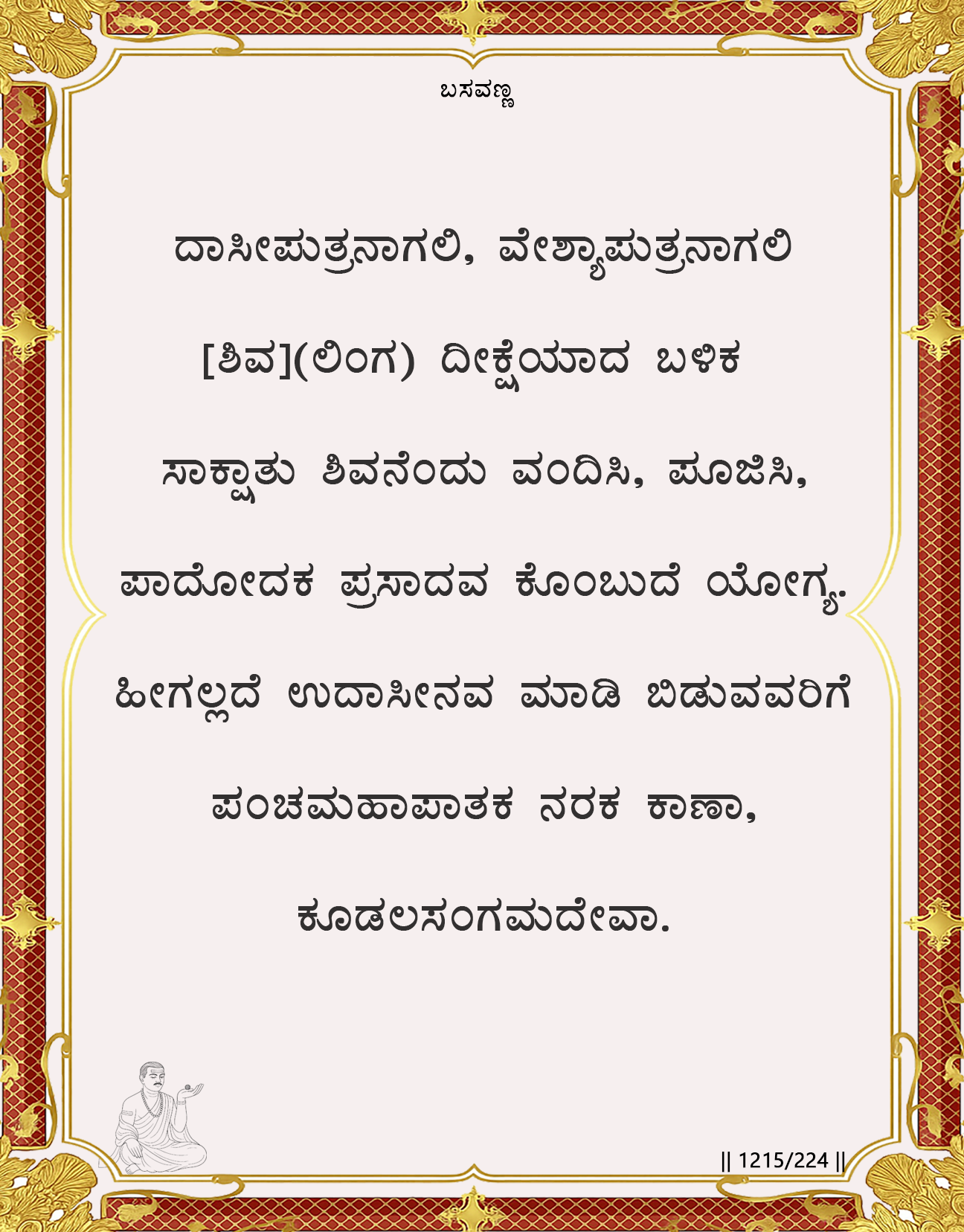
Whether born to a servant or a courtesan,
if they have received Shiva’s initiation
and begun to walk the inner path,
know them not by their birth,
but honour them as bhaktas on the way to becoming sharanas
offer respect, hospitality, and sacred food.
But those who mock or obstruct such seekers,
O Kudalasangama,
will fall into the hell
reserved for the five great sins.
In this vachana Basavanna proclaims that spiritual initiation dissolves all hierarchies of birth, affirming that one who has received Shiva’s grace becomes a bhakta moving toward the state of sharana, and therefore must be treated with reverence; to insult or obstruct such a seeker is not merely a social offense but a metaphysical violation of the divine order itself. This teaching resonates with the Shaiva Siddhānta understanding of the mantra “Om Namah Shivaya”, whose syllables unfold the soul’s entire journey Na (the Lord’s concealing grace), Ma (the world that binds), Śi (Shiva, the supreme reality), Vā (His revealing grace), and Ya (the Ātman) showing how grace gradually unveils the inner divinity latent in every being.
Basavanna ties this inner unfolding to the five laws of spiritual integrity Ariwu (right understanding), Āchāra (right conduct), Daya (compassion), Kayaka (sacralised labour), and Dasoha (selfless sharing) through which the seeker’s transformation becomes visible. Together, the mantra, the five laws, and Basavanna’s radical declaration converge into a single doctrine: that divine grace overturns all worldly distinctions and reveals the inherent Shiva-potential present in every aspirant.
Spiritual Context
Core Spiritual Principle: Divine grace (Shakti-pāta, initiation) confers a new, supreme identity that supersedes all karmic and social identities from birth. This new identity as a Bhakta/Sharana is the only one of spiritual consequence. To disrespect this identity is to disrespect the transformative power of the Divine itself.
Cosmic Reality Perspective: From the non-dual view, the Linga (Shiva) is the sole reality in all beings. Initiation is the conscious awakening to this truth. To mock an initiated seeker is to mock the awakening Shiva-consciousness within them, a profound act of ignorance (avidya) that reinforces duality.
Historical Reality (Anubhava Mantapa Context): This is the legal and social charter of the Lingayoga community. It legally nullifies the caste system within the Sangha. A king must bow to an initiated shoemaker. It establishes spiritual merit, not birth, as the sole criterion for authority and respect, creating a truly revolutionary social order.
Interpretation
“Whether born to a servant or a courtesan…”: Basavanna chooses the most socially stigmatized origins to make his point unequivocal: no human circumstance can limit or disqualify one from receiving divine grace.
“if they have received Shiva’s initiation… know them not by their birth, but honour them as bhaktas…”: Initiation is the ontological event that changes everything. The verb “know them not” is a command for a cognitive and perceptual shift. The community is ordered to see with spiritual eyes, not social eyes.
“offer respect, hospitality, and sacred food.”: These are not mere niceties but sacred acts (Dasoha) that reinforce the new spiritual reality. They are the practical liturgy of the new social order.
“those who mock or obstruct… will fall into the hell reserved for the five great sins.”: This is not a threat but a statement of karmic law. The “five great sins” (pancha-mahāpātaka) are actions that sever one from dharma. To obstruct a soul on the path to God is to place oneself in fundamental opposition to the cosmic order (rita), with natural, dire consequences.
Practical Implications: The Lingayoga community is defined by this principle. Every member, from the newest initiate to the most realized elder, is owed respect based on their connection to the Linga. The community’s health is measured by its adherence to this sacred hospitality.
The Cosmic Reality
Anga (Human Dimension): The individual soul, formerly defined by birth (jati), now redefined by initiation (diksha) and practice (sadhana).
Linga (Divine Principle): The source of grace that performs this redefinition and is the new core identity of the Anga.
Jangama (Dynamic Interaction): The culture of the Sangha the respect, offering, and mutual support that protects and nurtures the newly awakened divine potential in every Anga.
Shata Sthala
Primary Sthala: Bhakta The entire vachana elevates the status of the Bhakta to a position of sacred inviolability. This stage is recognized as the fragile, precious beginning of the journey that must be honored and protected above all else.
Supporting Sthala: Sharana The Bhakta is honored precisely because they are “on the way to becoming a Sharana.” The Sharana is the fulfilled state that gives the Bhakta’s journey its ultimate value and direction.
Practical Integration
Arivu (Awareness Practices): Consciously practice seeing the Linga in every initiated person you meet. Look past their personality, flaws, or social background to the divine seed of Bhakti within them.
Achara (Personal Discipline): Make it a personal vow to never speak disrespectfully of or to a fellow seeker, regardless of your personal disagreements or their level of understanding.
Kayaka (Sacred Action): In your work within the community, ensure that all tasks, especially menial ones, are performed with the understanding that they serve the Bhaktas and Sharanas the honored vessels of God.
Dasoha (Communal Offering): The community must institutionalize this respect. Leadership should be based on spiritual maturity, not worldly status. Newcomers and initiates should be welcomed, integrated, and honored explicitly as future Sharanas.
Modern Application
Modern spiritual communities often replicate social hierarchies of wealth, education, and influence. Newcomers are often ignored, and spiritual authority can become conflated with charismatic personality or business acumen, rather than genuine spiritual maturity.
This vachana provides the blueprint for an authentic spiritual community. It liberates the Sangha from worldly power structures and creates a true meritocracy of the spirit. It ensures that the community remains a safe and nurturing ground for the most vulnerable and crucial stage of the path: the beginning. It calls us to honor the seeker in everyone, especially the beginner.
Essence
The river does not ask the mountain’s permission to flow.
Grace does not ask caste for entry.
Where God has taken residence,
who are we to post a guard at the door?
Initiation is a quantum event that changes the fundamental state of the individual’s consciousness from a “classical” state (defined by historical, karmic data like caste) to a “quantum” state (a superposition of divine potentiality, a Bhakta/Sharana-in-becoming). To mock such a person is to forcefully “collapse their wavefunction” back to the limited classical identity, an act of violence against the cosmic process of evolution itself. The “hell” is the karmic decoherence and existential alienation that results from such an anti-evolutionary act.
Imagine a caterpillar has just entered its chrysalis and begun the transformation into a butterfly. To mock or disturb it at this stage is not just to insult a caterpillar; it is to destroy a butterfly-in-the-making. Basavanna commands us to honor the chrysalis stage, for within it dwells the sovereign potential of flight. The initiated Bhakta is this chrysalis.
We have a deep-seated tendency to judge others by their past and their origins. This vachana speaks to our capacity for hope and our ability to see potential. It commands us to honor the journey of transformation in others, for in doing so, we honor the possibility of transformation in ourselves. It affirms that every soul, regardless of its starting point, holds the sovereign potential for divinity.

Views: 0