Poetic Rendering

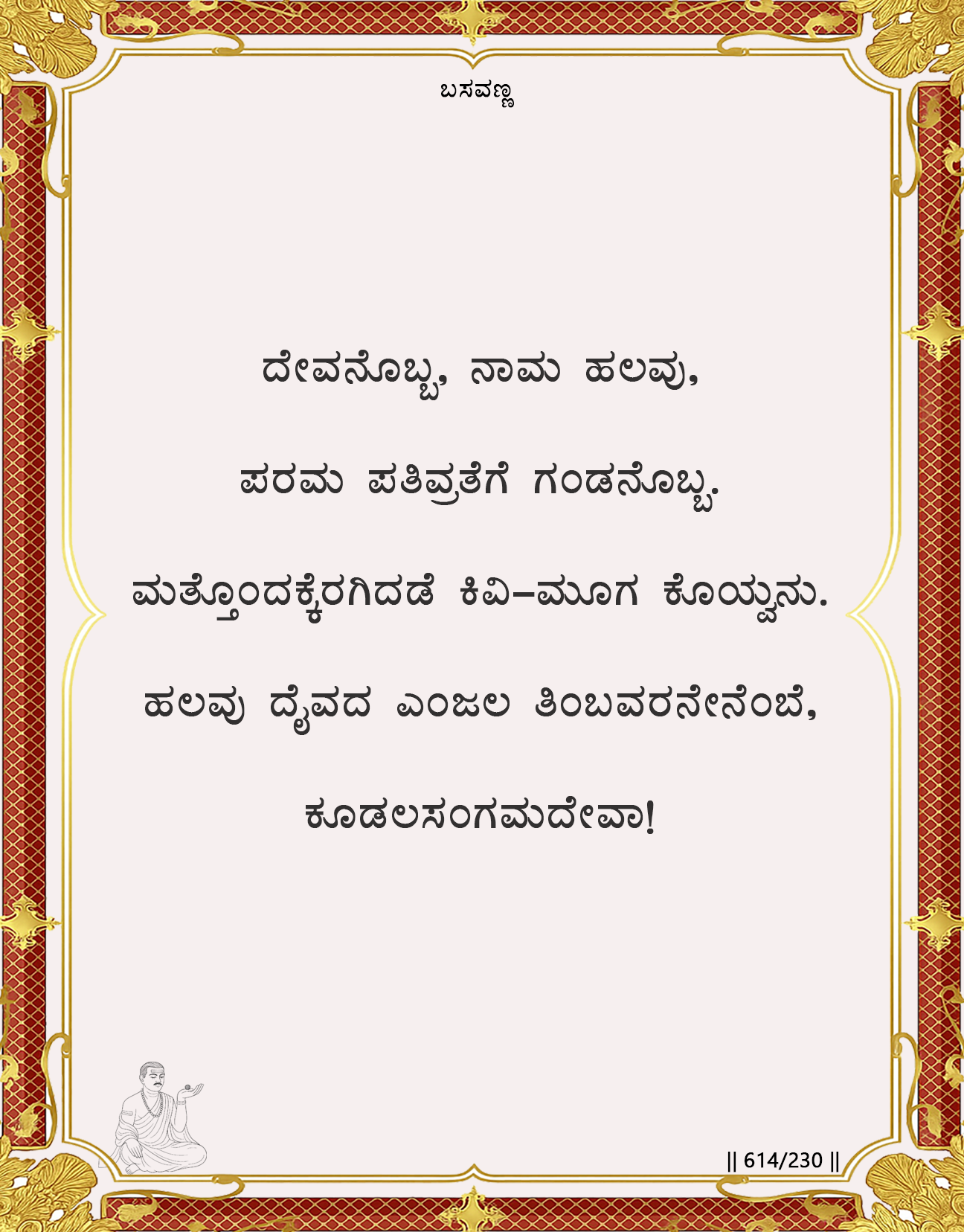
There is but One
though the world calls Him by a thousand names.
As a devoted wife clings to her single beloved,
so must the heart cling to the One Divine.
If she strays, she carries the scars of infidelity;
so too, the seeker who wanders after many gods
loses the fragrance of truth and the clarity of vision.
To divide the One into many
is to fall into the greed of lesser desires,
like a creature feeding on what has been spat out.
The only refuge, the only purity,
is in You alone,
O Kudalasangama!
In this vachana, Basavanna asserts that the Divine is fundamentally One, though human beings fracture that unity by inventing many names, forms, and sectarian divides. True spiritual fidelity is compared to the unwavering loyalty of a devoted wife: the seeker must anchor their heart to the One Reality without dispersing devotion across imagined divisions. To engage in such fragmentation is to degrade one’s own spiritual dignity, falling into a kind of inner impurity born of confusion and greed. Basavanna reminds that spiritual transformation requires a single-pointed devotion to the undivided Divine Presence, for only in Kudalasangama does the soul find its true and unsullied refuge.
Spiritual Context
Core Spiritual Principle: Spiritual progress requires an undivided heart (ekagrata). Dispersion of devotion among multiple deities or sectarian identities dilutes spiritual energy and reinforces the fundamental error of duality. The highest practice is to recognize the One Supreme Reality in all, and to direct all one’s love and surrender to that One, without contradiction or competition.
Cosmic Reality Perspective: From the non-dual (Advaita) perspective, the Linga is the absolute, all-encompassing source. The “thousand names” are merely conventional labels for the one, indivisible consciousness. To worship one name as separate from another is to misunderstand the fundamental nature of reality and to remain trapped in the realm of name and form (Nama-Rupa).
Historical Reality (Anubhava Mantapa Context): In a religious landscape filled with sectarian competition between Shaiva, Vaishnava, and Shakta traditions, Basavanna’s teaching is a unifying, transcendent call. It does not reject the names but contextualizes them as pointers to the One. This provided a theological basis for the Lingayoga community to remain focused on its core practice of Ishtalinga worship, without getting entangled in doctrinal disputes about other forms of God.
Interpretation
“There is but One though the world calls Him by a thousand names.”: This establishes the fundamental metaphysical truth. The multiplicity is in language and perception, not in the essence of the Divine.
“As a devoted wife clings to her single beloved… so must the heart cling to the One Divine.”: This is the core metaphor. Marital fidelity implies exclusivity, intimacy, trust, and total commitment. The spiritual heart must exhibit the same quality of unwavering, exclusive focus on the Divine. This is the practical application of the theory of non-duality.
“If she strays, she carries the scars of infidelity; so too, the seeker who wanders after many gods loses the fragrance of truth…”: “Scars of infidelity” and “loss of fragrance” are powerful images for the spiritual consequences of a divided heart. The consequence is not divine punishment but an inherent loss of clarity, purity, and intensity of spiritual experience. The energy is scattered, and the connection remains superficial.
“like a creature feeding on what has been spat out.”: This is a devastating image of spiritual degradation. To chase after limited, sectarian gods is to consume something that has been rejected by the highest understanding it is to nourish oneself on spiritual leftovers instead of the direct, nourishing presence of the One.
Practical Implications: For a Lingayogi, the Ishtalinga is the concrete form (Sthula Linga) that represents the formless Absolute (Linga). The practice is to pour all one’s devotional energy into this one relationship, understanding that it encompasses all. This single-pointedness (ekagrata) is what accelerates spiritual transformation.
The Cosmic Reality
Anga (Human Dimension): The devotee whose love and awareness must be integrated and focused into a single, powerful stream directed at the Divine.
Linga (Divine Principle): The one, undivided ocean of consciousness that is the source and goal of all devotion.
Jangama (Dynamic Interaction): The unwavering flow of love from the Anga to the Linga. It is the faithful, moment-to-movement of the heart that refuses to be distracted by other currents, thereby maintaining the purity and power of the connection.
Shata Sthala
Primary Sthala: Bhakta The emotional intensity, the personal relationship, and the language of fidelity and infidelity are hallmarks of the Bhakta’s passionate path of love.
Supporting Sthala: Aikya The reason for this exclusive devotion is the non-dual realization of Aikya. The Bhakta’s love is the means to achieve the Jnani’s understanding of unity.
Practical Integration
Arivu (Awareness Practices): In meditation, continually return your focus to the Ishtalinga as the singular center of your universe. When other thoughts or spiritual concepts arise, see them as waves on the ocean of the One, but do not follow them; return to the depths.
Achara (Personal Discipline): Simplify your spiritual life. Avoid mixing practices from different traditions in a way that creates conceptual conflict or dilutes focus. Let your primary mantra, your primary form of worship, be your unwavering commitment.
Kayaka (Sacred Action): See all your work as an offering to the One Divine. Do not compartmentalize your life into “spiritual” and “secular” domains; offer everything to Koodalasangamadeva.
Dasoha (Communal Offering): The community should reinforce this unity. While respecting the diverse paths of others, the Sangha’s collective worship and discourse should center on the core principle of the One Linga, strengthening the shared focus of all members.
Modern Application
The modern spiritual marketplace offers a bewildering array of practices, gurus, and deities. This can lead to “spiritual consumerism,” where seekers hop from one tradition to another, collecting experiences but never achieving depth. This creates a fragmented spiritual identity and a lack of transformative power.
This vachana is an antidote to spiritual distraction. It liberates us from the anxiety of needing to try everything. It champions depth over breadth, and fidelity over novelty. It assures us that the fastest path to transformation is to choose one authentic path and follow it with total commitment, trusting that the One contains the all.
Essence
Do not drink from a thousand puddles
when a single, deep well
holds the entire ocean.
My heart has room for one Beloved.
All other names are just echoes of His.
The human heart-mind system has a limited capacity for coherent energy output. Focusing this energy on a single, fundamental frequency (the Linga) creates a powerful, resonant standing wave that can eventually trigger a phase transition in consciousness (Aikya). Chasing multiple frequencies (many gods) creates destructive interference a chaotic, low-energy state where the waves cancel each other out, preventing any fundamental transformation. The “fragrance” is the coherent vibrational signature of a system tuned to one frequency.
Imagine you need to heat water. Using a laser (single-pointed devotion) will bring it to a boil efficiently. Using a scattered light source (divided devotion) will only warm it slightly. Basavanna instructs us to use the laser of our love on the one target, to achieve the boiling point of enlightenment.
We fear missing out and we crave variety. This vachana speaks to our deeper need for authentic, transformative experience, which only comes through depth and commitment. It reveals that true spiritual wealth is not found in having many options, but in the profound, irreversible transformation that comes from giving ourselves completely to the One.

Views: 0