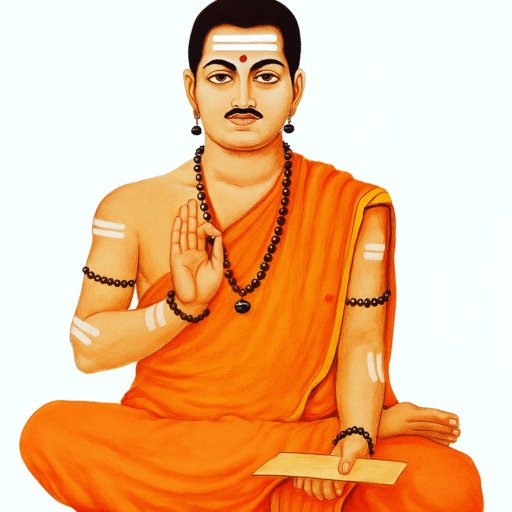

Poetic Rendering

Some will mock,
some will praise
yet both brush only the outer skin.
Some deeds bring merit,
others bring blame
passing over the heart
like day following night.
But the one who stands
in Koodalasangamadeva,
steady and awake,
is untouched by either shadow or shine
free from praise, free from scorn,
resting in the light
that outlives them all.
Basavanna teaches that praise and blame, merit and sin all the polarities that agitate the human mind remain only surface-level experiences. They affect the ego, not the essence. The true sharana is one whose inner anchor is fixed in Koodalasangamadeva, and therefore remains unshaken by either approval or criticism, gain or loss. This is samatva, equanimity: not withdrawal from life, but a deep freedom within it. Such a devotee moves through the world without being bound by its shifting judgments, rooted instead in the unwavering presence of the Divine.
Spiritual Context
Core Spiritual Principle: Transcendent Immanence. The world of dualities (praise/blame, merit/sin) is real but not ultimate. The seeker learns to inhabit this relative world from the absolute standpoint of the Linga, which is immanent within the experience yet transcendent to its valuations.
Cosmic Reality Perspective: From the non-dual view, Shiva-Shakti manifests as all opposites. Praise is Shakti, blame is Shakti; both are movements of the one Divine Energy. To be attached to one and averse to the other is to be trapped in a fragment of the Whole. The enlightened one witnesses the play of Shakti from the standpoint of Shiva unmoved, complete.
Historical Reality (Anubhava Mantapa Context): The Sharanas were social revolutionaries who actively challenged caste and gender norms. Such actions inevitably attracted both fierce blame from the orthodox and high praise from their fellows. This vachana provided the spiritual armor to remain steadfast and non-reactive, ensuring their revolutionary work was fueled by conviction, not a desire for approval or a fear of reprisal.
Interpretation
“Brush only the outer skin.” This metaphor establishes a core ontological distinction between the transient personality (the skin) and the eternal Self (the heart). Social judgments are superficial and lack the power to touch one’s essence.
“Passing over the heart like day following night.” This frames dualities as natural, cyclical phenomena. The “heart” (the core Self identified with the Linga) is like the sky unchanging, while the weather of merit and blame passes through it.
“Resting in the light that outlives them all.” The ultimate reality is the light of consciousness itself. All objects of consciousness, including social and karmic valuations, arise and subside within it. To rest as that light is to be free.
Practical Implications: Spiritual maturity is measured by one’s non-reactivity to praise and blame. The practice is to use every instance of external judgment as a mirror to see where one is still identified with the “outer skin,” and to consciously re-anchor awareness in the inner Linga.
The Cosmic Reality
Anga (Human Dimension): The human is a socio-karmic entity that naturally seeks reward (praise, merit) and avoids punishment (blame, sin). This is the realm of the conditioned mind.
Linga (Divine Principle): The Linga is pure, non-dual awareness, utterly impartial and untouched by any relative value judgments. It is the silent witness (Sakshi) upon which the drama of life plays out.
Jangama (Dynamic Interaction): This is the conscious process of de-identification. It is the dynamic act of feeling the sting of blame or the flush of praise, and then consciously referring that experience back to the Linga, allowing the Linga’s equanimity to dissolve the ego’s reaction.
Shata Sthala
Primary Sthala: Sharana. The state described is the very definition of a stabilized Sharana. Having taken refuge, they are no longer buffeted by the worldly winds of opinion and karmic consequence. Their center of gravity has shifted from society to the Divine.
Supporting Sthala: Aikya. This level of equanimity is impossible without a tasted, abiding sense of unity with the Linga. The Sharana’s freedom is not a stoic repression but a natural expression of their Aikya nature, where the separate self that could be affected by praise or blame has been subsumed in the divine whole.
Practical Integration
Arivu (Awareness Practices): Cultivate witness consciousness. In meditation and daily life, practice noticing the arising of pleasure in response to praise and pain in response to blame. Simply note, “This is praise,” “This is blame,” without following the narrative, anchoring instead in the awareness that perceives them.
Achara (Personal Discipline): The discipline is to refrain from seeking validation or fearing criticism. Make decisions based on inner alignment with the Linga’s presence, not on projected social outcomes.
Kayaka (Sacred Action): Perform your duty with excellence, but offer the fruits whether they manifest as success/failure or praise/blame to the Linga. Let the quality of your work be its own reward, independent of external recognition.
Dasoha (Communal Offering): Offer the gift of non-judgmental presence. Refrain from gossiping, praising, or blaming others, thus creating a community space where individuals are valued for their inherent divinity, not their fluctuating social performance.
Modern Application
The “Feedback Loop of the Ego,” supercharged by social media. Our self-worth is increasingly outsourced to “likes,” “shares,” and public commentary, creating fragile, performative identities in a constant state of anxiety and reactivity.
This vachana is the key to digital-age sanity and authentic living. It teaches how to engage with the world without being defined by it. It allows an activist to work without burning out from criticism, an artist to create without being crippled by reviews, and any individual to live a life of integrity, guided by an inner compass instead of the fickle opinions of the crowd.
Essence
The world will paint you white or black,
a saint’s halo, a villain’s stain.
But you are the canvas, vast and clear,
on which their colors appear.
Know yourself as the space, not the hue.
The light you are outshines their view.
This vachana outlines a spiritual immune system. The ego has no inherent defense; it is a construct built from and vulnerable to external input. The Linga, as pure consciousness, is the true immune system it can interface with any pathogen (praise/blame) without being infected, because its nature is fundamentally different from the invading substance.
Imagine your true self is the sky. Praise is a fluffy white cloud, blame is a dark storm cloud. If you identify as a cloud, you will be tossed about, formed, and dissolved by the winds of opinion. But if you know you are the sky, you can welcome all clouds, knowing they are temporary appearances that do not affect your vast, silent, boundless nature.
This addresses the universal human craving for acceptance and terror of rejection. It offers a resolution that does not require changing the world, but rather realizing a dimension of oneself that is inherently whole, accepted, and untouchable. It is the foundation of true psychological freedom and self-esteem.

Views: 0