Poetic Rendering

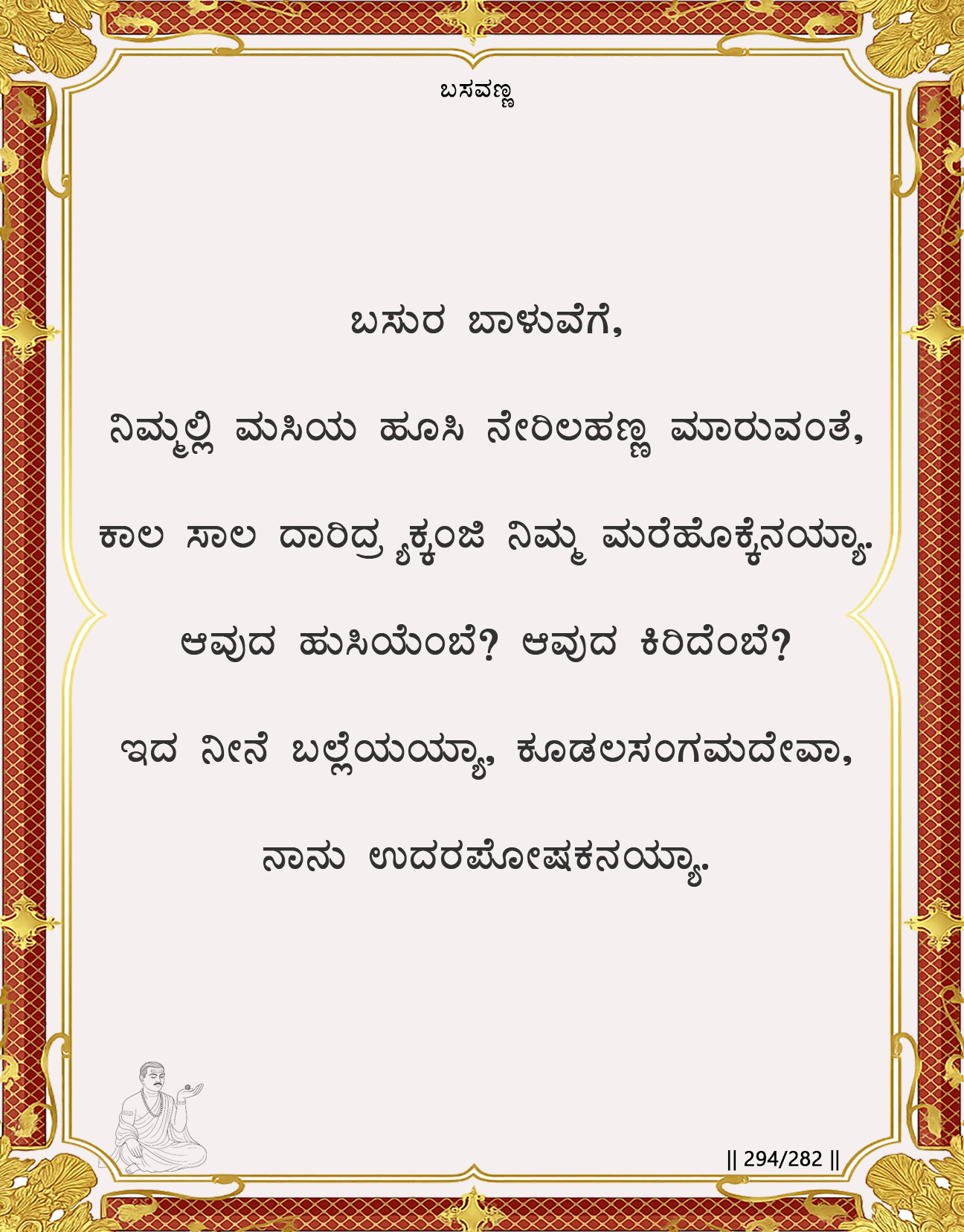
Like the child growing in the womb
hidden, helpless, sustained by another
so do I live in this world,
selling the perishable to keep myself alive.
Making ends meet, I bargain with life itself;
each day leaves me poorer in spirit,
and so I come to Your doorstep in fear of falling.
What is it that must be cast off?
What is it that still clings small and petty within me?
Only You know, O Koodalasangamadeva.
Outwardly I trade to fill my stomach,
but the vast hunger inside
is nourished only by Your grace.
Basavanna begins with the image of the child in the womb a life entirely dependent, sustained from within by a greater life. He uses this to describe the human condition: though we appear to be acting in the world like fruit-vendors trading to survive, our existence is as fragile and dependent as the unborn child’s. Every worldly effort yields only temporary gain and adds new forms of spiritual debt and anxiety. Recognizing this helplessness, the seeker turns to the Divine for refuge.
Unsure what inner impurities or attachments still bind him, Basavanna admits that only God can discern what must be discarded. The vachana contrasts the small, anxious transactions of worldly survival with the vast inner hunger that only divine grace can satisfy. Ultimately, Basavanna reveals that true sustenance is not material but spiritual a nourishment that flows from surrender to Koodalasangamadeva.
Spiritual Context
Core Spiritual Principle: Dependent Origination in Grace. True existence is not the independent agency of the vendor but the dependent sustenance of the child in the womb. Shivayoga is the recognition that all action (Kayaka), including survival, is a superficial transaction within Maya; real sustenance flows from conscious surrender to the Source.
Cosmic Reality Perspective: From the non-dual view, the “world” where buying and selling occurs is the realm of Shiva’s dynamic Shakti, but perceived through the filter of ego (vendor). The “womb” is the non-dual matrix of Shiva-Shakti itself, where the Jiva is always already held and nourished. The struggle is the soul’s ignorance of its true, sustained position.
Historical Reality (Anubhava Mantapa Context): This vachana spoke directly to the householder-yogis of the Basavayoga movement, who were fully engaged in commerce, agriculture, and governance. It validated their existential anxiety (“each day leaves me poorer in spirit”) while radically reframing their work: it is not through the success of their trade, but through the humility and surrender born of its inherent inadequacy, that they find the true sustenance of grace.
Interpretation
“Like the child in the womb…”: This establishes the foundational truth: our life is entirely contingent, a dependent variable. Our sense of agency is an illusion; true sustenance is given from within a greater Reality.
“Selling the perishable to keep myself alive”: The “perishable” is both the literal goods and the finite body-mind itself. The entire enterprise of worldly life is a barter system using impermanent currency to maintain an impermanent vessel.
“Each day leaves me poorer in spirit…”: This is the karmic insight. Worldly action, when done with a vendor’s mindset (expecting profit, fearing loss), accrues subtle debt (Karma), not wealth. It depletes spiritual energy (Chaitanya).
“What is it that must be cast off? What still clings…?”: The seeker is aware of bondage but cannot self-diagnose. This is the height of spiritual honesty, acknowledging that the ego cannot fully see its own attachments. The questions themselves are an offering to the Divine’s discerning grace.
“The vast hunger inside is nourished only by Your grace”: The “hunger” is the soul’s desire for infinite being (Sat), consciousness (Chit), and bliss (Ananda). No finite transaction can satisfy it. Grace (Prasada) is the direct, non-transactional flow from the Infinite to the finite.
Practical Implications: One must engage in work (Kayaka) while holding two truths simultaneously: the outer truth of necessary action, and the inner truth of total dependence. The profit from the first must be offered to alleviate the hunger of the second.
The Cosmic Reality
Anga (Human Dimension): The vendor-ego operating in the marketplace of time. It is defined by lack, calculation, anxiety, and the exhausting effort to maintain itself. Its very mode of existence is transactional, hence it feels impoverished by its own nature.
Linga (Divine Principle): The womb-space; the non-transactional, ever-giving source. It does not buy or sell but simply sustains and nourishes. It is the “knower” because it is the conscious ground in which all attachments are seen as fleeting shadows.
Jangama (Dynamic Interaction): The turning from the marketplace to the doorstep. It is the shift in attention from profit-and-loss to surrender-and-grace. This movement is the essential sadhana the moment the vendor stops shouting prices and sits silently, listening for the nourishing word from within.
Shata Sthala
Primary Sthala: Bhakta. The vachana is a classic Bhakta expression: feeling distant, dependent, and full of longing, yet possessing enough clarity to turn toward the source of grace with heartfelt questions.
Supporting Sthala: Prasadi. The act of asking “What must be cast off?” and admitting “Only You know” is an invocation for the discriminative grace that characterizes the Prasadi stage. The dawning light of grace begins with such self-awareness and surrender.
Practical Integration
Arivu (Awareness Practices): At the start and end of each workday, sit quietly. Visualize yourself as the child in the womb, sustained by a vast, intelligent life. Then, witness the day’s “buying and selling” from that space of secure dependence. Ask, “What clung to me today that I need help releasing?”
Achara (Personal Discipline): Dedicate a small, fixed portion of every financial transaction (a symbolic “fruit”) as an immediate offering. This could be a tiny set-aside for Dasoha. This ritualizes the truth that the transaction itself is not your sustenance; the grace flowing through it is.
Kayaka (Sacred Action): Perform your work as an act of sharing (Vitaraga), not selling. Focus on the genuine need you meet or the value you create, not the personal profit. When anxiety about survival arises, consciously offer that fear at the “doorstep” of your Istalinga.
Dasoha (Communal Offering): Use communal gatherings to share not just wealth, but these very vulnerabilities. Create a space where individuals can confess, “I feel like a vendor, spiritually poorer today.” Let the community’s collective remembrance of the “womb” of Koodalasangamadeva provide the reassurance and reorientation.
Modern Application
The Grinding Hustle & Spiritual Burnout. Life is reduced to a series of transactions: optimizing time, networking for gain, branding the self. This creates chronic anxiety, a sense of never having enough, and deep existential hunger amid material plenty the very “poorer in spirit” Basavanna describes.
This vachana invites Sovereignty through Surrender. It instructs us to internally reframe our work: we are not vendors selling our time and souls, but dependent children of a vast cosmos, permitted to participate in its flow. Our primary task is not to clinch the deal but to remain open to the nourishing grace within and around us. This ends the idolatry of hustle and restores work as a humble, sacred exchange within a benevolent whole.
Essence
A vendor’s shout, a coin’s cold gleam,
Sustain the shadow, not the dream.
Within the womb of worlds, I’m held,
While in the market, I’m compelled.
This petty hunger You alone can fill
The trade ends at Your silent sill.
This vachana describes the relational vs. transactional modes of existence. The vendor operates in a closed, Newtonian system of cause and effect (effort → profit/loss). The child in the womb exists in an open, quantum-relational field where its state is entangled with and defined by a larger, nurturing system. The spiritual crisis is the clash between these two models. Liberation is choosing to live from the relational model while operating within the transactional world.
Imagine a fish in a net (the vendor) thrashing to survive, exhausting itself. The fish does not realize it is simultaneously in the ocean (the womb). The moment it stops thrashing and rests, it feels the ocean’s water flowing through its gills, sustaining it effortlessly. Its survival was always from the ocean, not the net.
Our deepest anxiety is the fear that we are alone responsible for our survival, that we must “sell” ourselves to exist. This vachana reveals the liberating truth: we are already, and have always been, sustained. Our struggle is not what keeps us alive; it is what prevents us from feeling the embrace that already does. The journey is from the anxiety of the marketplace to the assured hunger of the child who knows its mother.

Views: 0