Poetic Rendering
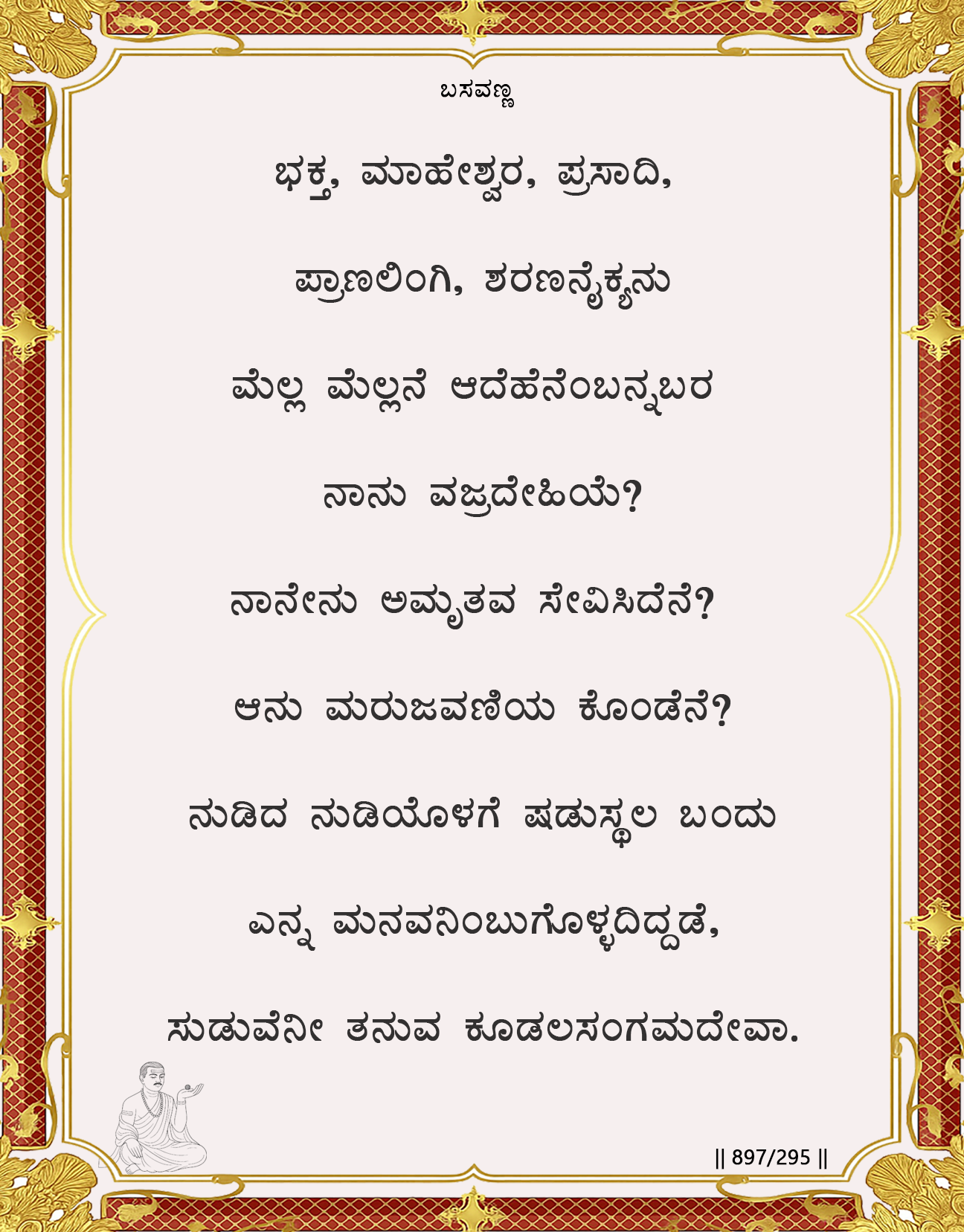
“Am I a Bhakta, a Maheshwara, a Prasadi, a Pranalingi, a Sharana,
an Aikya”
slowly, slowly, why do they speak so?
Am I some flawless diamond
that I should never crack?
Have I drunk the nectar of immortality
that I should never fade or falter?
These six stages of the path
the Shatasthala that unfold
only when grace ripens in its own time
if they sit merely upon my tongue
and have not yet descended
into the marrow of my being of their own accord,
then tell me
shall we burn this very body
that holds the divine within,
just because its flowering
has not hurried to meet our pride?
O Kudalasangamadeva,
the pace of Your manifestation
cannot be questioned.
Basavanna warns against claiming spiritual titles Bhakta, Maheshwara, Prasadi, Pranalingi, Sharana, Aikya before they are truly realized. He asks whether he is some perfect, unbreakable being or an immortal who never falters. The Shatasthala, the six stages of realization, cannot be forced, claimed, or accelerated. They arise only when grace descends in its own rhythm. If these states remain mere words on the tongue and have not matured into genuine inner realization, then to claim them is to lie in the name of the divine. Basavanna further asks: Should we destroy the very body that carries the divine simply because the divine has not manifested quickly enough? Thus he rejects spiritual impatience and insists that one must wait humbly for the divine to unveil itself. Core teaching:
Do not claim realization before it has happened.
Do not rush what must ripen.
Truth must descendit cannot be declared.
Spiritual Context
Core Spiritual Principle: Ontological Honesty (Satya-Avastha). In Lingayoga, your spiritual state is what you are, not what you say. To claim a state not fully embodied is a fundamental violence against truth (Satya) and a blockage to the very grace that would actualize it. The path demands rigorous self-honesty and patience.
Cosmic Reality Perspective: From the non-dual Shiva-Shakti view, the Shatsthala represent progressive stages of Shakti (individual consciousness) recognizing its identity with Shiva (universal consciousness). This recognition is an awakening, not a construction. The ego’s verbal claim is Shakti asserting a form upon itself, which impedes the formless recognition that grace alone confers.
Historical Reality (Anubhava Mantapa Context): This vachana was a vital quality-control mechanism within the Basavayoga community. As the Shatsthala provided a map for the journey, there was a danger of members using the terminology for status, creating a new spiritual hierarchy. Basavanna dismantles this, ensuring the community’s culture valued authentic, often hidden, growth over impressive claims.
Interpretation
1. “Slowly, slowly, why do they speak so?”: The repetition of titles (“Bhakta, Maheshwara…”) is a nervous incantation, betraying insecurity and a desire to solidify an unearned identity. True realization is silent confidence, not repetitive assertion.
2. “Am I some flawless diamond…? Have I drunk the nectar…?”: These rhetorical questions highlight the absurdity of the claim. A true diamond (flawless being) or an immortal (one beyond faltering) would not need to declare their state. The questions expose the claimant’s unacknowledged fragility and imperfection.
3. “These six stages… unfold only when grace ripens in its own time”: This establishes the causal mechanism. The Shatsthala are fruits of grace (Prasada), not trophies of effort. They “ripen”; they are not assembled.
4. “If they sit merely upon my tongue and have not yet descended into the marrow…”: This defines the difference between intellectual knowledge (tongue) and transformative realization (marrow). The latter is a total, cellular knowing that restructures one’s entire being.
5. “Shall we burn this very body that holds the divine within…?”: This is a profound plea for self-compassion and respect for the process. The body is the temple of the Linga. Impatience and self-loathing for not being “advanced” are a desecration of that temple. The divine unfolds through the vessel, not in spite of it.
Practical Implications: Use spiritual terminology with extreme caution, primarily as an internal guidepost, not a public identity. Cultivate a comfort with being undefined, a “seeker in progress,” and develop the discernment to feel the difference between a concept in the mind and a shift in the fundamental ground of being.
The Cosmic Reality
Anga (Human Dimension): The vehicle of time and process. It exists in becoming, subject to growth, faltering, and gradual transformation. Its mistake is to want to escape this temporal nature by claiming a finished state.
Linga (Divine Principle): The eternal, complete, and timeless reality. It is the fullness that the Anga seeks to realize. Its manifestation through the Anga follows a divine schedule (“its own time”).
Jangama (Dynamic Interaction): The true Jangama is the gracious descent of realization into the marrow of being. The false Jangama is the ego’s circular, upward projection of labels from the tongue. The seeker must quiet the latter to allow for the former.
Shata Sthala
Primary Sthala: Bhakta. The vachana embodies the Bhakta’s correct attitude: devotion coupled with humility, an aversion to false pretense, and a focus on sincere practice while awaiting grace.
Supporting Sthala: Prasadi. The entire argument hinges on the primacy of Prasadi (grace). All authentic movement from Bhakta onward is contingent upon this grace ripening, making it the supporting force behind every genuine step.
Practical Integration
Arivu (Awareness Practices): Practice “Marrow Check.” When you find yourself thinking or saying, “I am a devoted person,” or “I understand non-duality,” pause. Drop the statement and feel inward. Is there a felt, silent, cellular knowing in your body (marrow), or just a mental idea (tongue)? Rest in the sensation, not the label.
Achara (Personal Discipline): Undertake a period of “Title Renunciation.” For a set time, forbid yourself from using any spiritual labels to describe your state, even in your own mind. Simply note your direct experience: “Today, patience was difficult,” or “A moment of peace arose.”
Kayaka (Sacred Action): In your work, focus on the integrity and quality of the action itself, not on the job title or the recognition it may bring. Let your competence speak silently, without needing to claim expertise.
Dasoha (Communal Offering): Foster a community culture where members share their struggles and questions more than their insights and attainments. Celebrate the courage to say “I don’t know” or “I’m struggling with this” as higher virtues than claims of realization.
Modern Application
The Instagram Enlightenment & Rapid Transformation Industry. We live in an era of spiritual branding, where people claim enlightenment, mastery, or high-frequency states after a weekend workshop. Social media amplifies this, creating pressure to perform advancement. This cultivates profound inauthenticity, spiritual bypassing, and despair when the claimed state conflicts with unresolved human pain.
This vachana invites The Sanctity of Unfinishedness. It gives us permission to be a sacred work-in-progress. It encourages us to value depth over speed, integrity over image, and quiet growth over noisy declaration. The liberating move is to delete the internal and external pressure to be anything other than exactly what you are in this moment of your authentic journey, trusting that this honest ground is the only fertile soil for grace.
Essence
Why name the flower before the bud?
Why claim the knowing without blood
And marrow changed? This tongue speaks lies
That grace alone can sanctify.
I’ll keep this body, slow and plain,
A vessel for the coming rain.
Let titles wait, let words be still
And grow according to Your will.
This vachana stands as Basavanna’s supreme statement on spiritual integritya fiery prayer that transcends all stages of attainment. It exposes the fundamental peril of the path: the ego’s appropriation of holy names (Bhakta, Maheshwara, Sharana, etc.) as personal titles. This creates a fatal gap between verbal claim and lived reality, a gap he vows to incinerate in the sacred fire of truth.
At its core, the vachana describes the information theory of spiritual evolution. The ego’s claim to a title is redundant informationit merely repeats a pre-existing cultural or scriptural code without adding the novel information of actual, lived transformation. True progress is the generation of novel, incompressible information within the system of the self: a unique, irreversible reorganization of consciousness (the unbreakable diamond) leading to deathless bliss (the nectar). Grace (the Jangama, the Linga) is the external source that inputs this novel information. Basavanna warns that high redundancyempty talk and borrowed identitiescreates spiritual noise that drowns out the faint, authentic signal of genuine transformation.
We are terrified of ambiguity and process. We crave the solidity of a title, a finished identity, to counter the anxiety of being incomplete. This vachana reveals that craving for premature solidity is the enemy of our deepest growth. Our task is not to build a convincing spiritual persona, but to courageously inhabit the fertile, messy uncertainty of becoming. Basavanna’s plea“let this body burn”is the ultimate act of trust: making our very incompleteness an offering to the timing of a wisdom greater than our own. It is a request for the false, redundant self to be consumed so that only the novel, incompressible truth of authentic being remains.
Thus, the vachana provides the spiritual path’s essential immune system. It ensures progress is measured in genuine transformation, not conceptual understanding. The Shatsthala is revealed not as a ladder to climb for titles, but as a frequency to embody a resonance from the dense to the subtle, from the noisy word to the silent, novel fact of being. Just as a tree does not pretend to be a river, the true Sharana does not claim a state but expresses it fully, silently, and transparently.
- This teaching shatters the boundaries of its 12th-century origin to address the universal human condition:
- In Religion: It condemns preaching without inner transformation.
- In Governance: It exposes rhetoric without justice.
- In Education: It calls out knowledge divorced from ethical embodiment.
- In Science: It warns of progress without conscience.
- In Spirituality: It unveils devotion without awareness.
Across all civilizations, the disease is the same: appearance without essence, claim without novel information. Basavanna’s timeless medicine is humility, self-honesty, and devotion grounded in the service of truth. He does not judge; he invites us to awaken. He tells the world: Be fragile, be human, but be real. That vulnerable, burning honesty itselfthe courage to be unfinished before the divineis the diamond. That truth itself is the nectar.

Views: 0