Poetic Rendering

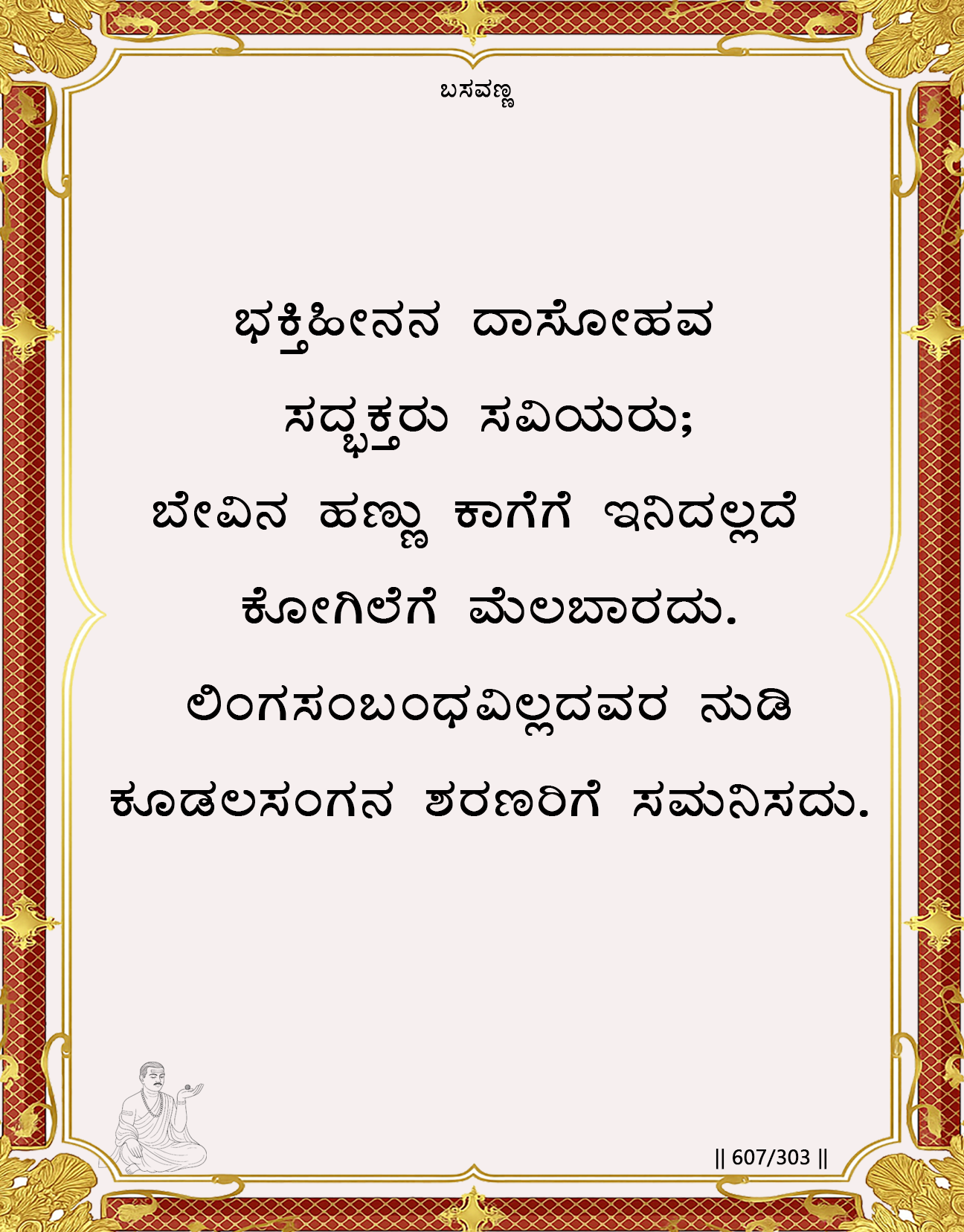
The alms of a devotionless man
true devotees cannot taste them.
Like bitter neem sweet only to the crow,
never to the cuckoo,
so is the speech of those without the bond of Linga
unfit for the ears of Your saints, O Koodalasangama Deva.
This vachana presents Basavanna’s radical critique of ritualism devoid of inner awareness. He establishes that the value of any spiritual act whether charity (dāna), prayer, or speech his determined not by its external form but by the consciousness from which it springs. Using the powerful metaphor of bitter neem fruit, he distinguishes between two modes of being: the crow, representing egoic consciousness that feeds on display and pretense, and the cuckoo, representing the awakened heart that resonates only with authenticity. This is not merely social commentary but a profound spiritual principle: devotion (Bhakti) requires the “bond of Linga” an unbroken connection to divine awareness that transforms action into worship. Without this inner link, even generous offerings become spiritually bitter and unrecognizable to those abiding in truth.
Spiritual Context
Core Spiritual Principle: Consciousness as Currency (Chaitanya-Mulya). In Lingayoga, the substance of any offering is the quality of awareness behind it. An act without the “bond of Linga” lacks spiritual valence, no matter its material or social value. True devotees are connoisseurs of consciousness; they cannot “taste” or accept offerings that come from a place of ignorance or ego.
Cosmic Reality Perspective: From the non-dual view, the Linga-bond represents Shakti consciously unified with Shiva. An offering from this unity carries the “frequency” of wholeness. An offering from a divided consciousness carries the “frequency” of separation (bitterness). The cuckoo (true devotee) is tuned to the former frequency and finds the latter not merely unpleasant, but unrecognizable as nourishment.
Historical Reality (Anubhava Mantapa Context): This vachana was a direct challenge to Brahminical ritual charity (Dana) performed for social merit (Punya) without inner transformation. In the Basavayoga community, it established that the acceptance of Dasoha (communal offering) was not a transactional act of receiving aid, but a sacred exchange that required discernment. The community would not legitimize or spiritually ingest the “alms” of those seeking to buy social or spiritual capital without genuine devotion.
Interpretation
1. “The alms of a devotion less man true devotees cannot taste them”: “Taste” (Rasa) here means to derive spiritual sustenance. The offering and the receiver must be on the same plane of consciousness. An offering devoid of devotional consciousness is like food without nutritional value it cannot nourish a spiritual being.
2. “Like bitter neem sweet only to the crow, never to the cuckoo”: The crow symbolizes a consciousness attracted to the shiny, the gross, and the outwardly impressive, even if it’s bitter (ego-gratifying). The cuckoo symbolizes a consciousness attuned to subtle sweetness (genuine spiritual essence). Their palates are fundamentally different, determined by their nature.
3. “So is the speech of those without the bond of Linga unfit for the ears of Your saints”: This extends the principle from material alms to speech teachings, advice, and praise. Words not flowing from the integrated awareness of the Linga are “unfit,” not just unhelpful, but potentially corrosive to the sacred space of the Sangha.
4. The Unstated Consequence: The verse implies a natural law of spiritual ecology. The “bitter alms” are not refused out of pride, but are inherently non-assimilable. To force acceptance would violate the integrity of both the giver (by validating their delusion) and the receiver (by polluting their consciousness).
Practical Implications: Discernment is a spiritual duty. As a seeker, scrutinize the source of the teachings you consume and the company you keep. As a potential recipient of help or praise, ask: “Does this come from a place of conscious unity, or from ego, guilt, or social expectation?” Learn to distinguish the “taste” of truth.
The Cosmic Reality
Anga (Human Dimension): The realm of form and transaction. It produces the physical alms and the audible speech. By itself, it is neutral. Its spiritual value is assigned entirely by the presence or absence of the Linga-bond in the actor.
Linga (Divine Principle): The sanctifying link, the “bond.” It is the divine consciousness that, when active in the giver, transforms matter and sound into Prasad (grace-filled offering).
Jangama (Dynamic Interaction): The resonance or its absence. When the offering carries the Linga’s frequency, a nourishing Jangama occurs between giver and receiver. When it does not, there is a Jangama of dissonance non-connection that protects the sanctity of the receiver’s field.
Shata Sthala
Primary Sthala: Bhakta. This teaching is crucial for the Bhakta, who is learning to develop spiritual discrimination (Viveka). It trains them to value the source of an offering over its appearance and to cultivate the “cuckoo’s palate” for genuine devotion.
Supporting Sthala: Sharana. The true devotees (“Your saints”) who cannot taste the bitter alms are established in the Sharana stage. Their very being is a filter that upholds the standard of authenticity for the entire community.
Practical Integration
Arivu (Awareness Practices): Cultivate “Inner Taste Buds.” Before accepting advice, consuming media, or participating in a ritual, pause. Ask inwardly: “What is the dominant consciousness behind this? Does it have the ‘sweetness’ of unity and selflessness, or the ‘bitterness’ of ego and separation?” Trust the intuitive sense that arises.
Achara (Personal Discipline): Before giving whether money, time, or praise examine your motive. Is it to relieve your own guilt, to be seen, or to control? If so, it is “bitter neem.” Purify the intent until the giving feels like a natural overflow of gratitude or connection (the Linga-bond), not a transaction.
Kayaka (Sacred Action): Let your work output be your “alms.” Ensure it is offered with the consciousness of service and integrity (the bond). This makes your work product spiritually nourishing to those who receive it, regardless of its material nature.
Dasoha (Communal Offering): The community must protect its collective “palate.” Gently but firmly decline donations or involvement from sources that seek to use the community for status or purification of ill-gotten gains. Explain that the community’s integrity depends on accepting only what is given in the right consciousness.
Modern Application
Performative Philanthropy and Influencer Spirituality. We live in an age of public charity drives, virtue-signaling, and spiritual content created for clicks and brand-building. This is the “bitter neem” of our time actions and words designed for social optics, devoid of transformative inner alignment. It creates cynicism and spiritual indigestion.
Value Source Over Scale. This vachana teaches us to prioritize the authenticity of the giver over the grandeur of the gift. A small, anonymous act from a sincere heart is infinitely more nourishing than a large, publicized donation from a conflicted source. It calls us to be “cuckoos” to disengage from the noisy, bitter feast of performative culture and seek out the quiet, genuine exchanges that truly sustain the soul.
Essence
What use the gift, however grand,
That leaves the giver’s heart unmanned?
The crow may feast on neem’s harsh fare,
The cuckoo seeks the sweetness rare.
So let my every act and word
Be by the bond of Linga stirred,
Lest what I offer, meant as grace,
Finds no true home in Love’s own space.
This vachana describes the biochemical specificity of spiritual exchange. Just as a enzyme (the true devotee) has an active site that only binds to a substrate (offering) with a precise molecular shape (consciousness of unity), so too does grace flow through specific channels. The “bond of Linga” is the correct conformational shape of consciousness. An offering without it is like a substrate that cannot fit the enzyme’s active siteno reaction (spiritual nourishment) occurs. The system is designed for perfect specificity to maintain the integrity of the spiritual organism.
Imagine a lock (the heart of a true devotee) and a key (an offering). The key’s shape is not just its physical form (the money, the words), but the intention with which it was forged. Only a key forged with the metal of pure intent (the Linga-bond) can turn the lock and open the door to grace. A key forged with the base metal of ego, even if gold-plated, will not fit. The lock isn’t being selective; it is simply being what it is.
We deeply desire that our offerings of love, help, creativity be received and found nourishing. This vachana reveals that reception depends not on the receiver’s gratitude but on the ontological quality of the offering itself. It challenges us to stop focusing on the external impact of our actions and to turn our attention inward, to the purity of the source. The ultimate generosity is to offer only what is true, ensuring it is fit for the divine in the other, even if it means offering less, or sometimes, offering nothing at all until our inner bond is secured.

Views: 0