Poetic Rendering
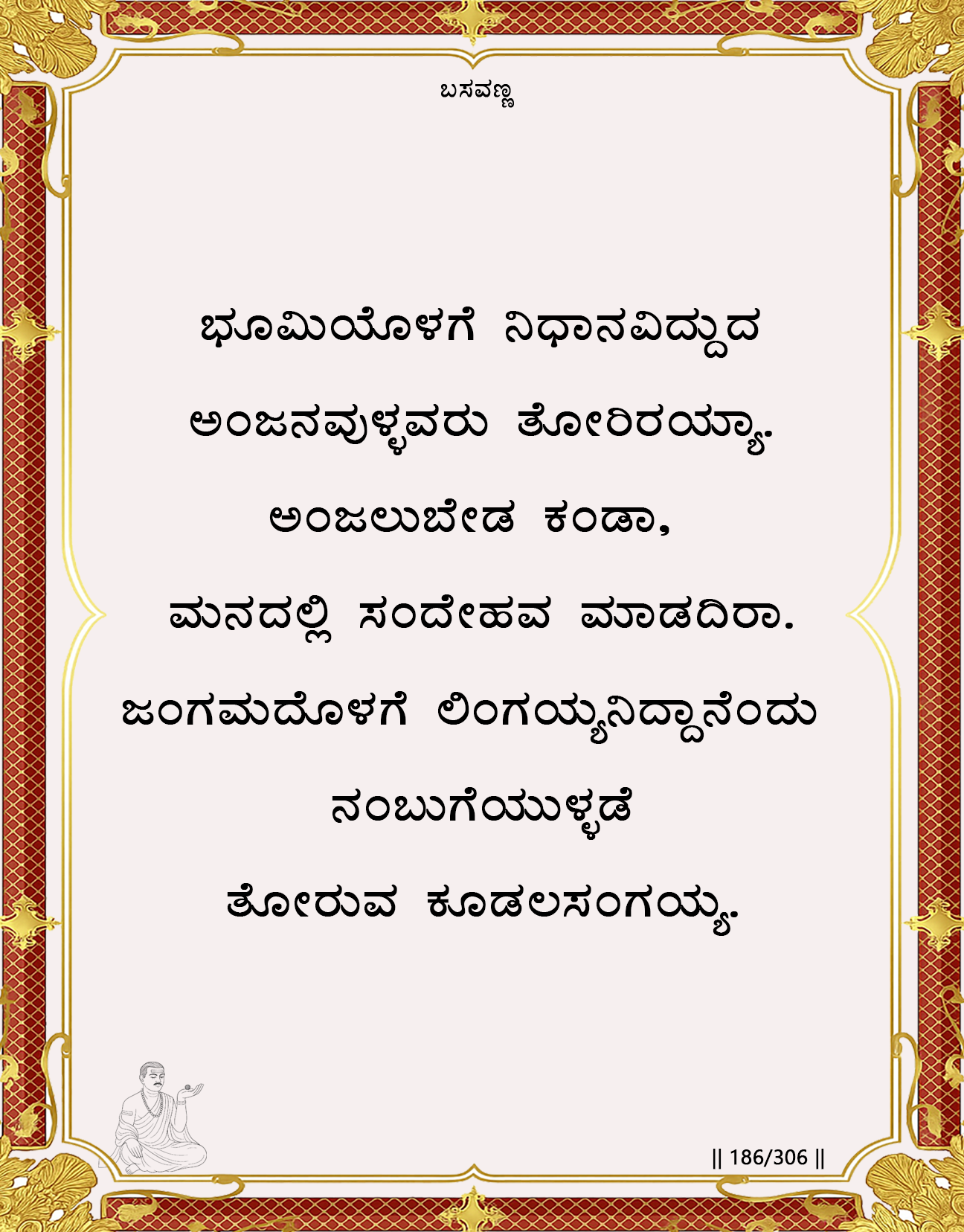
Hidden deep in the earth lie treasures untold;
only a practiced eye knows where the richness sleeps.
So fear not, child
let no doubt divide your mind.
For within the Jangama too
the Linga quietly dwells;
if your trust is steadfast,
Kudalasangayya Himself
will make the hidden shine forth
Basavanna urges the seeker to continue the sacred discipline of holding the Linga in the palm and offering worship with sinceritya practice akin to “trataka” in Lingayoga. Just as a miner reveals what lies concealed beneath the earth, the Divine hidden within the living Jangama who bears the same Lingawill gradually become visible to the seeker. The unmanifest begins to manifest through the living sages because they are the true companions of Kudalasangamadeva. Steadfastness, inner clarity, and devotion open the inner sight that perceives the Divine in its living form.
Spiritual Context
Revelation through Focused Embodiment (Trataka Siddhanta). In Lingayoga, realization is not abstract. It is triggered through the embodied ritual of Tratakaholding the Istalinga and gazing until the mind’s oscillations cease. This practice leverages the body’s senses to transcend sensory perception, forcing a collapse of dualistic thought and creating the empty, receptive space wherein the unmanifest (the treasure) spontaneously manifests.
The non-dual process is enacted physically: The hand (Anga) holds the Linga (Shiva in form). The gaze (the directed energy of Shakti) is locked upon it. When the gaze becomes steady and thought-free, the seeking Shakti merges with the still Shiva in the field of perception. This microcosmic ritual mirrors the macrocosmic truth: focused attention on the divine principle leads to dissolution of separation.
This vachana was a key practical manual for the Sharanas. At a time when elaborate, priest-dependent rituals were the norm, Basavanna prescribed this simple, direct, and personal yoga accessible to every householder. It democratized the path to God-realization, making it a matter of personal discipline and grace rather than priestly intercession.
Interpretation
1. “Hidden deep in the earth lie treasures untold; only a practiced eye knows…”: The “earth” is the ordinary, distracted mind and the opaque world of forms. The “practiced eye” is not physical sight but the faculty of attention refined through Trataka. This practice trains the mind to see the divine essence hidden within the gross.
2. “So fear not, childlet no doubt divide your mind”: Doubt (Vikshepa) is the primary obstacle in Trataka. It causes the gaze to waver and the mind to “divide” its attention. Basavanna offers the compassionate reassurance of a Guru, urging the surrender of doubt to the process itself.
3. “For within the Jangama too the Linga quietly dwells”: This connects the internal practice to the external guide. The Jangama is a living example of the success of the practiceproof that the treasure is real and attainable. The seeker’s faith in the Jangama reinforces their faith in the process of Trataka.
4. “If your trust is steadfast, Kudalasangayya Himself will make the hidden shine forth”: The practitioner’s role is to maintain steadfast trust and focus (the “mining”). The revelation itselfthe “shining forth”is an act of divine grace (Prasada). The steady gaze of Trataka is the supreme invocation of that grace.
The Cosmic Reality
Anga (Human Dimension): The instrument of practice. The body holds the Linga; the mind directs the gaze. Its nature is to be unsteady; its purpose is to be disciplined into perfect stillness as an offering.
Linga (Divine Principle): The still point, the anchor of consciousness. It is both the object of focus and the subject that is ultimately realized when the seeking mind subsides.
Jangama (Dynamic Interaction): The living transmission of the practice and its fruit. The Jangama validates the path and dynamically supports the seeker, embodying the union that Trataka seeks to achieve.
Shata Sthala
Primary Sthala: Bhakta. Trataka is the quintessential practice of the Bhakta stage, cultivating the single-minded devotion and focus required for all further progression.
Supporting Sthala: Pranalingi. The “shining forth” of the hidden Linga as a living, breathing presence within the practitioner is the hallmark of the Pranalingi stage, achieved through the grace earned in steadfast practice.
Practical Integration
Arivu (Awareness Practices): Practice Trataka as prescribed. Sit in a clean, quiet space. Hold your Istalinga in your left palm. Gaze steadily at its center without blinking, until tears naturally form or the mind stills. The goal is not to see a vision, but for the seer and seen to merge in a thought-free awareness.
Achara (Personal Discipline): Establish a fixed, daily time for Trataka. Begin with short periods (5-10 minutes) and extend gradually. The discipline is in the regularity, not the duration. Protect this time as sacred, non-negotiable mining of your inner treasure.
Kayaka (Sacred Action): Extend the principle of the unwavering gaze to your work. Perform each task with full, undivided attention, as if it were the Linga in your hand. This turns daily action into moving Trataka, mining the sacred from the mundane.
Dasoha (Communal Offering): Practice Trataka in community. Sit together in silence, each with their Linga, creating a powerful collective field of focused consciousness. Share the challenges (doubt, restlessness) and insights, supporting each other’s “steadfast trust.”
Modern Application
Fragmented Attention and Spiritual Seeking Without Discipline. Our attention is perpetually scattered across digital screens, making deep focus nearly impossible. We often seek spiritual experiences through consumptionbooks, podcasts, retreatswhile avoiding the demanding, singular discipline of a practice like Trataka that actually transforms consciousness at its root.
Reclaim Your Gaze, Reclaim Your Mind. This vachana prescribes the antidote to distraction: the radical, disciplined practice of Trataka. It calls us to put down our devices, pick up our anchor (the Linga or a chosen focal point), and train our minds to be still. In a world selling endless complexity, it offers a profound simplicity: liberation is found not in more information, but in the cessation of mental noise through unwavering focus on one divine point.
Essence
The hand holds still the form of Grace,
The eyes, one point, find resting place.
Let doubt, like dust, from vision clear
The miner’s trust conquers fear.
Then in the depth where thoughts unwind,
The Gardener’s treasure, yours to find:
A light not lit, but always true,
Shines forth in me, shines forth in you.
This vachana describes the operational protocol for inducing a quantum collapse in consciousness. The mind in its default state exists in a superposition of countless thought-wave potentials. The Istalinga is a classical, localized object. The practice of Trataka (steady gaze) is the act of continuous observation/measurement. In quantum terms, continuous observation “collapses the wave function.” By persistently “measuring” or focusing on the single point of the Linga, the practitioner collapses the mind’s superposition into a single, determinate state: thought-free, objectless awareness. This collapsed state is the “hidden treasure” that was always present but obscured by probabilistic mental noise. Grace is the natural law that governs this collapse when conditions (steadfastness, purity of intent) are met.
Imagine a snowy television screen (the ordinary, noisy mind). The Istalinga is a single, clear dot on the screen. Trataka is the act of focusing all your attention solely on that dot. As you do, the surrounding static (random thoughts) begins to fade because your “receiver” is tuned to only one signal. Eventually, the static disappears entirely, leaving only the clear, luminous dotwhich then reveals itself to be the source of the screen’s very light. You haven’t created the light; you’ve just stopped tuning into the noise that obscured it.
We are afraid of stillness and silence, equating them with boredom or emptiness. This vachana, through the method of Trataka, reveals that within that stillness is not emptiness, but a plenitudethe “treasure untold.” Our spiritual work is not to generate light, but to cease the frantic activity that scatters our perception. The promise is that if we have the courage to be still and look with unwavering trust, what we have been seeking will, by its own nature, reveal itself to us. The Divine is not found; it is uncovered when the search itself comes to a perfect, focused stop.
The teaching represents mature non-dualism: the Divine is not separate from the world but hidden within it, waiting to be recognized through transformed perception. The message applies universally: the student must dig for understanding, the artist must mine for inspiration, the lover must uncover the depth in the beloved. The vachana ultimately democratizes enlightenment: the divine treasure isn’t reserved for special beings in special places it waits in the ordinary “earth” of our daily existence, accessible to anyone willing to develop the “skilled hand” of faithful, persistent, courageous engagement with life as it is. Basavanna’s metaphors are never local they are cosmic archetypes.
- The Earth stands for matter the densest form of existence.
- The Treasure stands for consciousness the subtlest form.
- The Jangama stands for life the bridge between the two.
When awareness flowers through faith, matter itself becomes transparent and we see the Divine shining through every grain of dust. This is the vision of the Living Cosmos: the world is not dead; it is a breathing Linga, and every being a Jangama in motion. “Hidden within the earth of being lies the treasure of God;
through faith and the Jangama’s light, it shines as awareness.”

Views: 0