Poetic Rendering
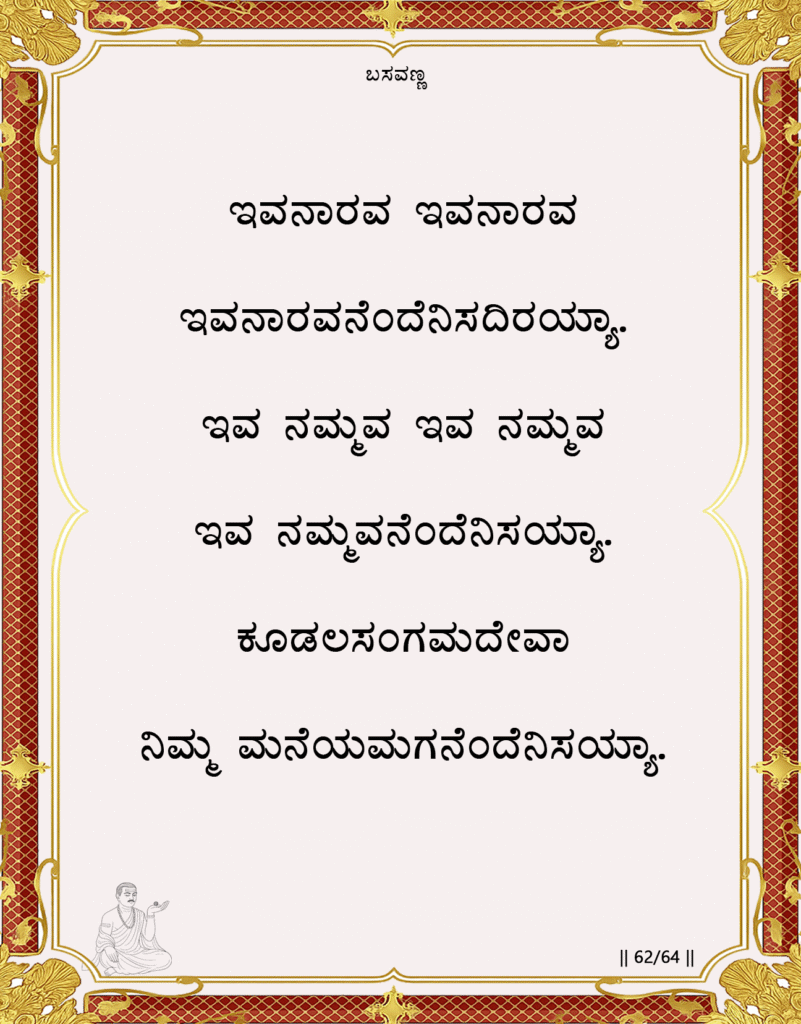
Let no one ask,
“Whose man is he?”
Let them say instead,
“He is ours,
truly one of our own.”
O Koodalasangamadeva,
let them recognize me
as a child of Your household.
This vachana reveals the deepest human yearning not for worldly status or achievement, but for authentic spiritual kinship. Basavanna articulates the soul’s desire to be recognized by its true family, the community of awakened beings. The repetition in the original Kannada creates a rhythmic incantation, emphasizing the intensity of this longing. This isn’t about rejecting human relationships but about grounding them in a deeper, divine connection where the soul finds its ultimate home.
Spiritual Context
Core Spiritual Principle: The soul’s ultimate fulfillment lies in being acknowledged and embraced by its true family the divine community (Sangha) and the Divine itself. This transcends all worldly identities and affiliations.
Cosmic Reality Perspective: In the non dual reality, all beings are expressions of the one Divine Consciousness (Linga). The feeling of separation and loneliness is the fundamental illusion (maya). The soul’s longing for belonging is, at its core, the longing to realize its innate, non separate status as a “child of the divine household.”
Historical Reality (Anubhava Mantapa Context): In 12th century Karnataka, identity was rigidly defined by caste, clan, and lineage. This Vachana is a radical declaration of a new, voluntary spiritual citizenship. It seeks to replace the question “What is your caste?” with the affirmation “He is one of ours” where “ours” refers to the egalitarian fellowship of the Sharanas. It represents the culmination of the social revolution initiated by Basavanna, where one’s primary identity is no longer biological but spiritual.
Interpretation
1. “Let no one ask, ‘Whose man is he?'” This is a plea for liberation from the world of objectification and labels. The question “Whose man is he?” reduces a person to a possession, a commodity owned by a family, a master, or a caste. Basavanna prays to be freed from this fragmented, transactional identity.
2. “Let them say instead, ‘He is ours, truly one of our own.'” This is the desire for a collective, inclusive identity. “Ours” does not imply exclusion but points to the boundless community of those who see the divine in each other. It is an identity based on shared essence, not on shared bloodlines or social contracts.
3. “O Koodalasangamadeva, let them recognize me as a child of Your household.” This is the ultimate aspiration. The “household of Kudalasangamadeva” is the entire cosmos, governed by divine law and overflowing with grace. To be recognized as its “child” is to have one’s true nature validated by the community of the enlightened and, by extension, by the Divine itself. It is the soul claiming its rightful inheritance.
Practical Implications: The seeker is guided to: Consciously de prioritize worldly labels and find their core identity in their connection to the Divine. Actively seek and contribute to spiritual communities (Sangha) that foster this sense of universal kinship. See every fellow seeker as a sibling in the “divine household,” transcending personal likes and dislikes.
The Cosmic Reality
Anga (Human Dimension): The Anga is the soul that feels orphaned in the world of separateness. Its deepest prayer is for adoption into its true family, to be seen and known for what it truly is.
Linga (Divine Principle): The Linga is the head of the “household,” the divine parent (Devaguru) and the very home (Kshetra) to which the soul seeks to return. It is the source of this unconditional belonging.
Jangama (Dynamic Interaction): The Jangama is the living community of Sharanas who embody this truth. They are the ones who can “recognize” a soul as a “child of the household.” The dynamic interaction is the act of mutual recognition among sharanas and their collective acknowledgment of their shared divine parentage.
Shata Sthala
Primary Sthala: Bhakta Sthala. This intense longing for divine kinship is the very engine of initial devotion. The Bhakta feels separate and yearns for union, which begins with the feeling of being accepted and belonging to the divine family.
Supporting Sthala: Sharana Sthala. The fulfillment of this prayer is the state of the Sharana. A true Sharana is one who is universally recognized as a rightful member of the divine household and who, in turn, recognizes that same divinity in all beings.
Practical Integration
Arivu (Awareness Practices): Contemplation on Identity: Meditate on the question “Who am I?” Let go of all temporary labels (name, profession, nationality) and rest in the feeling of being a “child of the divine household.”
Prayer of Belonging: Use this Vachana as a personal mantra, imbuing the repetition with the heartfelt longing to be seen and accepted by the Divine and its devotees.
Achara (Personal Discipline):Conduct yourself in a way that is worthy of the “divine household.” Let your actions, words, and thoughts reflect the dignity of your true heritage.
Kayaka (Sacred Action): Perform your work as a service to the divine household, seeing your colleagues and clients as fellow members of this vast family.
Dasoha (Communal Offering): The highest Dasoha is to make everyone feel that they are “one of our own.” Foster an inclusive, welcoming community where every seeker feels they belong.
Modern Application
“The Crisis of Belonging and Identity Fragmentation.” In the modern world, traditional sources of identity (family, religion, local community) have often weakened, leaving individuals feeling isolated, rootless, and searching for belonging. This often leads to a frantic search for identity in consumer brands, political tribes, or online subcultures, which are ultimately unsatisfying.
This Vachana offers a profound and permanent solution to the existential crisis of belonging. It provides a spiritual identity that is not based on external, fragile factors but on the eternal truth of one’s divine nature. It liberates one from the need to “fit in” with worldly groups and offers a true “home” in the community of seekers and in the heart of the Divine itself.
Essence
Strip from me the names I was loaned at birth.
Let me not be known as a son of the earth.
Let the only word that follows my name
be a whisper of grace, a acknowledging claim:
“He is ours. He is home.
He belongs to the One
from whom all families come.”
This Vachana addresses the metaphysical problem of existential alienation. It posits that the soul’s feeling of not belonging is a symptom of its misidentification with temporary forms. The solution is a re orientation of identity from the horizontal plane of biological and social lineage to the vertical axis of divine descent. Its multidimensional impact is to heal the psychological wound of separation at its root, providing a theological basis for a universal human family. It positions the Jangama Sangha as the visible, tangible proof of this new identity, the “household of Kudalasangamadeva” made manifest on Earth.
Your deepest longing is to be seen, known, and loved for who you truly are, beyond all the roles you play and the masks you wear. This fulfillment can only be found when you are recognized by, and recognize yourself in, a community of love and a source of grace that transcends the small, separate self. You are not a stranger in this universe. You are a child of the house, and you are coming home.

Views: 0