

Summary
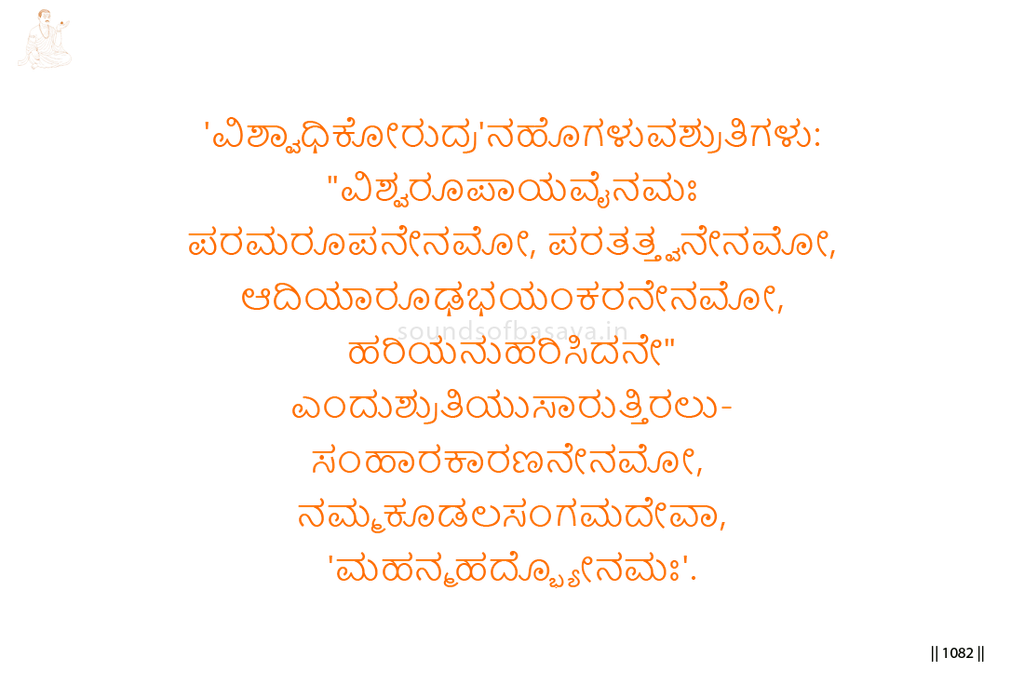
Basavanna offers repeated salutations to Kudalasangama Deva as the Supreme Form, the Supreme Reality, the fearsome One established in the primordial, and the cause of dissolution.
He also addresses Him as the One who overcomes Hari. Each Divine description ends in Namo, leaving no assertion or request—only reverent bowing before Kudalasangama Deva.
Imagery & Symbolic Relevance
“To the Supreme Form, Namo” gives the first salutation. Kudalasangama Deva is addressed as Parama-rūpa, the highest or supreme form.
“To the Supreme Reality, Namo” moves from form to Paratattva. The Lord is not praised only through appearance; He is addressed as the highest truth or principle.
The next salutation names Him as the fearsome One established in the primordial. The line places Him at the beginning and emphasizes His formidable greatness.
The phrase “the One who overcame Hari” shows that Hari does not stand as an independent final power before Kudalasangama Deva.
The name Saṃhāra-kāraṇa, the cause of dissolution, identifies Him as the ground from which dissolution proceeds.
The repeated Namo governs the whole vachana. Basavanna does not explain, question, or seek a boon. Each recognition becomes an act of bowing.
The closing reference to our Kudalasangama gathers Supreme Form, Supreme Reality, primordial greatness, and the power of dissolution into the Lord personally addressed by the devotee.
Lingayoga
In Lingayoga, recognition must mature into surrender.
The seeker may know the Linga through form, truth, origin, and Divine power, but these recognitions should not become objects of intellectual possession. Basavanna answers each one with Namo.
The repeated salutation removes self-assertion. Anga does not claim equality with, mastery over, or complete knowledge of Linga; it bows before Kudalasangama Deva.
The practice-point is direct: let recognition of the Lord become humility rather than spiritual self-claim.
Editorial Commentary
Parama-rūpa should be retained as Supreme Form. The Kannada vachana does not require it to be expanded automatically into “form beyond every form.”
The phrase concerning the primordial and fearsome One should also remain restrained. The line praises Kudalasangama Deva’s original and formidable greatness; it does not specify what or whom He terrifies.
The statement about overcoming Hari expresses Kudalasangama Deva’s supremacy. It affirms His preeminence and should be received as a direct recognition of His unmatched authority.
Related Vachana
Sharana Sthala Vachana 1290 — Beyond Method, Only Reverence Remains
Sharana Vachana 1290 says that Basavanna does not claim the methods of devotion, the sixteen forms of worship, Bhava and Nirbhava, or Jnana and Mahajnana. After relinquishing these as personal attainments, he says “Namo, Namo” at the feet of the Sharanas.
This directly prepares Vachana 536. In Sharana, spiritual method, experience, and knowledge give way to reverence. In Aikya, the same reverence is offered directly to Kudalasangama Deva as Supreme Form, Supreme Reality, primordial greatness, and the cause of dissolution.
Advancing Vachana
Aikya Sthala Vachana 1398 — Beyond All Lineage and Comparison
Vachana 536 bows to Kudalasangama Deva as Supreme Reality and as the One before whom even Hari does not stand independently.
Vachana 1398 carries this recognition beyond theological lineage and comparison. It places Kudalasangama Deva beyond reckonings concerning Hari, Hara, and Divine genealogy, and asks that the unborn and incomparable One be directly beheld.
Thus, the repeated salutation of Vachana 536 advances into direct recognition of Kudalasangama Deva beyond comparison and theological classification.
