

Summary
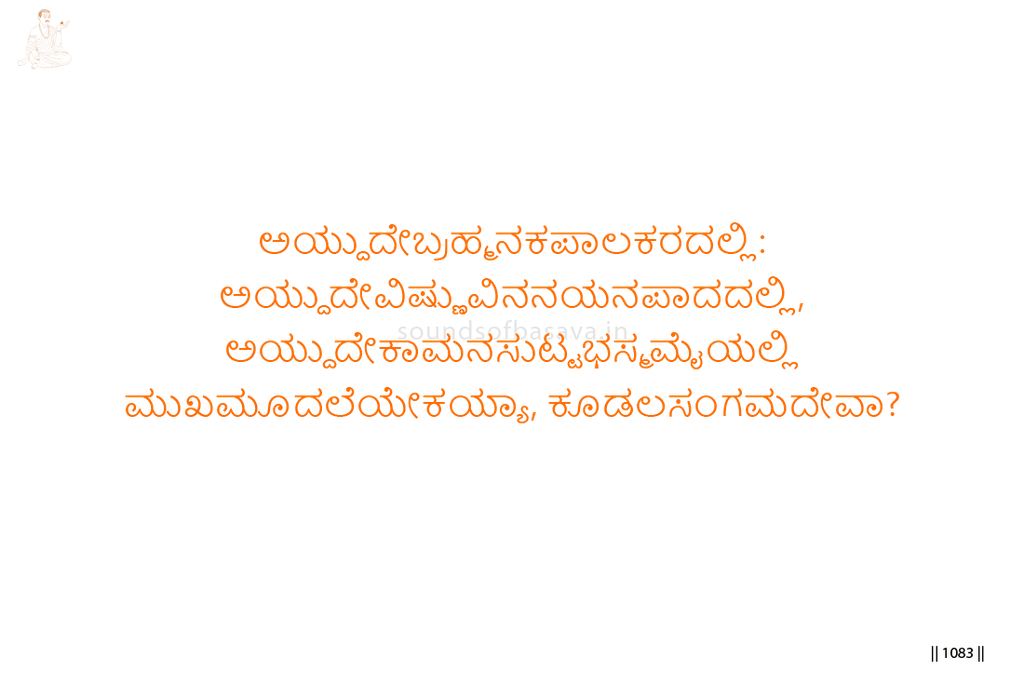
Basavanna recalls three manifestations of Shiva’s greatness: Brahma’s skull came into His hand, Vishnu’s eye came to His feet, and the ashes of the burnt Kama came upon His body.
With these signs before him, Basavanna asks why anyone should turn the face away from Kudalasangama Deva. The vachana is a direct affirmation of Shiva’s supremacy and a challenge to hesitation before Him.
Imagery & Symbolic Relevance
The repeated “Did it not come?” governs the vachana. Basavanna presents each image as known evidence rather than speculation.
Brahma’s skull in the hand is the first image. What belongs to Brahma is held by Shiva. The image displays Kudalasangama Deva’s greatness through His relation to Brahma.
Vishnu’s eye at the feet is the second image. The eye offered at Shiva’s feet expresses Vishnu’s devotion and places even an exalted Divine figure before Shiva in reverence.
The ashes of the burnt Kama upon the body form the third image. Kama has been consumed by Shiva’s fire, and the remaining ash is borne upon His body. The image shows Shiva’s power over desire.
The three images concern the hand, the feet, and the body. Together, they make Shiva’s greatness visible through what He bears and through what has come before Him.
The final question—“Why turn the face away?”—is the decisive movement. After recalling these manifestations, Basavanna challenges reluctance, disregard, or doubt toward Kudalasangama Deva.
Lingayoga
In Lingayoga, recognition of the Linga must lead to unwavering orientation.
The seeker should not acknowledge Kudalasangama Deva’s greatness in speech while inwardly turning elsewhere. The remembered signs must deepen trust and surrender.
The Kama-image also brings the teaching into practice. Desire must not govern the mind that has turned toward the Linga.
The practice-point is direct: recognize the Lord’s greatness, bring desire under sacred discipline, and do not turn the mind or face away from Kudalasangama Deva.
Editorial Commentary
The closing phrase must control the interpretation. Basavanna does not ask what remains to be separated. He asks why one should turn away after the Lord’s greatness has been made evident through these three sacred images.
The vachana should therefore remain centred on recognition of Shiva’s supremacy and the rejection of hesitation before Him.
The ashes of Kama should not be expanded into the claim that every form of human relation or embodied life has been destroyed. The source image concerns Shiva’s burning of Kama and the ash borne upon His body.
Related Vachana
Sharana Sthala Vachana 582 — Beyond All Claims and Marks
Sharana Vachana 582 recalls Vishnu as a Shiva-bhakta who offered his eye with steadfast devotion and received through Shiva-bhakti. It shows that even one honoured as Divine stands before Shiva through devotion rather than independent superiority.
This directly prepares Vachana 537. Sharana Vachana 582 explains the significance of Vishnu’s eye and removes false claims of rank; Vachana 537 gathers Vishnu’s eye, Brahma’s skull, and Kama’s ashes as visible affirmations of Kudalasangama Deva’s greatness.
Advancing Vachana
Aikya Sthala Vachana 538 — The Garland of Skulls
Vachana 537 recalls Brahma’s skull, Vishnu’s eye, and Kama’s ashes and asks why anyone should turn away from Kudalasangama Deva.
Vachana 538 continues the skull imagery. Seeing the garland around Hara’s neck, people read its markings and assign different Divine names and identities, while Hara simply smiles.
Thus, Vachana 537 demands recognition of Shiva through His sacred manifestations; Vachana 538 deepens the teaching by showing that the mind may still misread those manifestations through restless naming and classification.
