

Summary
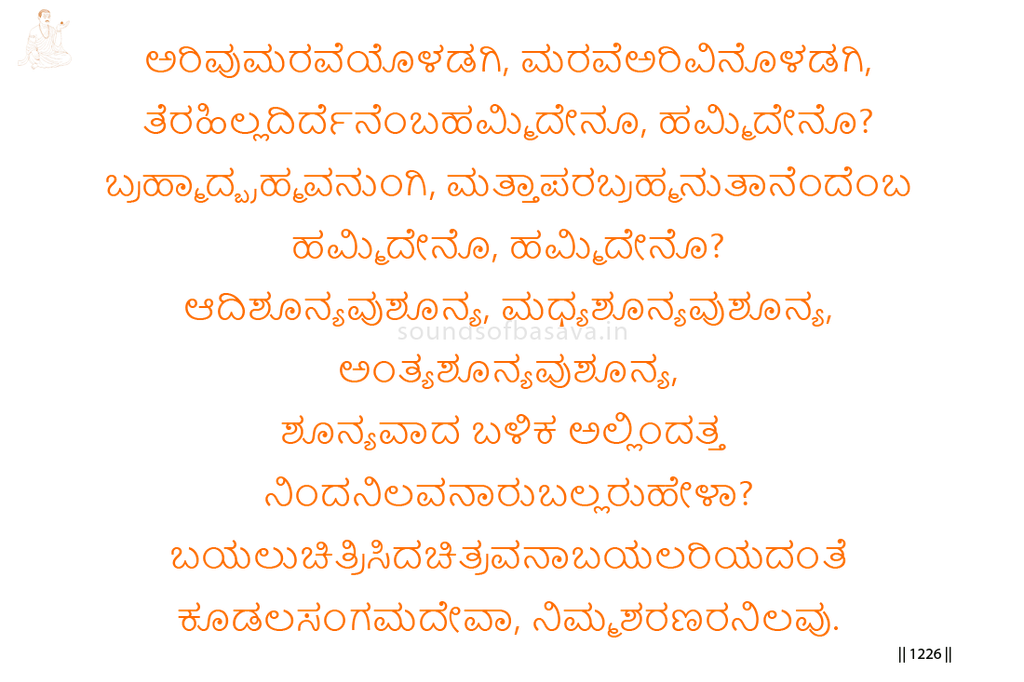
Awareness becomes hidden within forgetting, and forgetting within awareness. Yet the claim, “I remain without distinction,” gives rise to boastfulness.
Brahman swallows Brahman, but another boast follows: “I myself am Parabrahman.”
The Shunya of the beginning is Shunya; the Shunya of the middle is Shunya; the Shunya of the end is Shunya. After all has become Shunya, who can know and describe the state that stands beyond?
Like a picture drawn by Bayalu that cannot know Bayalu, such is the state of Kudalasangama Deva’s Sharanas.
Imagery & Symbolic Relevance
The vachana begins with a reciprocal image:
Awareness is hidden within forgetting.
Forgetting is hidden within awareness.
Ordinarily, awareness and forgetting appear to be opposites. Awareness knows; forgetting loses what was known. Basavanna places each within the other so that neither can maintain an independent boundary.
Awareness cannot stand outside forgetting and claim complete mastery over it. Forgetting cannot stand outside awareness as a wholly separate condition. Each is enclosed within the other.
Yet a subtle claim remains:
“I stood without distinction.”
The condition may no longer appear divided, but the speaker still retains the one who announces that non-division. The declaration itself becomes the place where hammu—boast or pride—arises.
The repeated expression “hammidenō, hammidenō” exposes this boast. Basavanna does not celebrate the claim. He brings it into view and questions the pride hidden within it.
The next image is even more forceful:
Brahman swallows Brahman.
The act of swallowing removes the distinction between what consumes and what is consumed. One Brahman cannot remain visibly beside another after the swallowing.
Yet after this disappearance, another claim arises:
“I myself am Parabrahman.”
The problem is not the word Parabrahman alone. The concern is the surviving “I myself” that takes possession of the condition.
Even after Brahman has swallowed Brahman, the claimant attempts to stand apart and announce what has occurred. The boast therefore recreates distinction through the very declaration that distinction has ended.
Basavanna then gives a threefold sequence:
The Adi-Shunya is Shunya.
The Madhya-Shunya is Shunya.
The Antya-Shunya is Shunya.
Adi is beginning.
Madhya is middle.
Antya is end.
Together they contain the full course through which something is ordinarily located: its arising, its continuance, and its conclusion.
Basavanna applies Shunya to each position. He then declares that each Shunya is itself Shunya. No beginning-Shunya, middle-Shunya, or final-Shunya remains as a separately possessed spiritual station.
The following question is decisive:
After becoming Shunya, who can know and tell the state that stands beyond from there?
The question removes the observer who might stand outside Shunya and describe it.
If someone remains to say, “I stand here,” “I reached beyond,” or “I know that state,” the distinction between the claimant and the claimed condition has returned.
The final image gives visible form to the entire vachana:
Bayalu draws a picture.
The source presents Bayalu as the power or field from which the picture appears. The picture is formed, visible, and distinguishable, but it does not thereby become independent of Bayalu.
Yet the picture cannot know Bayalu.
The picture cannot step outside the field from which it has been drawn, turn back, and make Bayalu an object before itself. Its very existence depends upon that which it attempts to know.
Basavanna says that such is the state of Kudalasangama Deva’s Sharanas.
The Sharana’s state cannot be possessed as an object by a separate knower. The one who would boast, define, or announce it belongs to the picture, while the state itself belongs to the Bayalu that has drawn it.
The complete movement is therefore exact:
awareness enters forgetting;
forgetting enters awareness;
the boast of being without distinction is exposed;
Brahman swallows Brahman;
the boast “I am Parabrahman” is exposed;
beginning, middle, and final Shunya become Shunya;
no one remains qualified to describe the state beyond;
and the picture drawn by Bayalu cannot know Bayalu.
Lingayoga
In Lingayoga, the subtlest obstruction may arise after obvious division has weakened. The practitioner may cease to claim ordinary possession yet retain the more refined claim, “I have reached non-division,” or “I am the highest reality.”
This vachana places that claimant under examination.
Awareness, remembrance, contemplation, and spiritual terminology may all serve practice. Their fulfilment does not lie in creating a more exalted identity for the practitioner.
The repeated hammu shows that realization cannot be converted into personal certification. The statement “I have reached” may restore the very division that the experience appeared to remove.
The image of Bayalu and its picture gives the practical measure. The practitioner remains within the field of Kudalasangama Deva and cannot stand outside it as an independent authority over the Sharana-state.
Lingayoga therefore matures as abidance without boast: no claim of knowing, no ownership of Shunya, and no separate speaker announcing identity with Parabrahman.
Editorial Commentary
Arivu means awareness, knowing, or understanding.
Marave means forgetting, oblivion, or the loss of what was known.
The opening lines place awareness within forgetting and forgetting within awareness. Neither is allowed to remain as a wholly independent opposite.
The phrase concerning terahu indicates a condition without separation, interval, or distinguishing division. The governing concern is the boast attached to the statement, “I remained without such distinction.”
Hammu means pride, boast, or self-exalting claim. Its repetition exposes the persistence of self-claim.
Brahmava nungi means Brahman swallowing Brahman. The image should be retained without converting it into an external doctrinal system.
The later boast is explicit: “I myself am Parabrahman.”
Adi, Madhya, and Antya mean beginning, middle, and end.
Each is joined to Shunya, and each Shunya is again declared Shunya. The source does not enumerate separate doctrinal categories for these three Shunyas.
Nilavu means state, standing, or abiding condition.
Bayalu means open expanse or openness. It should not be reduced merely to physical sky or to an abstract doctrine imported from outside the vachana.
The final grammar presents Bayalu as drawing or forming the picture. The picture cannot know the Bayalu from which it has appeared.
The closing line identifies this comparison directly with the state of Kudalasangama Deva’s Sharanas.
Related Vachana
Supporting Vachana
Sharana Sthala Vachana 939 — The False Mark Upon the Measureless
Sharana Vachana 939 presents Basavanna as a picture without a supporting wall when Bhakti is absent and as a Sharana without truth when Satya is absent. It concludes with the image of attempting to draw a mark where no line exists.
That vachana prepares Vachana 1019 by exposing sacred identity as false when it becomes personal inscription. The names “Pramatha” and “Sharana” cannot establish reality through self-claim.
Vachana 1019 carries this correction into the most subtle field. Even after awareness and forgetting enter one another, Brahman swallows Brahman, and the threefold Shunya becomes Shunya, the claimant may still attempt to draw the final mark: “I am without distinction; I am Parabrahman.”
Both vachanas remove the line drawn by the self upon what cannot be measured or privately possessed.
Advancing Vachana
Aikya Sthala Vachana 1242 — Beyond the “I” Before the Linga
Vachana 1019 exposes the boast that attempts to survive after every stated distinction has vanished. Its question is implicit: who remains to claim the state?
Vachana 1242 advances this into a direct question: before the Mahatma called Linga, where can the “I” remain?
It then clarifies that although the Sharana may continue to bear a body, he is not therefore ordinary or established in separate bhāva. The way of Kudalasangama’s Sharanas is altogether different.
Thus the residual “I am Parabrahman” exposed in Vachana 1019 is answered in Vachana 1242: before Linga, the separate “I” has no place from which to make that declaration.
