

Summary
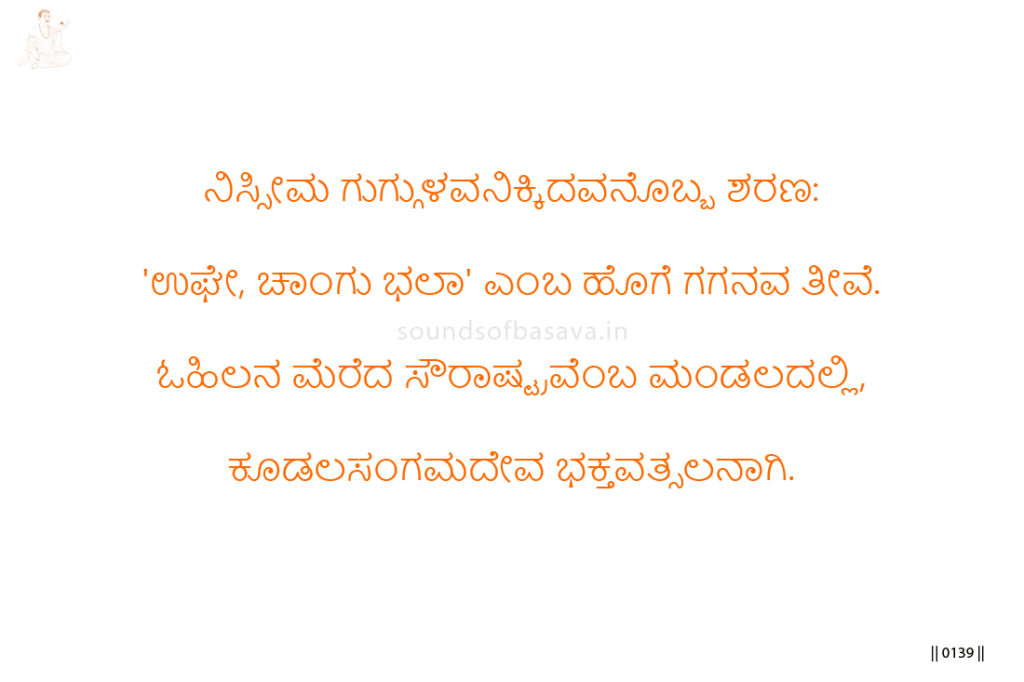
In this vachana, Basavanna shows that devotion is not limited by region, language, or formal expression. A Sharana offers a little incense and utters “Uge Changu Bhala,” and the fragrance rises to the sky.
The outer act is small, but the devotion is alive. Kudalasangama Deva is bhakti-vatsala, the One who loves devotion.
The vachana teaches that true bhakti is known by its inward fire, not by the size of the offering, the language of the cry, or the place from which it arises.
Imagery & Symbolic Relevance
The small incense offering is the first image. It is not a grand ritual. It is simple, direct, and filled with devotion.
The cry “Uge Changu Bhala” gives the vachana its cultural force. It is not formal scriptural language, but an ecstatic devotional utterance. Basavanna shows that such a cry can become sacred when it arises from true bhakti.
The smoke rising to the sky shows the reach of sincere devotion. A small offering, when joined with a true heart, expands beyond its visible size.
The reference to Saurashtra points to distance and difference. Devotion is not confined to one region or one familiar form.
Kudalasangama Deva as bhakti-vatsala is the heart of the vachana. He receives devotion wherever it is genuine. The measure is not outer identity but inward truth.
The imagery therefore teaches that the same flame of devotion can burn through many forms, sounds, places, and customs.
Lingayoga
In Lingayoga, the outer act is meaningful only when awareness is present. A small offering becomes powerful when the mind is gathered and the heart is turned toward the Divine.
This vachana protects the practitioner from attachment to form alone. Language, region, and style may differ, but the inward movement of bhakti is the essential current.
The cry, the incense, and the rising smoke show how simple expression becomes sacred when joined to living awareness.
Lingayoga therefore does not depend on external uniformity. It depends on the inner flame that turns the Anga toward Linga.
Editorial Commentary
This vachana should be read as a teaching on the universality of sincere devotion. Basavanna does not measure bhakti by language, region, or ritual grandeur.
The teaching is direct: where devotion is genuine, Kudalasangama Deva receives it.
Related Vachana
Supporting Vachana
Vachana 677 — The Five Pillars of Integrity
Vachana 677 teaches that the Sharana must stand firm in undivided devotion, Linga-Jangama unity, and trust in Prasada. Vachana 684 continues this by showing that such devotion is not limited by region or expression when the inward flame is true.
Advancing Vachana
Maheshwara Vachana 860 — The Dream that Masquerades as Realization
Vachana 684 shows that sincere bhakti rises beyond outward boundaries of place, language, and form. Maheshwara Vachana 860 advances this into the threshold of union, where devotion that has become fearless and inwardly true stands ready to enter deeper oneness before Kudalasangama Deva.
