

Summary
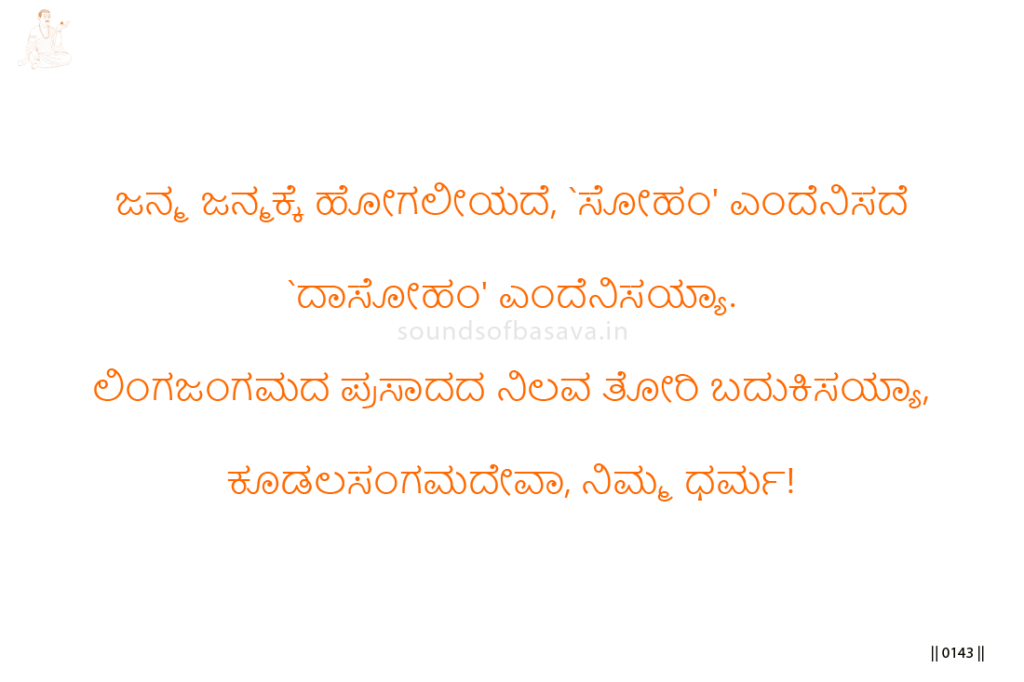
In this vachana, Basavanna prays that he may not fall away birth after birth. He asks that the thought “Soham” should not arise in him, but that “Dasoham” should remain.
The contrast is central. “Soham” can become a claim of identity if ego appropriates it. “Dasoham” preserves humility, surrender, and belonging to Kudalasangama Deva.
Basavanna then asks to be shown the state of Linga, Jangama, and Prasada, and to be sustained in that dharma. The vachana teaches that the highest realization must remain protected by humility.
Imagery & Symbolic Relevance
Birth after birth is the first image. Basavanna does not ask for a temporary state. He prays for continuity, so that he may not fall away from the path.
“Soham” is the second image. It points to the claim “I am That.” Basavanna does not treat this as mere doctrine. He warns against the subtle pride that can arise when realization becomes self-assertion.
“Dasoham” is the correcting image. It means “I am the servant.” Here servitude is not weakness or inferiority. It is freedom from ownership, pride, and spiritual self-claim.
Linga, Jangama, and Prasada form the living structure of the prayer. Linga is the worshipped presence, Jangama is the living realized presence, and Prasada is grace received without possession.
The imagery therefore moves from identity to surrender. The seeker does not crown himself with realization. He asks to remain in the dharma of Kudalasangama Deva.
Lingayoga
In Lingayoga, realization must not become a new identity for the ego. The seeker may approach the truth of union, but if the thought becomes self-claim, subtle separation remains.
“Dasoham” protects the practice. It keeps the Anga open before the Linga, without turning realization into possession.
The request to be shown the state of Linga, Jangama, and Prasada is important. Lingayoga matures when inward worship, living presence, and received grace are held together.
This vachana therefore teaches humility at the threshold of recognition. The practitioner must not merely seek experience, but remain surrendered within it.
Editorial Commentary
This vachana should be read as a teaching on humility after realization. Basavanna does not reject unity; he rejects the ego’s claim over unity.
The teaching is direct: let “Dasoham” remain, and let Linga, Jangama, and Prasada become the ground of life before Kudalasangama Deva.
Related Vachana
Supporting Vachana
Vachana 803 — Words Become the Mirror of the Soul
Vachana 803 teaches that speech must be transparent and joined to conduct. Vachana 834 continues this refinement by showing that even the language of realization must remain free from self-claim.
Advancing Vachana
Maheshwara Vachana 912 — The Cleansing That Reveals
Vachana 834 teaches that humility protects realization from becoming spiritual identity. Maheshwara Vachana 912 advances this into undivided recognition, where humility and realization no longer stand apart. What is guarded here through “Dasoham” becomes, in the next movement, recognition without division before Kudalasangama Deva.
