

Summary
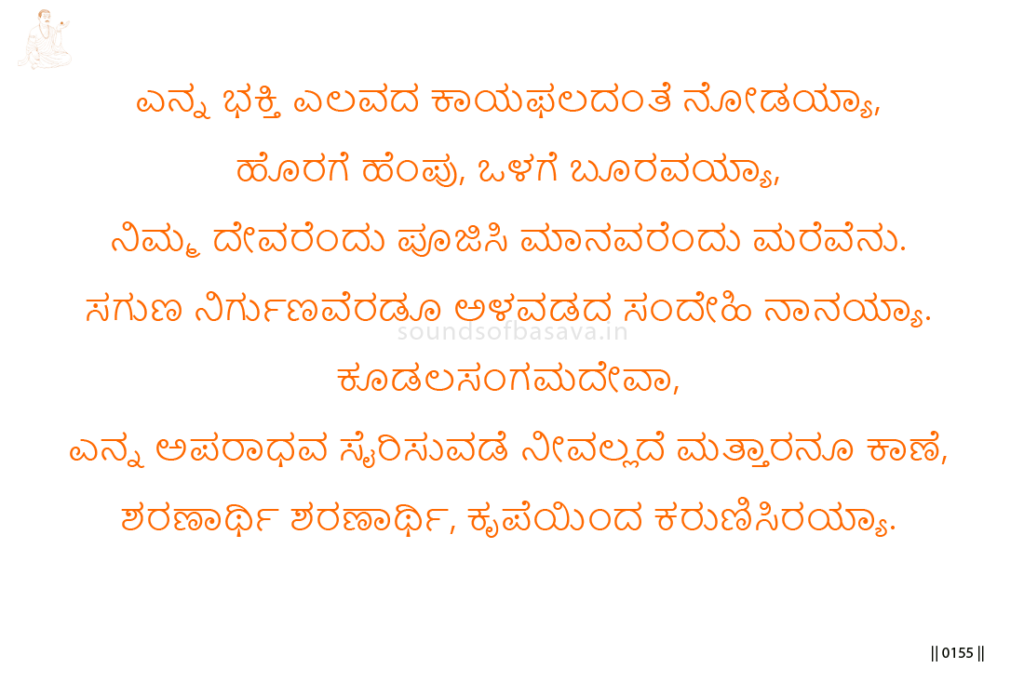
In this vachana, Basavanna confesses the incompleteness of his own devotion. He compares his bhakti to the wood-apple fruit: rough and hard outside, but hollow within.
He worships Kudalasangama Deva as God, yet forgets the human being before him. This is the central contradiction of the vachana. Devotion to God is incomplete when it does not become reverence toward living beings.
Basavanna then says that he has not truly entered either Saguna or Nirguna. He remains uncertain, caught between both. Therefore he cries, “Refuge, refuge,” and asks Kudalasangama Deva alone to bear his faults and show compassion.
Imagery & Symbolic Relevance
The wood-apple fruit is the first image. Its outer shell appears strong and complete, but the inside may lack sweetness and fullness. Basavanna uses this image to describe devotion that has outer form but inward poverty.
The image does not reject devotion. It rejects devotion that remains only external. Worship may appear correct, but if the heart has not ripened, bhakti remains like fruit without sweetness.
The second confession is sharper: “I worship You as God and forget the human being.” Basavanna sees that honoring the Divine while neglecting the human being creates a break in devotion.
This line is especially important in the Sharana path. Linga is not to be separated from life. If the devotee worships God but forgets the living person, the devotion has not become whole.
The reference to Saguna and Nirguna deepens the confession. Saguna refers to the Divine approached through form, qualities, worship, and devotion. Nirguna refers to the formless beyond qualities. Basavanna says he has not become established in either.
The repeated cry “Sharanarthi, Sharanarthi” shows the only remaining movement: refuge. He does not defend his state. He places his offense before Kudalasangama Deva and asks for compassion.
The imagery therefore moves from hollow devotion, to failed recognition of the human, to uncertainty in realization, and finally to refuge.
Lingayoga
In Lingayoga, worship of the Linga must transform the way one sees and receives life. The practitioner cannot worship inwardly and then forget the living being standing before him.
This vachana shows the danger of divided practice. The outer act may be devotional, but the inner relation remains incomplete if compassion and recognition do not arise.
Saguna and Nirguna also become practical concerns here. The seeker may speak of form and formlessness, but unless devotion ripens into lived awareness, both remain unsettled.
Lingayoga matures when worship, seeing, and conduct become one. Until then, the seeker must honestly confess incompleteness and take refuge in Kudalasangama Deva’s grace.
Editorial Commentary
This vachana should be read as a confession of incomplete bhakti. Basavanna exposes the gap between worshipping God and forgetting the human being.
The teaching is direct: devotion must not remain a hard shell. It must ripen inwardly through recognition, humility, and compassion.
Related Vachana
Supporting Vachana
Vachana 1060 — The Door I Failed to Open
Vachana 1060 confesses the failure to rise and bow when Kudalasangama Deva’s Sharanas came to the door. Vachana 1094 continues this self-examination by confessing another failure of recognition: worshipping God while forgetting the human being.
Advancing Vachana
Maheshwara Vachana 993 — Blessed by the Sight of the Sharana
Vachana 1094 exposes devotion that appears outwardly formed but remains inwardly hollow, uncertain, and incomplete. Maheshwara Vachana 993 advances this into the last question, where the remaining contradiction must be faced without concealment. What is confessed here as fruit without sweetness becomes, in the next movement, the final inquiry before deeper truth.
