

Summary
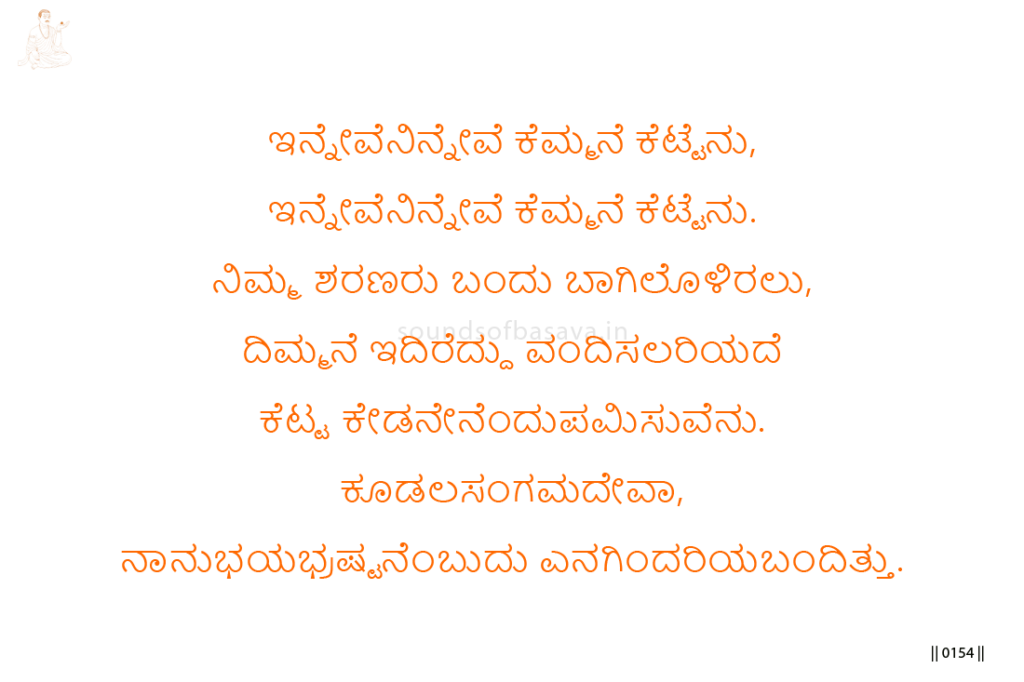
In this vachana, Basavanna confesses that he has ruined himself again and again. The specific fault he names is not worldly failure, but failure to receive Kudalasangama Deva’s Sharanas when they came and stood at his door.
He did not rise at once, did not go forward, and did not bow in reverence. The missed act of welcome becomes a serious spiritual failure because the Sharanas carry living relation to the Divine.
Basavanna then recognizes himself as bhaya-bhraṣṭa, one fallen away from true refuge. The teaching is direct: when the Sharana arrives, reverence must be immediate, because sacred presence has come to the door.
Imagery & Symbolic Relevance
The repeated cry “I ruined myself” gives the vachana its urgency. Basavanna does not blame circumstance or another person. He sees the failure within himself.
The doorway is the central image. It is the place of arrival and recognition. The Sharanas come near; they are not distant or hidden. Yet nearness alone does not become realization if the heart does not respond.
Rising at once shows alert reverence. Going forward shows readiness to receive. Bowing shows humility before living presence.
The failure to do these things reveals inward dullness. The issue is not etiquette alone. Basavanna sees that he failed to recognize the sacred when it stood before him.
The Sharanas at the door represent grace arriving in embodied form. To ignore them is to miss Kudalasangama Deva’s presence as Jangama.
The phrase bhaya-bhraṣṭa gives the consequence its force. Basavanna realizes that he has fallen away from the security that comes through right relation to the Sharanas.
The imagery therefore teaches that devotion must be awake at the moment of encounter. A door can open into grace, or remain closed through negligence.
Lingayoga
In Lingayoga, the Linga worshipped inwardly must be recognized in the living presence of the Sharanas. Practice fails when it honors the inner form but neglects the Jangama standing before it.
This vachana shows the discipline of responsiveness. The body must rise, the mind must recognize, and the heart must bow without delay.
The doorway is also the field of testing. The seeker may speak of devotion, but when the Sharana arrives, the truth of that devotion is revealed through conduct.
Lingayoga matures when reverence becomes immediate. Awareness must not remain theoretical; it must move into action when Kudalasangama Deva’s Sharanas appear.
Editorial Commentary
This vachana should be read as a teaching on missed sacred recognition. Basavanna’s remorse shows that neglect of the Sharanas is not a minor lapse.
The teaching is direct: when the Sharanas come to the door, the Bhakta must rise, receive, and bow.
Related Vachana
Supporting Vachana
Vachana 1051 — The Confession That Opens the Door
Vachana 1051 shows Basavanna confessing faults in walking, speaking, doing, giving, knowing, and forgetting, and then falling in refuge before the Shiva-sharanas. Vachana 1060 continues this confession by naming a specific fault: failure to rise and bow when Kudalasangama Deva’s Sharanas came to the door.
Advancing Vachana
Maheshwara Vachana 978 — Beyond Mechanical Worship
Vachana 1060 teaches that sacred presence must be recognized immediately when the Sharanas arrive. Maheshwara Vachana 978 advances this into unbroken awareness, where recognition does not fail at the threshold. What is confessed here as missed reverence becomes, in the next movement, the need for uninterrupted awareness before Kudalasangama Deva.
