

Summary
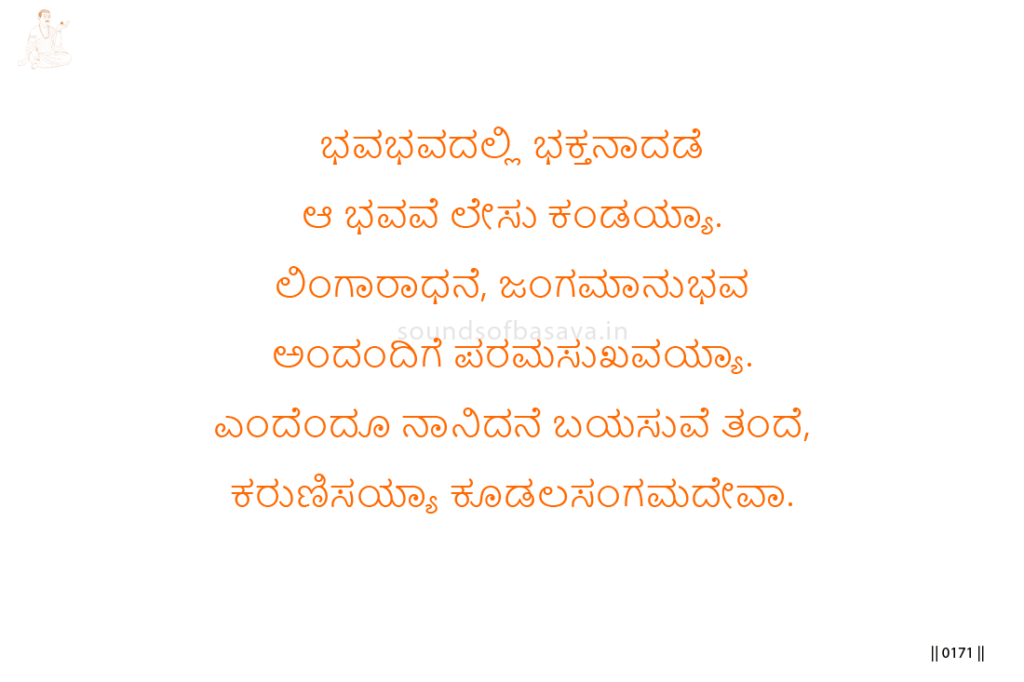
In this vachana, Basavanna says that if he remains a Bhakta through bhava-bhava, then that very state is blessed.
Here bhava-bhava points to the successive states of Lingayoga practice: the inner becomings, meditative depths, and changing conditions of awareness through which the seeker passes.
He names the source of this blessedness: Linga-ārādhane and Jangama-anubhava. Through worship of the Linga and living experience of the Jangama, supreme bliss arises. Basavanna asks only that he may always long for this before Kudalasangama Deva.
Imagery & Symbolic Relevance
Bhava-bhava is the opening key, each bhava is a condition of becoming. Awareness enters one state, deepens into another, and moves through subtle shifts of devotion, meditation, longing, clarity, and surrender.
Basavanna says that if one remains a Bhakta in these states, that very condition becomes blessed. The state itself is not the highest value; the presence of bhakti within it gives it sanctity.
Linga-ārādhane is the first pillar named. It is the direct worship and inward orientation toward the Linga. It keeps the practitioner centered during meditative movement.
Jangama-anubhava is the second pillar. It is the living experience of Jangama presence, through which devotion is corrected, deepened, and made experiential.
From these two arises parama sukha, supreme bliss. This bliss is not distant or theoretical. It arises when inner worship and living Sharana experience remain joined.
The final prayer shows Basavanna’s desire clearly. He asks that this longing remain always, through every state of practice, before Kudalasangama Deva.
Lingayoga
In Lingayoga, the seeker passes through many inner states. Some are steady, some subtle, some filled with clarity, and some marked by longing or inward silence.
This vachana teaches that the essential requirement is not to become attached to any state, but to remain a Bhakta through them all.
Linga-ārādhane anchors the inner movement. Jangama-anubhava keeps the practitioner connected to living realization and prevents meditation from becoming self-enclosed.
When bhakti continues through changing meditative states, practice becomes blessed. Supreme bliss arises not from a passing experience alone, but from sustained devotion within those states.
The prayer is therefore for continuity: may bhakti remain unbroken through every inner becoming.
Editorial Commentary
This vachana should be read as a prayer for continuity of bhakti in Lingayoga.
The teaching is direct: every meditative state becomes blessed when Linga-ārādhane and Jangama-anubhava remain alive within it.
Related Vachana
Supporting Vachana
Vachana 1292 — The Dangerous Wonder Called Bhakti
Vachana 1292 shows bhakti as a dangerous wonder that transforms the seeker completely. Vachana 1294 continues this by asking that such devotion remain through every inner state of Lingayoga, joined with Linga-ārādhane and Jangama-anubhava.
Advancing Vachana
Maheshwara Vachana 998 — The Devotion That Withers Without the Sharana
Vachana 1294 prays for bhakti to remain through every state of inner becoming. Maheshwara Vachana 998 advances this into undivided abidance, where changing meditative states no longer disturb the seeker’s orientation. What is desired here as blessed continuity becomes, in the next movement, uninterrupted abiding before Kudalasangama Deva.
