

Summary
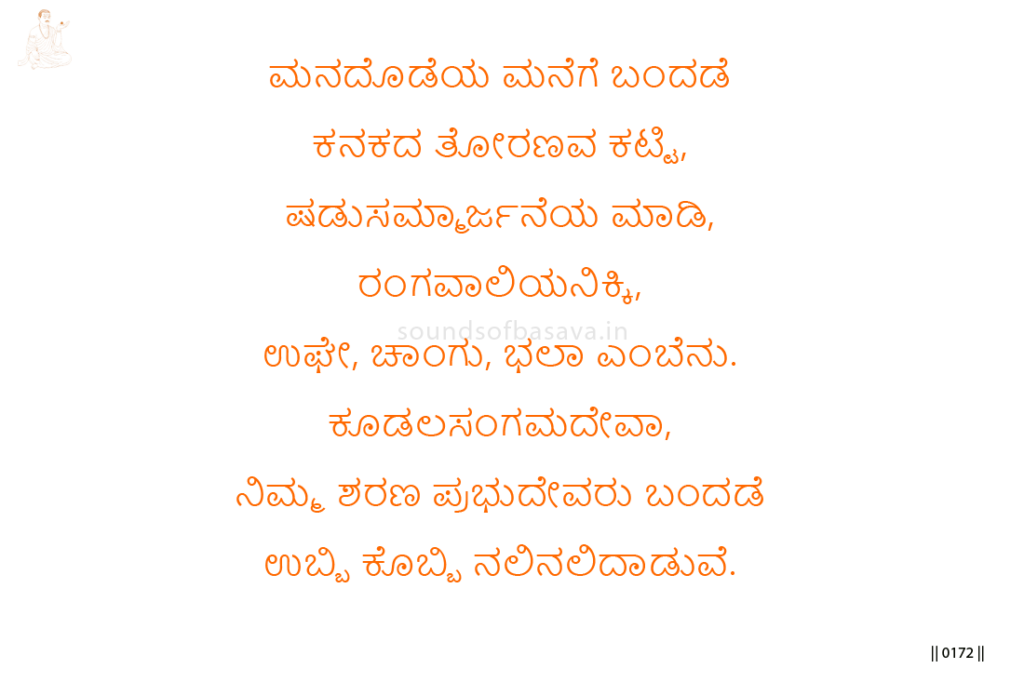
In this vachana, Basavanna imagines the arrival of the Master of the mind. He says he will prepare the house with golden festoons, sixfold purification, sacred designs, and words of welcome.
These acts show reverence and readiness. The house becomes a sacred threshold prepared for divine arrival.
Yet when Kudalasangama Deva’s Sharana, Prabhudeva, comes, Basavanna’s response becomes more than ceremony. He overflows with joy and dances. Formal reception becomes living delight in the presence of the realized Sharana.
Imagery & Symbolic Relevance
The Master of the mind points to the inward Lord, the one who claims the field of thought, awareness, and devotion.
The golden festoon marks the doorway as sacred. It announces that the guest is worthy of the highest honor.
The sixfold purification signifies complete preparation. The place of reception must be cleansed before it becomes fit for sacred presence.
The rangavalli adds auspicious beauty. It turns the threshold into a visible field of welcome.
The words “Uge, Changu, Bhala” give voice to celebration. They are not private feelings alone, but public sounds of reverent joy.
The arrival of Prabhudeva changes the tone of the vachana. Before the Lord, Basavanna prepares. Before the Sharana, he cannot remain contained. He rejoices, swells with delight, and dances.
The imagery therefore shows two movements: the house is prepared with care, and the heart is awakened by living presence.
Lingayoga
In Lingayoga, the mind must become a house fit for the Master within. It must be cleansed, ordered, adorned, and made receptive.
The ritual images point to inner discipline. Golden festoons become reverence at the threshold of awareness. Purification becomes inward clearing. Rangavalli becomes the beauty of a mind made ready.
Prabhudeva represents living Jangama presence. Such presence does not merely receive honor; it awakens recognition.
Practice matures when preparation becomes participation. The seeker first makes the inner house ready, and then, through Sharana presence, devotion becomes direct joy.
Editorial Commentary
This vachana should be read as a teaching on sacred reception.
The teaching is direct: prepare the mind for the Lord, and recognize the living Sharana with overflowing joy.
Related Vachana
Supporting Vachana
Vachana 1294 — The Blessed Continuity of Bhakti
Vachana 1294 joins Linga-ārādhane with Jangama-anubhava as the source of supreme bliss. Vachana 1302 gives this relation a concrete form: the Lord is welcomed through sacred preparation, and Prabhudeva’s arrival awakens living joy.
Advancing Vachana
Maheshwara Vachana 1028 — The Fall of Ravana’s Greatness
Vachana 1302 shows the prepared house and the awakened heart. Maheshwara Vachana 1028 advances this into the completion of the work, where sacred readiness and living encounter must become fulfilled realization before Kudalasangama Deva.
