

Summary
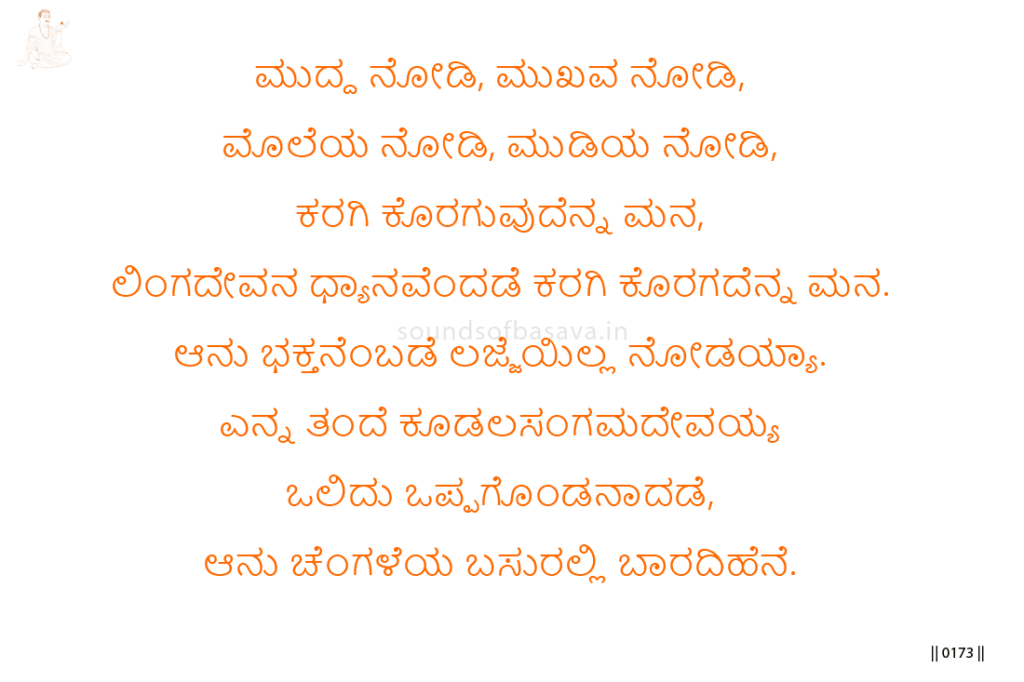
In this vachana, Basavanna examines the condition of his own seeing. When he sees beauty, face, breast, and hair, his mind melts and becomes restless.
But when he turns toward meditation on Lingadeva, the same mind does not melt or long. This contrast makes him ashamed to call himself a Bhakta.
The final question deepens the confession. If Kudalasangama Deva had truly accepted him and made him His own, would he still have come through Chengalaya’s womb? Basavanna is not blaming birth or womanhood; he is lamenting a vision not yet reborn into Sharana-seeing.
Imagery & Symbolic Relevance
The repeated act of seeing shapes the vachana. Basavanna names the eye’s attraction to visible form: beauty, face, breast, and hair.
The issue is not mere physical sight. It is the way perception moves. The mind responds quickly to outer beauty, but remains dry before Lingadeva’s meditation.
This reveals a divided inner condition. The senses are alive to form, while devotion has not yet gained the same power over the heart.
The phrase “my mind melts” is important. Melting suggests softness, attraction, and loss of firmness. Basavanna’s sorrow is that the mind melts before appearance, but not before the Linga.
The shame of calling himself a Bhakta follows from this contrast. He does not condemn beauty; he questions his own untransformed response to it.
Chengalaya’s womb is the final image. The feminine form first appears as attraction, but at the end appears as birth. This reversal turns the vachana from desire into self-examination.
The question is therefore not against Chengalaya. It asks whether one truly accepted by Kudalasangama Deva would still be born into ordinary seeing, or whether he would be reborn into a vision that recognizes the sacred rightly.
The imagery moves from attraction, to shame, to the longing for a new birth of perception.
Lingayoga
In Lingayoga, sight must become disciplined by remembrance. The eye should not merely stop at form; it must learn to turn toward Linga.
This vachana shows the difficulty of that transformation. The mind may be quick to respond to sensory beauty, yet slow to soften before meditation.
Basavanna’s honesty is itself part of practice. He does not pretend that devotional identity has purified his seeing. He exposes the gap between name and inner state.
Lingayoga matures when vision is reborn. The seeker no longer sees only appearance, but learns to recognize the presence of Kudalasangama Deva through purified awareness.
Editorial Commentary
This vachana should be read as a confession about perception.
The teaching is direct: one should not claim the name Bhakta while the mind melts before form but remains unmoved before Lingadeva.
Related Vachana
Supporting Vachana
Vachana 1302 — Preparing the House for the Lord of the Heart
Vachana 1302 teaches that the inner house must be prepared for the Master of the mind and awakened by living Sharana presence. Vachana 1320 continues this inward correction by showing that even vision itself must be prepared and transformed.
Advancing Vachana
Maheshwara Vachana 1030 — Why Leave the Living Waters?
Vachana 1320 exposes a vision still divided between attraction to form and unmoving meditation before Lingadeva. Maheshwara Vachana 1030 advances this into the undivided ground, where perception no longer remains split. What is confessed here as unreborn seeing becomes, in the next movement, the need to stand in a ground where vision, devotion, and recognition are one before Kudalasangama Deva.
