

Summary
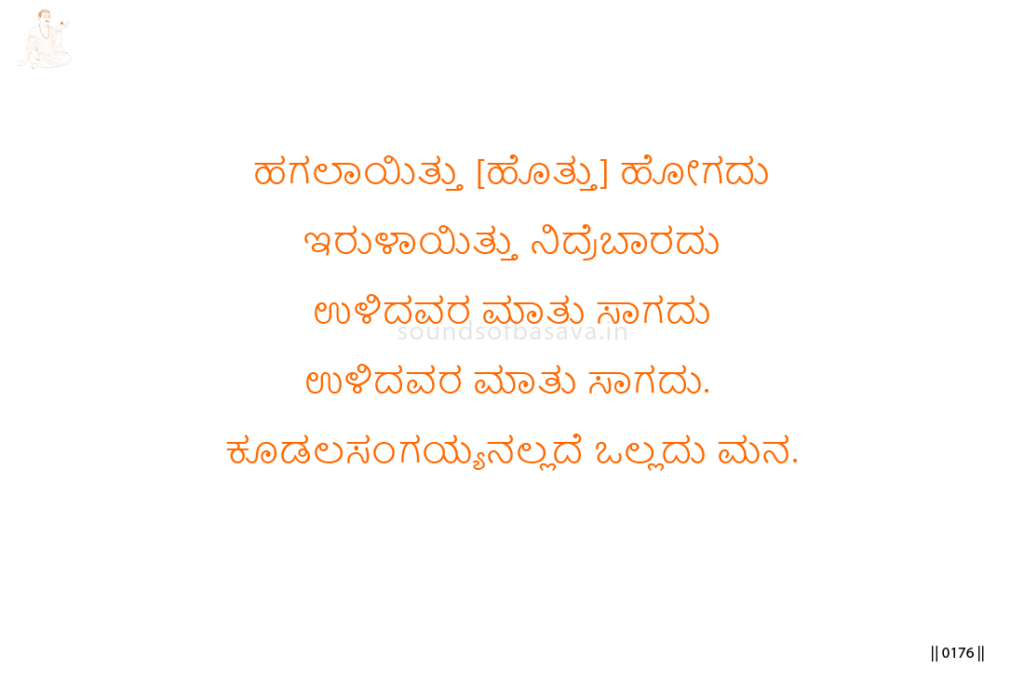
In this vachana, Basavanna describes a mind seized by longing for Kudala Sangamayya. Day comes, but time does not pass. Night comes, but sleep does not arrive.
The words of others no longer enter the heart. Ordinary conversation has lost its power to satisfy.
The mind delights in none but Kudala Sangamayya. What appears as restlessness is the sign of a heart that has found its only true attraction.
Imagery & Symbolic Relevance
The day that does not pass shows longing stretching time. The outer day moves, but the inner heart waits.
The sleepless night deepens the same condition. Rest does not come because the mind remains turned toward the Beloved.
The words of others not entering the heart show inward absorption. Basavanna is not rejecting people; he is saying that ordinary speech cannot answer this longing.
The final line gives the cause of the unrest. The mind no longer delights in many things. Its joy has narrowed into one relation with Kudala Sangamayya.
The imagery therefore moves from disturbed time, to sleeplessness, to speech losing force, and finally to single-pointed love.
Lingayoga
In Lingayoga, longing can become a form of concentration. The mind that once scattered among many interests begins to gather around the Linga.
This vachana shows that such gathering may feel restless before it becomes settled. Time, sleep, and conversation lose their usual hold because awareness is being drawn inward.
The practitioner should distinguish this longing from ordinary agitation. Here unrest is not caused by worldly desire, but by the heart’s inability to rest anywhere except in Kudala Sangamayya.
Practice matures when longing becomes steady remembrance.
Editorial Commentary
This vachana should be read as a teaching on single-pointed longing.
The teaching is direct: when the mind delights only in Kudala Sangamayya, even time, sleep, and speech lose their former authority.
Related Vachana
Supporting Vachana
Vachana 1363 — The Taste of Your Name
Vachana 1363 shows Kudalasangama Deva’s Name filling the whole being with sweetness. Vachana 1394 continues this movement by showing the mind unable to delight in anything except Kudala Sangamayya.
Advancing Vachana
Maheshwara Vachana 978 — Beyond Mechanical Worship
Vachana 1394 shows complete awareness taking the form of restless longing, where the mind no longer rests in day, night, or ordinary speech. Maheshwara Vachana 978 advances this into unbroken awareness, where longing becomes steady presence. What is restless here becomes, in the next movement, continuous abidance before Kudalasangama Deva.
