

Summary
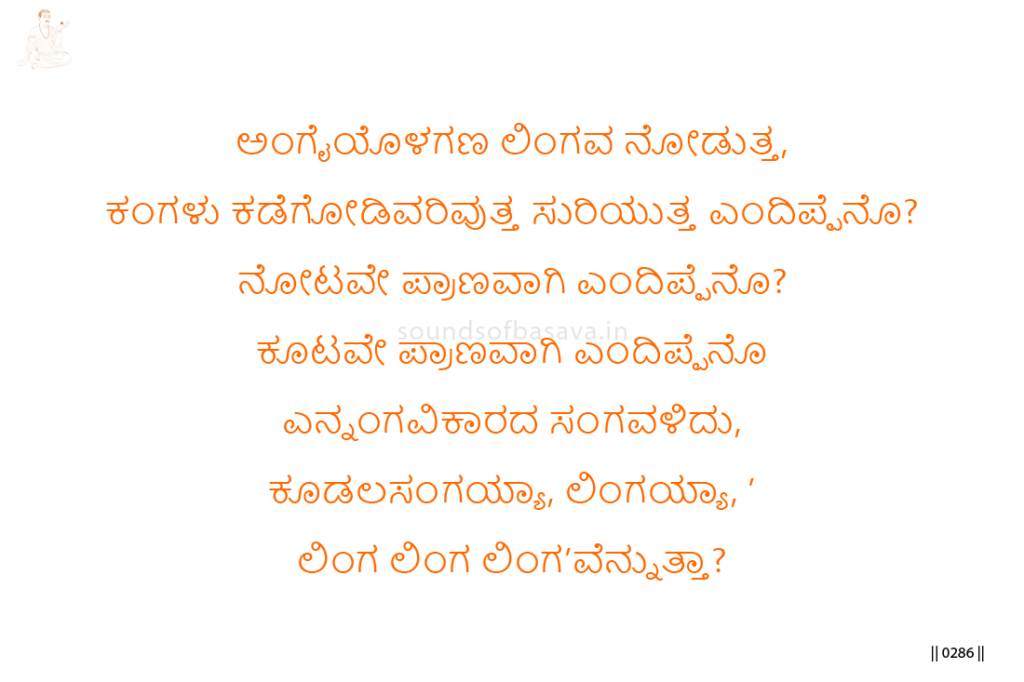
In this vachana, Basavanna sees the Linga within the Anga, yet questions why the eyes still run outward. Inner recognition has begun, but perception is still being pulled toward outer objects.
He asks whether sight itself is life, and whether company itself is life. These questions expose dependence on seeing and association.
He then names this as the association of bodily distortion. Before Kudalasangayya, he asks that this be removed, so that Linga alone may stand as Linga. The teaching is clear: when Linga is seen within, the senses and associations must no longer rule the seeker.
Imagery & Symbolic Relevance
The first image is the Linga within the Anga. The sacred presence is not absent or distant; it is already seen within the embodied self.
The second image is the eyes running outward. The eyes represent perception and attention. Even after inner seeing, they may still scatter toward the outer field.
The third image is sight as life. Basavanna questions whether the act of seeing outward forms should be treated as the basis of life.
The fourth image is company as life. Association, nearness, and social contact are also questioned. They must not replace the inner ground of Linga.
The fifth image is bodily distortion. This is the condition in which the body’s habits and attachments still draw the seeker away from inward steadiness.
The final image is Linga as Linga. Basavanna asks that the distortion be removed so that Linga may remain the true center without being displaced by sight, company, or bodily pull.
Together, these images show the struggle between inner recognition and outward habit. Linga is seen within, but the eyes still wander. The seeker must be freed from the body’s distorted associations so that Linga alone governs perception and life.
Lingayoga
In Lingayoga, this vachana tests the steadiness of inner seeing. To see Linga within is not yet the end of practice if the eyes still scatter outward.
The senses are not rejected, but they must not become the ruler. Company is not rejected, but it must not become the ground of life.
The practical movement here is re-centering. Basavanna asks that the body’s distorted pull be removed, so that perception, association, and life remain ordered by Linga.
Editorial Commentary
This vachana should be read as a confession of divided orientation. Basavanna does not speak as one who has never known the Linga. He speaks as one who sees the inner Linga and still notices the old outward pull of the eyes.
The questions “Is sight life?” and “Is company life?” are therefore corrective. They ask the seeker to examine what is being treated as essential. If outward seeing and association become the basis of life, inner Linga-recognition has not yet become steady.
The final plea gathers the whole vachana. Basavanna does not ask for the destruction of the body, the eyes, or company. He asks that the distorted association of the Anga be removed, so that Linga may remain Linga before Kudalasangayya.
Related Vachana
Supporting Vachana
Bhakta Sthala Vachana 1320 — The Vision Not Yet Reborn
Bhakta Sthala Vachana 1320 supports this vachana by showing a vision still drawn toward outer form while remaining unmoved before Lingadeva. Vachana 485 carries the same concern into Maheshwara Sthala: even when the Linga is seen within the Anga, the eyes may still run outward, and perception must be corrected.
Advancing Vachana
Prasadi Sthala Vachana 853 — The Flood of Love
Prasadi Sthala Vachana 853 advances this movement by showing the fulfilled state in which the faculties no longer scatter. Vachana 485 asks why the eyes still run outward when the Linga is seen within. Vachana 853 carries this into Prasadi Sthala, where eyes, ears, hands, and heart overflow in one current of awareness before Kudalasangama Deva.
