

Summary
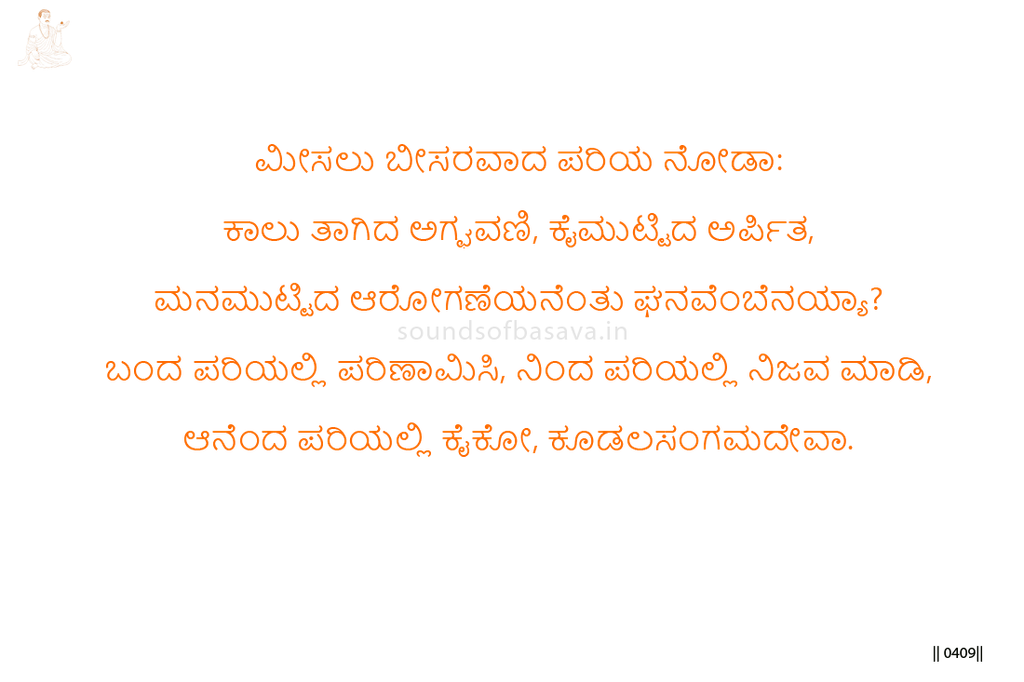
In this vachana, Basavanna asks how an act can be called truly great when it remains only externally touched.
What is touched by the foot, what is touched by the hand as offering, and what is touched by the mind in enjoyment—how can these be called complete by themselves?
Basavanna turns the question toward Kudalasangama Deva. What comes must be transformed. What stands must be made true. What is accepted must be taken in the right way.
The teaching is that sacred action is not complete by contact alone. Foot, hand, and mind must be brought into true alignment before the act becomes worthy before Kudalasangama Deva.
Imagery & Symbolic Relevance
The first image is what is touched by the foot. This suggests contact at the level of movement, approach, or outer nearness.
The second image is what is touched by the hand as offering. The hand may place, give, or perform, but the action is not complete merely because the hand has touched it.
The third image is what is touched by the mind in enjoyment or reception. The mind too can touch an act and still leave it incomplete if it remains separate from truth.
Basavanna therefore questions the greatness of such acts. External contact, physical offering, and mental participation do not by themselves make the act whole.
The final prayer gives the correction. What comes must be transformed in its coming. What stands must be made true in its standing. What is taken must be accepted rightly by Kudalasangama Deva.
Lingayoga
In Lingayoga, this vachana teaches that offering must pass beyond physical contact and mental approval.
The foot may approach, the hand may offer, and the mind may receive, yet the act may still remain partial. The seeker must allow the whole movement to become true before Linga.
For Prasadi Sthala, this is important. Prasada is not merely what is touched, held, or mentally accepted. It is what has been transformed into sacred receiving through Kudalasangama Deva.
Editorial Commentary
The three levels of contact: foot-touched, hand-touched, and mind-touched. They show that contact alone is insufficient.
The final verbs carry the teaching: transform what comes, make true what stands, and accept what is to be received.
The central point is that an offering becomes great only when the whole movement is made true before Kudalasangama Deva.
Related Vachana
Supporting Vachana
Maheshwara Sthala Vachana 71 — The Unacceptable Vows
Maheshwara Vachana 71 supports this vachana by saying that vows performed outwardly, while the mind remains elsewhere, do not stand in Kudalasangama Deva’s truth.
In Vachana 885, Basavanna questions whether what is touched by foot, hand, and mind can be called great unless it is transformed and made true. Both vachanas teach that sacred action must become inwardly whole; otherwise, it remains partial and cannot stand.
Advancing Vachana
Pranalingi Sthala Vachana 1272 — Established in Prāṇa-Linga
Pranalingi Vachana 1272 advances this teaching by presenting the realized state in which nothing is touched or received unless it has first been offered to Linga. Life itself becomes continuous consecration.
In Vachana 885, the act must be transformed, made true, and rightly accepted by Kudalasangama Deva. In Vachana 1272, this matures into Pranalingi living: everything is first surrendered to Linga and only then received as Prasada.
