

Summary
In this vachana, Basavanna refuses to confine Linga and Jangama within fixed marks.
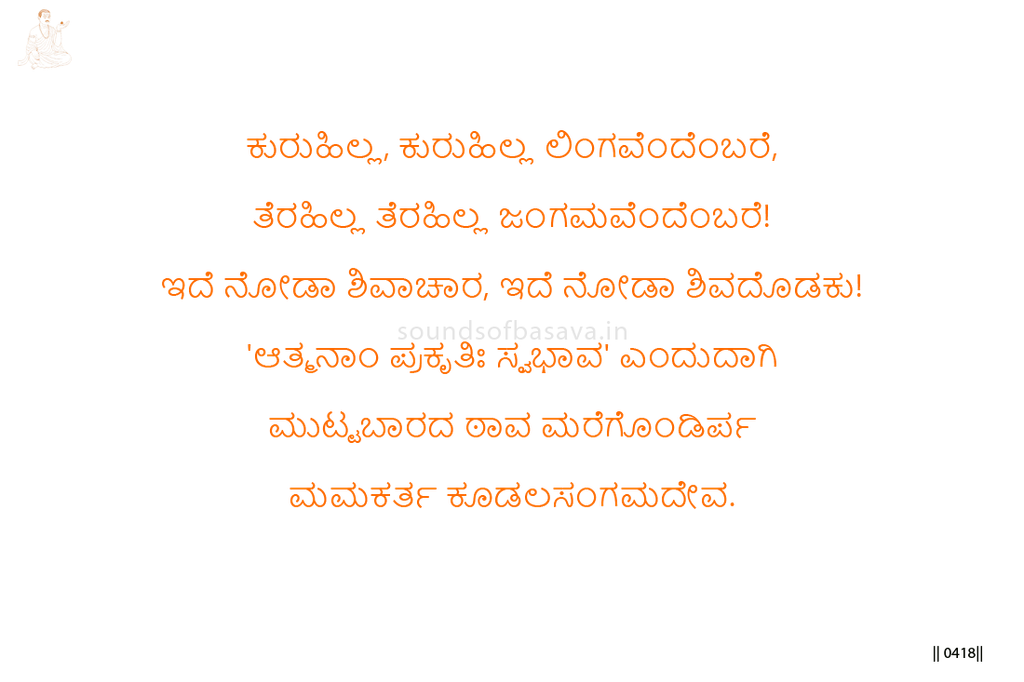
There is no mark, no mark, by which one can say, “This is Linga.” There is no boundary, no boundary, by which one can say, “This is Jangama.”
Basavanna says: see, this is Shivachara; see, this is Shiva’s great way.
Kudalasangama Deva, the Mamakarta, remains hidden in the place that cannot be touched.
The teaching is that Linga and Jangama cannot be reduced to outer sign, fixed definition, or limited location. True Shivachara begins when the seeker does not imprison the living truth within marks and boundaries.
Imagery & Symbolic Relevance
The first movement is the absence of mark. Basavanna says there is no mark by which Linga can be finally defined.
This does not deny Linga. It denies the claim that Linga can be contained by a sign, symbol, or visible boundary.
The second movement is the absence of boundary for Jangama. Jangama means the living, moving presence of Linga. It cannot be enclosed by a narrow idea, a single external form, or a fixed expectation.
Basavanna then names this as Shivachara. Shivachara here means conduct aligned with Shiva. Such conduct does not arise from limiting Linga or Jangama, but from living in awareness that they exceed fixed marking.
He also calls this Shiva’s great way. The path is not a matter of grasping the Divine through outer certainty. It is a way of reverent recognition before what cannot be confined.
The final phrase points to Kudalasangama Deva as Mamakarta, hidden in the place that cannot be touched. Mamakarta may be understood as the one who makes the “mine” or the one who governs the inner claim of possession. Here, even that possessive center is brought before the untouched place where Kudalasangama Deva remains hidden.
Lingayoga
In Lingayoga, this vachana teaches that Linga and Jangama must not be reduced to external definition.
The seeker may need form, sign, and practice, but must not mistake these for the full reality of Linga. The seeker may meet Jangama in living form, but must not limit Jangama to outward appearance.
For Prasadi Sthala, the teaching is important. Prasada cannot be received rightly by a mind that insists on enclosing the Divine within “this alone” or “that alone.”
True receiving begins when the seeker lets go of rigid marking and allows Kudalasangama Deva to be recognized in the untouched depth beyond possessive claim.
Editorial Commentary
The repeated Kannada structure should be preserved: “no mark, no mark” for Linga, and “no boundary, no boundary” for Jangama.
This repetition is not ornamental. It directly rejects fixed reduction.
Shivachara should be understood as living conduct aligned with Shiva, not merely ritual correctness.
The “untouched place”, It points to a depth that cannot be seized, handled, or made into possession.
The central teaching is that the path opens when Linga and Jangama are not confined by mark, boundary, or the possessive movement of “mine.”
Related Vachana
Supporting Vachana
Maheshwara Sthala Vachana 421 — Water the Root, and the Tree Blossoms
Maheshwara Vachana 421 supports this vachana by teaching that Jangama is the living mouth of Linga and that to see Jangama as merely human is divided perception.
In Vachana 949, Basavanna says that Linga has no fixed mark and Jangama has no fixed boundary. Both vachanas teach that Linga and Jangama must not be separated or reduced to outer limitation.
Advancing Vachana
Pranalingi Sthala Vachana 928 — The Measureless State
Pranalingi Vachana 928 advances this teaching by showing that subtle spiritual states cannot be measured by the seeker alone and must be tested through the Guru’s living discernment.
In Vachana 949, Basavanna says that Linga cannot be marked and Jangama cannot be bounded. In Vachana 928, this becomes Pranalingi discernment: what exceeds ordinary measure must be recognized through the touchstone of living realization.
