

Summary
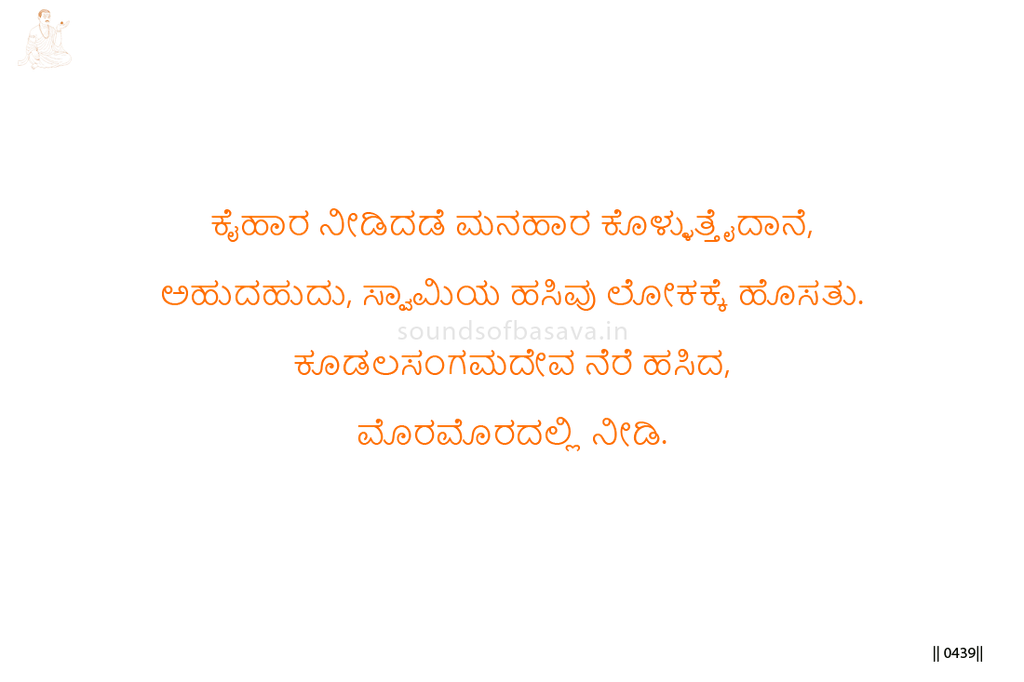
In this vachana, Basavanna says that when Kaihara is given, the Lord receives it as Manahara.
Kaihara means food or offering given by hand. Manahara points to what is received by the heart. The act is therefore not merely placing food outwardly; it must carry inward readiness.
Basavanna then says, “Yes, yes, the hunger of Swami is new to the world.” This hunger is not ordinary bodily hunger. It is a sacred hunger that calls for immediate response.
When Kudalasangama Deva is deeply hungry, Basavanna says to give at once. The teaching is direct: the true offering should not wait for repeated asking, delay, or outward pressure. The hand must move before hunger becomes a cry.
Imagery & Symbolic Relevance
The first image is Kaihara, the hand-offering. The hand is important because the act must become direct. It is not distant intention or spoken sympathy. It is offering made through action.
The second image is Manahara. The Lord receives not only the food, but the inner quality with which it is given. The hand gives, but the heart must also be present.
The third image is Swami’s hunger. Basavanna says this hunger is new to the world. The phrase should be kept close to the Kannada. It means this hunger cannot be measured like ordinary hunger.
The final movement is urgency. When Kudalasangama Deva is hungry, the offering must be made immediately and fully. Delay weakens the act.
The vachana therefore joins hand, heart, hunger, and offering into one movement. A true offering is not only what is given; it is the timely readiness with which it is given.
Lingayoga
In Lingayoga, this vachana teaches that offering must be both outwardly direct and inwardly alive.
The hand may give food, but the offering becomes complete only when the heart is also joined to the act.
For Prasadi Sthala, the point is right response. What is received as grace must move as timely offering. The seeker should not wait until the need becomes a demand.
Editorial Commentary
“Kaihara” and “Manahara” should be retained because they carry the structure of the vachana. Kaihara is the offering given by hand. Manahara shows the inward receiving of that offering.
“The hunger of Swami is new to the world” should not be reduced to common hunger. Basavanna is pointing to a sacred hunger that the world does not easily understand, a deeper urge within existence itself that moves through many forms, seeking higher realization and expressing its own unfolding.
The last line should be read as urgent instruction: when Kudalasangama Deva is deeply hungry, give without delay.
Related Vachana
Supporting Vachana
Maheshwara Sthala Vachana 421 — Water the Root, and the Tree Blossoms
Maheshwara Vachana 421 supports this vachana by teaching that Jangama is the mouth of Linga. A mouth receives nourishment into the living body; in the same way, offering made to Jangama reaches Linga.
In Vachana 1160, Basavanna speaks of the Lord’s hunger and the offering that must be given by hand and received in the heart. Maheshwara Vachana 421 supports this by clarifying the sacred channel of nourishment: offering becomes meaningful when it reaches the living mouth of Linga.
Advancing Vachana
Pranalingi Sthala Vachana 1062 — Beyond the Offering and the Meal
Pranalingi Vachana 1062 advances this teaching by asking whether offering to Ishtalinga and eating the sacred meal have become Prāṇa-Lingasthala and Prasādasthala within.
In Vachana 1160, the offering must be timely, direct, and joined with the heart. In Vachana 1062, this advances into Pranalingi as inward assimilation: food, offering, and receiving must not remain outer acts, but become realized within before Kudalasangama Deva.
