

Summary
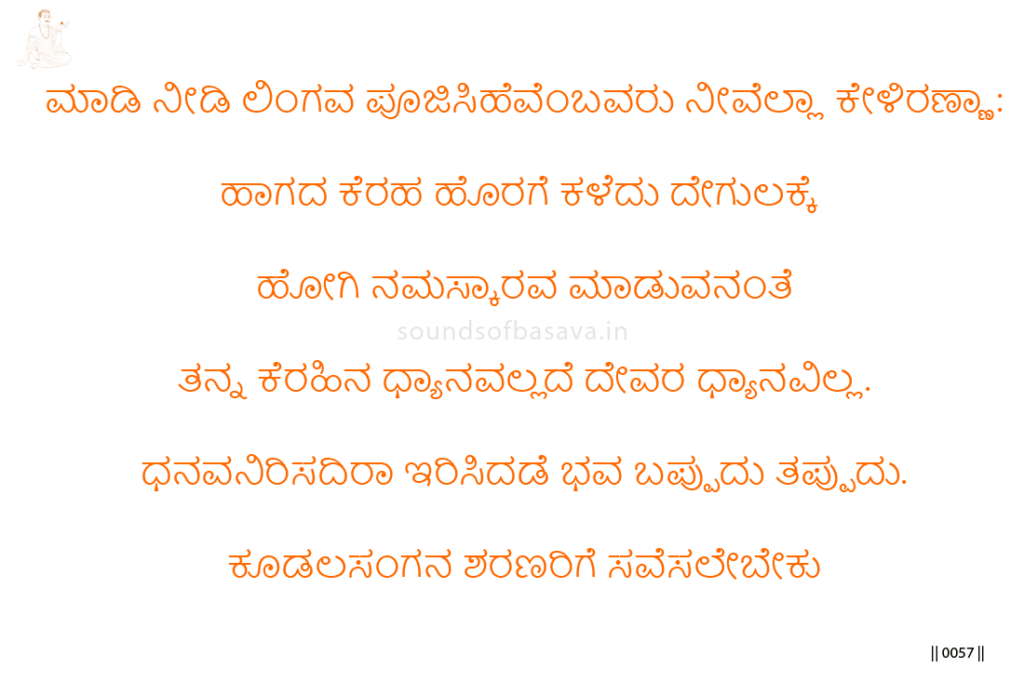
In this vachana, Basavanna addresses those who say, “We have given, offered, and worshipped the Linga.”
He gives the image of a person who leaves his sandals outside the temple and enters to bow. The body stands before God, but the mind remains outside, thinking of the sandals.
Basavanna then applies this to wealth. What is held back becomes a cause of bhava. Wealth must be spent in service of Kudalasangama Deva’s Sharanas.
Imagery & Symbolic Relevance
The sandals at the temple door are the central image. They are physically left outside, yet inwardly they still hold attention.
The temple represents the place of worship. Entering it does not guarantee inward presence.
The act of bowing shows outward devotion. But Basavanna exposes the division: the body bows inside while the mind guards what was left outside.
The sandals therefore represent attachment that continues after apparent renunciation. What has been left behind may still possess the mind.
The warning about wealth extends the same insight. Wealth kept back with attachment does not remain neutral. It draws the seeker into bhava.
The final instruction gives the remedy. Wealth must be used for Kudalasangama Deva’s Sharanas, so that possession becomes service.
Lingayoga
In Lingayoga, worship requires inward entry.
The Anga may stand before Linga, but if attention remains with possession, worship is divided.
The sandals show how small attachments can occupy the mind during sacred practice. Wealth shows the same problem at a larger scale.
Practice matures when body, attention, and resources move in one direction: service of Kudalasangama Deva’s Sharanas.
Editorial Commentary
This vachana examines divided worship.
Basavanna shows that what the mind guards outside the temple can obstruct what the body performs inside it.
Related Vachana
Supporting Vachana
Vachana 193 — The Living Altar
Vachana 193 teaches that worship of the Linga must become response to the Jangama in need. Vachana 199 continues by showing that even giving and worship remain incomplete when the mind clings to what it keeps aside.
Advancing Vachana
Maheshwara Vachana 219 — The Two Suns of Devotion
Vachana 199 shows the split between outward worship and inward attachment. Maheshwara Vachana 219 advances this into the deeper union of Linga-bhakti and Jangama-bhakti, where offering must become living service before Kudalasangama Deva.
