

Summary
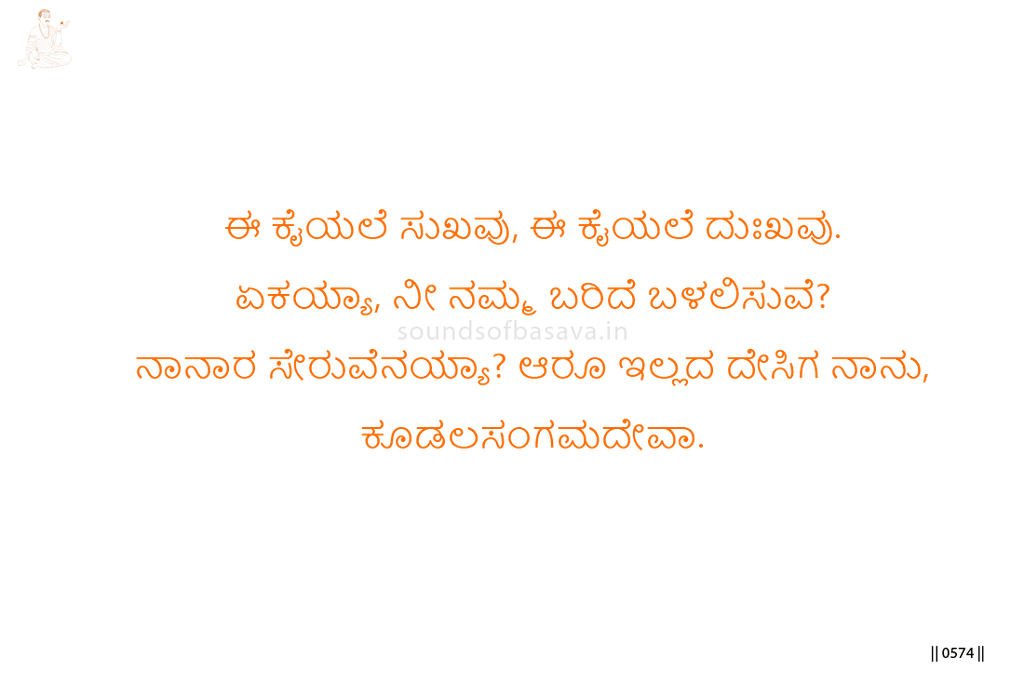
In this vachana, Basavanna says that joy is in this very hand, and sorrow is also in this very hand. He sees that both happiness and suffering arise close at hand within the same field of life.
He then asks Kudalasangama Deva why He leaves him to wander and suffer in this way. The question is not an argument against the Lord, but the cry of one who has seen the instability of worldly experience.
Basavanna then asks whom he can join and where he can go. He calls himself a traveler without anyone. This shows the seeker’s recognition that no ordinary support can finally accompany him through joy, sorrow, wandering, and inner helplessness.
The spiritual concern placed before Kudalasangama Deva is therefore refuge. Basavanna stands alone before the Lord and asks for release from wandering through the opposites of joy and sorrow.
Imagery & Symbolic Relevance
The first image is joy in this very hand. The hand indicates immediacy. Joy is not somewhere distant; it is already near, held within lived experience.
The second image is sorrow in the same hand. Basavanna does not place sorrow elsewhere or blame another source for it. Joy and sorrow are both held in the same field, showing the unstable nature of worldly experience.
The third image is being made to wander and suffer. The seeker feels carried through changing conditions, unable to rest in either joy or sorrow. What gives pleasure in one moment may become the cause of pain in another.
The fourth image is the question, “Whom shall I join?” This shows the exhaustion of outer dependence. The seeker looks for a companion, support, or refuge, but finds none sufficient.
The final image is the traveler without anyone. A traveler is still on the way, not settled at home. Basavanna’s loneliness is not merely social isolation; it is the inward condition of one who can no longer depend on temporary supports and must turn wholly toward Kudalasangama Deva.
Lingayoga
In Lingayoga, this vachana teaches discernment regarding the opposites of experience. Joy and sorrow should not be treated as separate ultimate realities. Both arise and pass within the seeker’s life.
For Pranalingi Sthala, the point is direct. The seeker must not allow the vital life-force that animates body and mind and sustains all experience and awareness to be carried helplessly between pleasure and pain. The life-current must turn toward Kudalasangama Deva as the only true refuge.
The practice-point is clear: recognize that joy and sorrow are both close at hand and both unstable. Do not seek final support in either. When no outer companion remains sufficient, turn to Kudalasangama Deva, who alone can gather the traveler beyond wandering.
Editorial Commentary
The phrase “this hand” should remain central. Basavanna is not speaking of distant fate. He is saying that both joy and sorrow are already present within the seeker’s own lived field. The “traveler without anyone” shows the turning point: once ordinary supports are seen as insufficient, the seeker stands alone before Kudalasangama Deva and seeks the only refuge that does not fail.
Related Vachana
Supporting Vachana
Prasadi Sthala Vachana 8 — The Ocean and the Cry
Prasadi Vachana 8 supports this teaching by showing the seeker overwhelmed by the ocean of samsara. When the waves rise beyond measure, the seeker can no longer claim control and can only cry, “Ayya, Ayya,” before Kudalasangama Deva.
Vachana 1065 carries this helplessness into Pranalingi Sthala. Joy and sorrow are both held in the same hand, and Basavanna stands as a traveler without anyone, asking whom he can join. What Prasadi 8 shows as the cry of one overwhelmed by samsara becomes, here, the cry of one who has seen that neither joy, sorrow, nor outer companionship can become final refuge.
Advancing Vachana
Sharana Sthala Vachana 353 — Lifted by the Sharanas
Sharana Vachana 353 advances this teaching by answering the loneliness of the seeker through realized companionship. There, the cry “There is none for me” is overturned when Kakkayya and Chennayya lift Basavanna, hold him close, and draw him near with affection.
In Vachana 1065, Basavanna says he is a traveler without anyone, moving between joy and sorrow and asking whom he can join. In Vachana 353, this matures into Sharana Sthala as lived support through the Sharanas. The companionless traveler is no longer abandoned; he is lifted into the living fellowship of Kudalasangama Deva’s realized devotees.
