

Summary
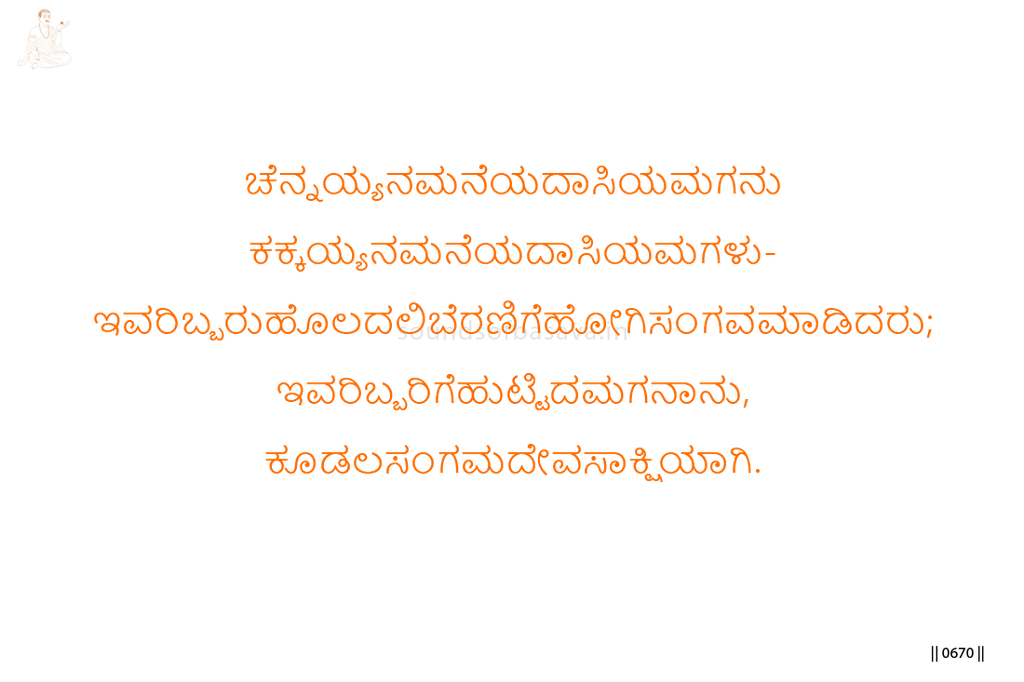
In this vachana, Basavanna speaks of the servant’s son in Chennayya’s house and the maid’s daughter in Kakkayya’s house.
The two go to the field, come together, and from them a son is born. Basavanna says, “I am the son born to these two.”
The final measure is not social naming or birth-lineage. Kudalasangama Deva is the witness.
Imagery & Symbolic Relevance
Chennayya’s house is the first place named. It brings realized Sharana presence into the vachana.
Kakkayya’s house is the second place named. The two houses stand within the field of Sharanas, not within ordinary pride of lineage.
The servant’s son and the maid’s daughter give the concrete human origin. Basavanna does not hide bodily birth or make it noble through social language.
The field is the place of meeting. It is plain, open, and outside the protected language of lineage.
Their union gives the bodily fact. Birth arises through human coming together; it does not create spiritual superiority.
“I am the son born to these two” is the direct self-placement. Basavanna brings the statement upon himself, not upon others.
Kudalasangama Deva as witness gives the final turn. The world may classify birth, but the Lord alone witnesses the truth of life.
Lingayoga
In Lingayoga, this vachana tests whether the seeker still clings to birth as identity.
The practice-point is direct: do not build spiritual worth from lineage, house, or social origin. Let bodily birth be seen plainly, and stand before Kudalasangama Deva as witness.
For Sharana Sthala, this is freedom from birth-pride through surrender before the Divine witness.
Editorial Commentary
This vachana should not be turned into a broad doctrine beyond the given images. Its force lies in its plainness: two houses, two humble figures, a field, a union, a son, and Kudalasangama Deva as witness. The statement is not shame and not pride; it removes birth from the seat of spiritual authority.
Related Vachana
Supporting Vachana
Pranalingi Sthala Vachana 715 — The Master of the House
Pranalingi Vachana 715 supports this teaching by saying that even one called Shvapacha becomes truly kulaja when Kudalasangama Deva dwells within. Vachana 346 gives the Sharana form of that reversal: birth may be traced through servant, maid, house, and field, but the true measure is not lineage; Kudalasangama Deva is witness.
Advancing Vachana
Aikya Sthala Vachana 590 — The Alchemy of True Nobility
Aikya Vachana 590 advances this teaching by showing that all embodied life arises through the same process and that caste, occupation, and inherited claim cannot establish true nobility. Vachana 346 removes birth-lineage from authority by placing Kudalasangama Deva as witness; Aikya Vachana 590 carries this further, declaring that only the one who knows the Linga-sthala is truly noble before Kudalasangama Deva.
