

Summary
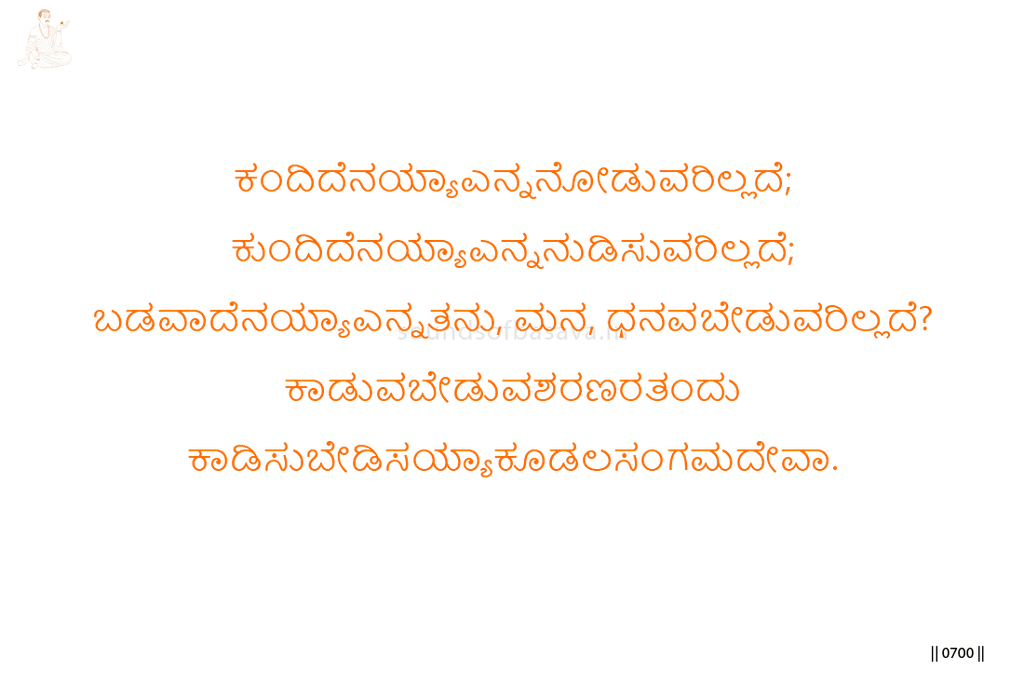
In this vachana, Basavanna says he has become poor because there is no one to look for him. He has become diminished because there is no one to call upon him. He has become destitute because there is no one to seek his body, mind, and wealth.
The poverty named here is not ordinary material poverty. It is the absence of opportunity to offer oneself in service.
Basavanna therefore prays to Kudalasangama Deva to bring the Sharanas who seek, ask, and call upon him, so that he may be made to serve. The teaching is direct: the Sharana does not seek comfort from being left alone; he seeks the grace of being needed by the Sharanas.
Imagery & Symbolic Relevance
Poverty is the first image. Basavanna says he is poor because no one seeks him. This reverses ordinary thinking: lack is not the absence of possession, but the absence of service.
Diminishment is the second image. He is diminished because no one calls upon him. His concern is not public recognition, but the loss of occasion for useful offering.
Destitution is the third image. He becomes poor because no one seeks his body, mind, and wealth. These three form the full field of human participation: bodily effort, mental attention, and material resource.
The Sharanas who seek and ask form the closing image. Basavanna does not ask Kudalasangama Deva to remove demands from his life. He asks for Sharanas who will make service possible.
The imagery therefore moves from poverty, to diminishment, to destitution, to the prayer for demanding Sharanas. What the world may call burden, Basavanna treats as grace.
Lingayoga
In Lingayoga, this vachana teaches that body, mind, and wealth find meaning through service.
The practice-point is direct: do not preserve body, mind, and wealth as private possessions. Let them become available to the Sharanas of Kudalasangama Deva.
For Sharana Sthala, this is Dasoha as readiness. The Sharana is not fulfilled by being unused or undisturbed. He becomes spiritually rich when the Sharanas call upon him and his life can be spent in service.
Editorial Commentary
The key reversal should remain clear. Basavanna does not lament because he lacks wealth, status, or comfort. He laments because no one asks for his body, mind, and wealth. The closing prayer is therefore not for relief from burden, but for the arrival of Sharanas who create the opportunity for service before Kudalasangama Deva.
Related Vachana
Supporting Vachana
Pranalingi Sthala Vachana 759 — The Living Kayaka
Pranalingi Vachana 759 supports this teaching by saying that the Bhakta who does and gives is like a hidden treasure, and that the pure Sharana who does not go to another’s house merely to fill his own belly is recognized as Kudalasangayya. Vachana 432 carries this into Sharana Sthala as a prayer for service: Basavanna asks Kudalasangama Deva to bring Sharanas who will seek his body, mind, and wealth, so that giving may become living Dasoha.
Advancing Vachana
Aikya Sthala Vachana 1183 — Behold the One Ripened in the Dense Reality
Aikya Vachana 1183 advances this teaching by showing the ripened one who has offered body, mind, and wealth into Guru, Linga, and Jangama and has become established in Kaya-Prasada. Vachana 432 asks for Sharanas who will seek body, mind, and wealth for service; Aikya Vachana 1183 carries this into Aikya, where that offering is no longer only readiness but complete establishment in Kudalasangama Deva.
