

Summary
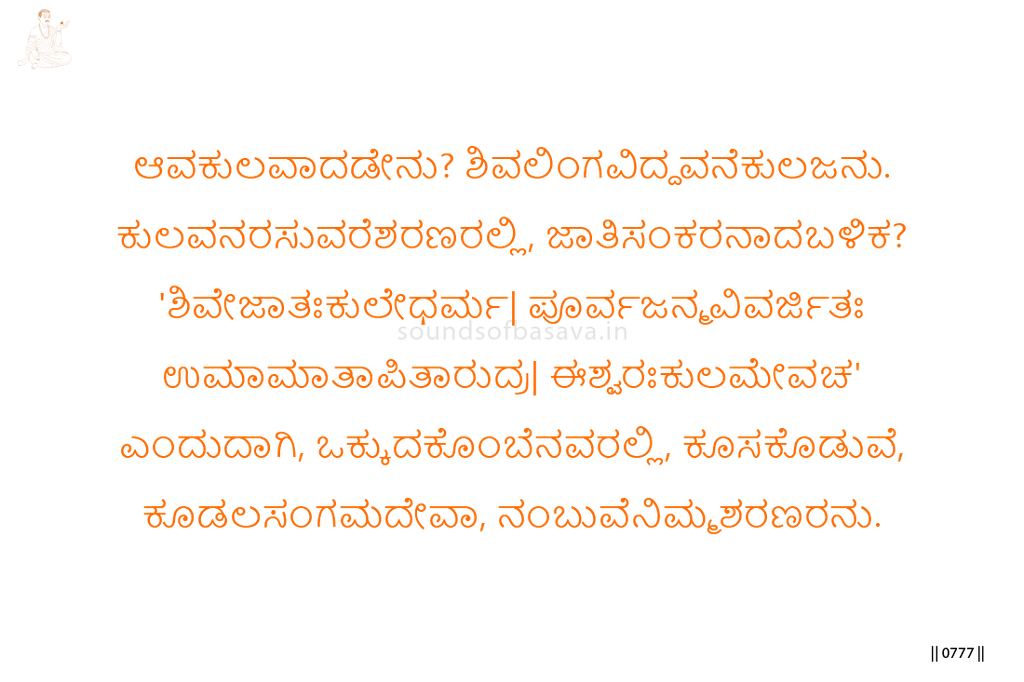
In this vachana, Basavanna rejects caste and lineage as the true measure of a person.
He asks, “What does caste matter?” He then gives the answer: the one who has Shiva-Linga is the true Kulaja. Kulaja ordinarily means one of noble lineage, but Basavanna changes the measure. Nobility does not come from birth; it comes from living relation to the Linga.
He then asks whether anyone can search for caste among Sharanas. Once one stands in the field of the Sharanas, caste inquiry loses its authority. The old question of birth no longer determines spiritual belonging.
The later image is sharp. If one seeks lineage even among those whose old divisions have been crossed, it is like giving a child into a broken or unsuitable line. The point is that inherited lineage cannot carry the truth of the Sharana.
The final declaration is trust. Basavanna says that he trusts Kudalasangama Deva’s Sharanas. The trust is not in caste, family, clan, or ancestry, but in the realized company of the Lord.
The teaching is direct: the Sharana is not measured by caste or birth-lineage. The one who bears the Shiva-Linga and belongs to Kudalasangama Deva’s Sharanas is the true noble one.
Imagery & Symbolic Relevance
Caste is the first image under question. Basavanna does not merely lower its importance; he asks what it matters at all when the Shiva-Linga is present.
The Shiva-Linga is the decisive image. It becomes the true mark of belonging. The one who has Shiva-Linga is not defined by inherited caste, but by relation to the Lord.
Kulaja is the central reversal. In ordinary usage, it points to noble birth or good lineage. Basavanna redefines it: the true Kulaja is the one whose life is joined to Shiva-Linga.
The search for caste among Sharanas is the next image. The question itself becomes misplaced. In the company of Sharanas, caste-searching belongs to the old measure, not to the living truth.
The image of broken lineage or confused inheritance sharpens the criticism. If one continues to seek caste where Sharana-belonging has already replaced it, one is trying to preserve a measure that no longer holds.
The final trust in Kudalasangama Deva’s Sharanas completes the vachana. Basavanna does not leave the seeker in negation. He gives the positive ground: trust the Lord’s Sharanas.
The movement of the vachana is therefore from the rejection of caste as measure, to Shiva-Linga as true nobility, to the uselessness of caste-search among Sharanas, and finally to trust in the Sharanas of Kudalasangama Deva.
Lingayoga
In Lingayoga, this vachana teaches freedom from birth-based identity.
The seeker should ask: do I still measure myself or others by caste, family, ancestry, social respectability, or inherited status? Basavanna removes these measures from the Sharana’s path. The true question is whether the life is joined to Shiva-Linga. For Sharana Sthala, the practice-point is clear: do not search for caste among Sharanas. Trust the company of Kudalasangama Deva’s Sharanas, where Linga-belonging replaces lineage-pride.
Editorial Commentary
This vachana should remain sharper than a general statement on equality. Basavanna is not simply saying that all castes are equal within the old framework. He is saying that the old framework does not decide the Sharana’s worth. True Kulaja is the one who has Shiva-Linga; true belonging is in Kudalasangama Deva’s Sharanas.
Related Vachana
Supporting Vachana
Pranalingi Sthala Vachana 568 — The Alchemy of Inner Transformation
Pranalingi Vachana 568 supports this teaching by asking whether Bhakti and knowledge have any caste-boundary. It also uses the image of iron transformed into gold to show that spiritual worth comes through real transformation, not inherited identity. This supports Vachana 718 directly. Vachana 718 says that the one who has Shiva-Linga is the true Kulaja and asks why caste should be searched among Sharanas; Vachana 568 gives the supporting principle: Bhakti and knowledge do not belong to caste, but to the one transformed before Kudalasangama Deva.
Advancing Vachana
Aikya Sthala Vachana 1196 — Beyond the Five Impurities
Aikya Vachana 1196 advances this teaching by declaring that birth impurity, caste impurity, bodily impurity, contact impurity, and death impurity do not belong to the Linga-Bhakta whose Anga and Linga are joined. It further says that for Shiva-Bhaktas whose old worldly standing has fallen away and whose lineage has become Shiva-kula, to impose caste impurity is a grave error. This is the natural advancement from Vachana 718. Vachana 718 ends caste-search among Sharanas and locates true nobility in Shiva-Linga; Aikya Vachana 1196 carries that into fulfillment, where caste, birth, and impurity no longer define the one established in Linga before Kudalasangama Deva.
