

Summary
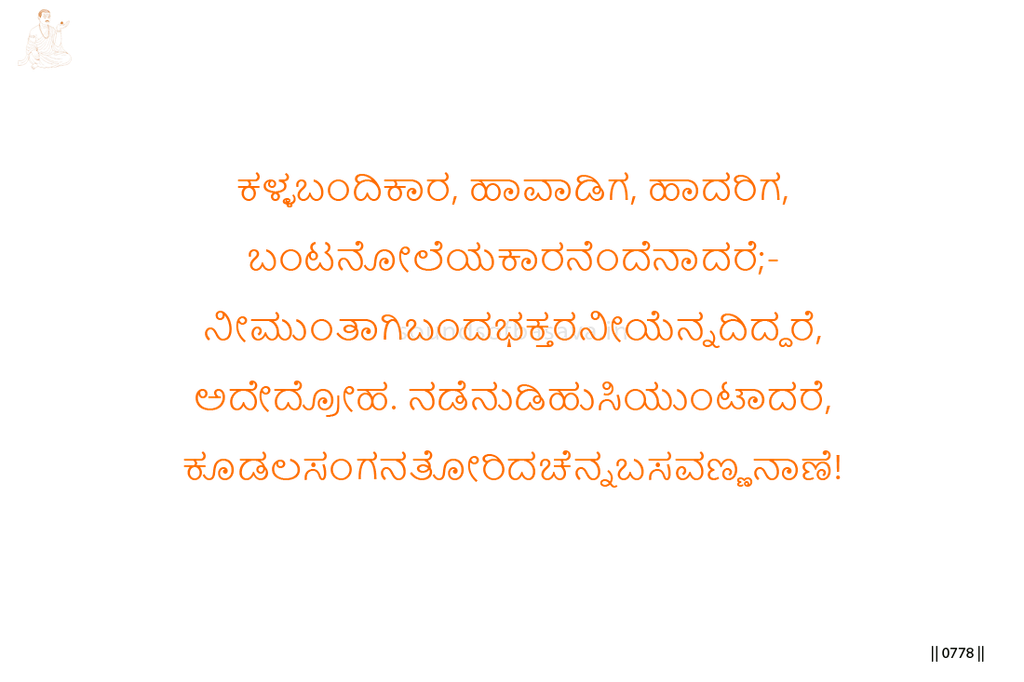
In this vachana, Basavanna warns against rejecting the devotee through outer labels.
He names harsh designations: thief, jailer, snake-charmer, degraded person, or one who carries another’s message. Such names may be placed on a person by the world. But Basavanna’s concern is sharper: if the Bhakta who comes before us is not recognized as such, that failure itself becomes betrayal.
The teaching is not that conduct is irrelevant. It is that outer labels do not give final knowledge of the devotee. A person may be socially condemned, misunderstood, or named by low occupations, yet the living truth of Bhakti may stand there.
Basavanna then joins conduct and speech. If walk and word become false, the betrayal deepens. Recognition of the Bhakta must not remain merely in speech; conduct must also align with that recognition.
The final line invokes the oath of Chennabasavanna, who showed Kudalasangama. This gives the vachana its authority and seriousness. The path is not judged by worldly naming, but by the living recognition shown through Chennabasavanna.
The teaching is direct: the Sharana must not reject or misrecognize the Bhakta through outer labels. To fail in recognition, and to let conduct and speech become false, is betrayal before Kudalasangama Deva.
Imagery & Symbolic Relevance
The thief is the first label. It represents moral accusation and public blame. Basavanna begins with a name that immediately lowers a person in worldly eyes.
The jailer or keeper of bonds is the second label. It suggests one associated with restraint, punishment, or worldly authority. Even such a name does not give final spiritual measure.
The snake-charmer is another unsettling image. It may carry associations of danger, skill, performance, or marginal livelihood. Basavanna does not let such an outer identity become the measure of Bhakti.
The degraded or fallen person adds another public judgment. The world may classify a person through shame, conduct, occupation, or reputation. Basavanna refuses to make that classification final.
The messenger or carrier of another’s word gives a further image of borrowed speech or subordinate role. Even this does not decide the inner standing of the one who comes before the seeker.
The Bhakta who comes before us is the central image of the vachana. Basavanna turns from labels to recognition. The decisive question is not what the world calls that person, but whether the devotee is recognized as devotee.
Betrayal is the turning word. Droha here is not ordinary disagreement. It is the failure to honor the living devotee when the outer label has been allowed to hide the inward truth.
Walk and word form the ethical pair. If conduct and speech become false, recognition has failed in life as well as language. The Sharana’s speech must not praise one truth while conduct follows another.
Chennabasavanna’s oath completes the vachana. He is invoked as the one who showed Kudalasangama. The final witness is therefore not public naming, but the realized showing of the path through Chennabasavanna.
The movement of the vachana is therefore from harsh outer labels, to recognition of the Bhakta, to the danger of betrayal, to the alignment of conduct and speech, and finally to the authority of Chennabasavanna who showed Kudalasangama.
Lingayoga
In Lingayoga, this vachana teaches restraint before judging the living devotee.
The seeker should ask: do I see only name, occupation, fault, reputation, or social position? Do I dismiss the Bhakta because the world has already labelled him? Do my words recognize devotion while my conduct still follows prejudice?
For Sharana Sthala, the practice-point is clear: do not let outer labels cover the living presence of Bhakti. Let speech and conduct remain true before the Bhakta, before Chennabasavanna’s witness, and before Kudalasangama Deva.
Editorial Commentary
The harsh opening labels should remain sharp. They are not decorative; they show how quickly worldly judgment can conceal spiritual recognition. The core of the vachana is the warning against droha: the betrayal that occurs when the Bhakta who comes before us is not received as Bhakta. The final oath by Chennabasavanna should be kept central, because it binds the teaching to the path he showed.
Related Vachana
Supporting Vachana
Pranalingi Sthala Vachana 403 — The Heart’s Hidden Truth
Pranalingi Vachana 403 supports this teaching by asking who can know another’s heart and by warning against quickly calling a Shiva-bhakta good or bad. It concludes with the decisive recognition that Jangama is Linga. This supports Vachana 719 directly. Vachana 719 warns against rejecting the Bhakta through labels such as thief, jailer, snake-charmer, fallen person, or messenger; Vachana 403 gives the supporting ground: the inner state of the Shiva-bhakta is not known through surface judgment, and the living Jangama must be approached as Linga.
Advancing Vachana
Aikya Sthala Vachana 1154 — The Revelation of Linga-Aikya
Aikya Vachana 1154 advances this teaching by showing Chennabasavanna as the one who established the living foundations of Guru, Linga, Jangama, Padodaka, and Prasada, made the experiential path of Shatsthala clear, removed delusion, and showed Linga-Aikya. This is the natural advancement from Vachana 719. Vachana 719 invokes the oath of Chennabasavanna who showed Kudalasangama; Aikya Vachana 1154 carries that invocation into fulfillment, where Chennabasavanna is not merely named as witness, but revealed as the one through whom delusion is removed and the path of Linga-Aikya is shown.
