

Summary
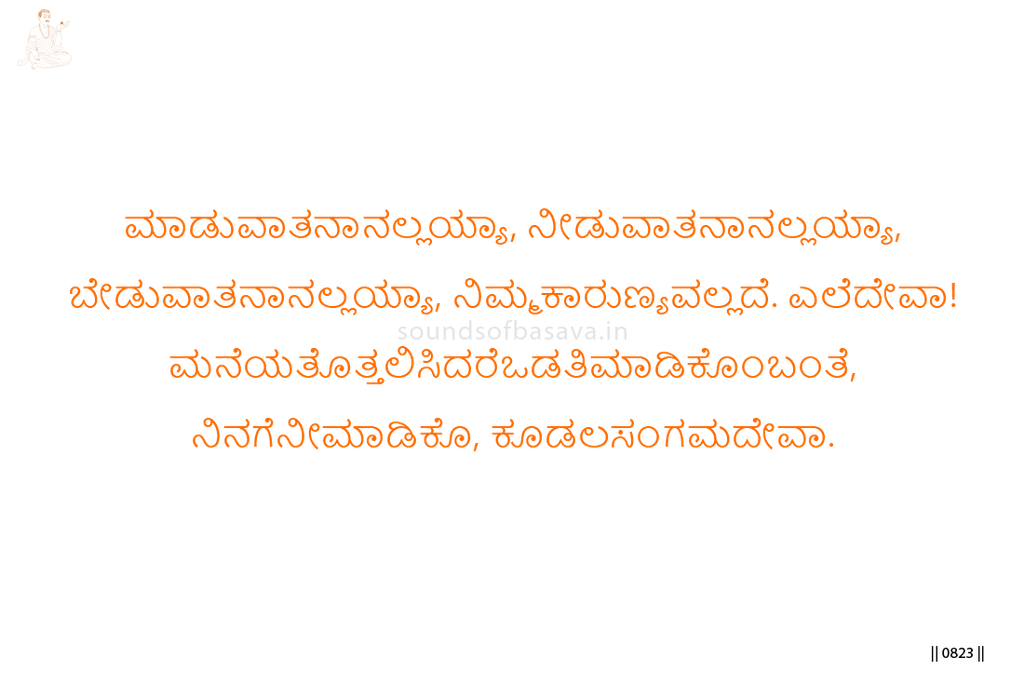
Basavanna denies the three central claims of spiritual selfhood: “I act,” “I give,” and “I seek.” He says he is not the one who acts, not the one who gives, and not the one who asks. Nothing stands apart from Kudalasangama Deva’s compassion.
The vachana then turns this denial into surrender. Basavanna asks the Lord to take up the work Himself, as the mistress of a house takes responsibility when the house-servant becomes tired. The image shows exhaustion of self-effort and the handing over of agency.
The Sharana-stage teaching is direct: the individual must not claim action, giving, or seeking as his own. When all three are surrendered into Divine compassion, the seeker no longer stands as the doer. What remains is Kudalasangama Deva acting according to His own grace.
Imagery & Symbolic Relevance
The first image is the denial of action. “I am not the one who acts” removes the claim of personal agency. Basavanna does not deny that action occurs; he denies that the separate self is its true source.
The second image is the denial of giving. “I am not the one who gives” cuts even deeper, because giving can easily become a refined spiritual identity. Basavanna refuses to let Dasoha become a place for self-claim.
The third image is the denial of asking or seeking. Even the one who asks, seeks, or prays is not retained as independent. The movement of seeking itself belongs to Kudalasangama Deva’s compassion.
The phrase “not apart from Your compassion” is the central theological movement of the vachana. Action, giving, and seeking are not self-generated. They arise only through the Lord’s grace.
The house-servant and mistress image gives the vachana its human concreteness. When the servant of the house becomes weary, the mistress takes up the work herself. Basavanna places himself in the condition of the exhausted servant and asks Kudalasangama Deva to take responsibility.
The final prayer, “You Yourself do it for Yourself,” completes the surrender. The Lord is not merely asked to help the seeker act. The Lord is asked to become the doer, the receiver, and the fulfiller of the act.
Lingayoga
In Lingayoga, this vachana teaches the surrender of doership at the level of action, giving, and seeking. The practitioner must not keep a hidden “I” behind sacred work, offering, or longing.
For Sharana Sthala, the practice-point is complete reliance on grace. The Sharana does not say, “I act for You,” “I give to You,” or “I seek You,” while secretly preserving selfhood. He sees that even these movements belong to Kudalasangama Deva.
This also purifies Kayaka and Dasoha. Kayaka is not self-authored action, and Dasoha is not self-owned giving. Both become truthful only when the Lord’s compassion is recognized as the ground of movement.
Editorial Commentary
The house-servant image should remain close to the Kannada. The point is not independent productivity or self-preparation, but the exhaustion of the servant and the Lord’s taking up of the work. Basavanna’s prayer is not merely “help me”; it is “You Yourself do what belongs to You.”
Related Vachana
Supporting Vachana
Pranalingi Sthala Vachana 759 — The Living Kayaka
Pranalingi Vachana 759 supports this teaching by describing the Bhakta who does and gives as a hidden treasure, the Padodaka-Prasada-jivi as one whose life is sustained by sacred receiving and offering, and the pure Sharana as one who goes to another’s house without seeking to fill his own belly. This prepares Vachana 832 directly. In Vachana 759, doing and giving become pure when freed from self-seeking; in Vachana 832, Basavanna goes further and removes the very claim “I act,” “I give,” and “I seek,” placing all movement under Kudalasangama Deva’s compassion.
Advancing Vachana
Aikya Sthala Vachana 1177 — You Alone Are the Doer
Aikya Vachana 1177 directly advances this teaching by carrying the surrender of personal agency into its completed Aikya recognition. In Sharana Vachana 832, Basavanna declares that he is neither the doer, giver, nor asker; everything rests upon Divine grace, and Kudalasangama Deva must Himself complete what the exhausted servant cannot. In Aikya Vachana 1177, one sacred agency is recognized as operating through Guru, Linga, Jangama, Prasada, Upadesha, and Basavanna himself; therefore, nothing remains for the separate self to seek or reject. Thus dependence upon grace in Sharana advances into freedom from personal doership in Aikya, where the source, action, guidance, and fulfilment are no longer claimed as separate.
