

Summary
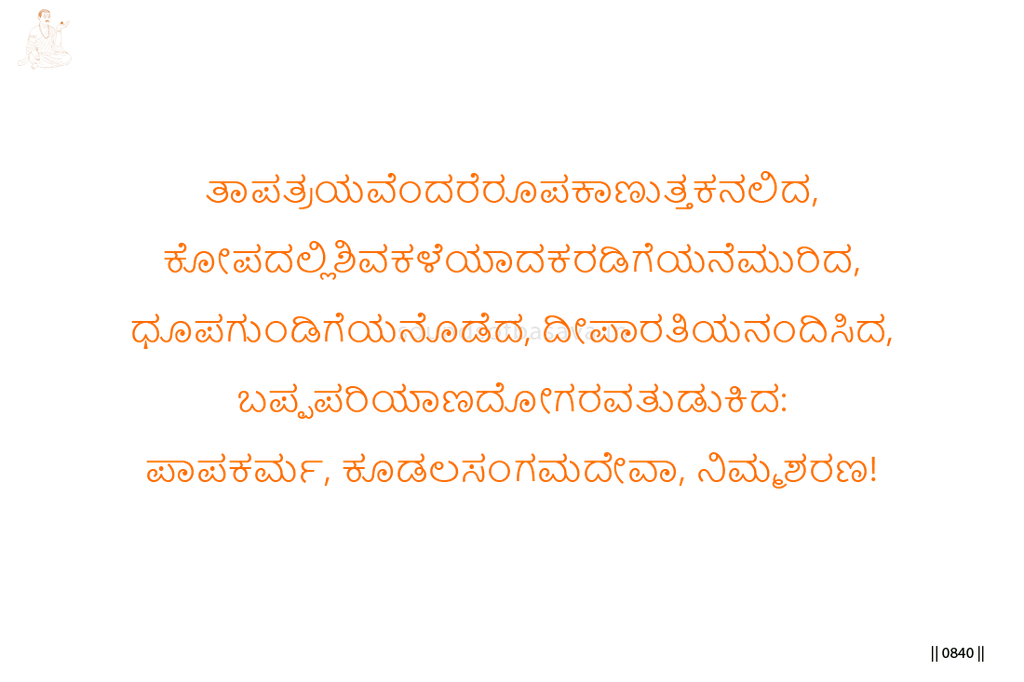
Basavanna names the rising of tāpatraya, the threefold affliction, and places before it a sequence of disturbances: form appearing, anger breaking forth, the incense-vessel breaking, the lamp being put out, bodily trembling, and the gathering of sin and karma. These are not treated as remote possibilities. They are the very field in which the Sharana is tested.
The teaching is not that such disturbances never arise. Rather, the Sharana must not become them. Anger may appear, ritual order may break, light may be extinguished, the body may tremble, and karmic burden may press close, yet the seeker is not to collapse into those movements as identity.
The final declaration rests in Kudalasangama Deva. His Sharana remains His Sharana amid these pressures. The Sharana-stage teaching is clear: restraint is not merely outward control, but the refusal to become the disturbance that arises.
Imagery & Symbolic Relevance
Tāpatraya is the opening field. It names affliction in its full force, not a minor discomfort. Basavanna begins with suffering as something that burns and presses upon embodied life.
Form appearing before the eye is the first disturbance. The field of perception can provoke response. What is seen can stir reaction and pull the seeker outward.
Anger is the next image. It appears with force and can break like a violent impulse. Basavanna places anger among the events that test whether the seeker will remain steady or become the reaction.
The incense-vessel breaking and the lamp being extinguished are ritual images. They show the collapse of outward order, fragrance, and light. Even when sacred arrangements are disturbed, the Sharana must not inwardly break.
The trembling body is another test. Bodily unrest, fear, strain, or weakness may arise. Basavanna does not deny the body’s trembling, but he refuses to make it the final measure of the person.
Sin and karma gathering close form the last pressure. The old burden of action and consequence may appear as if it is about to define the seeker. Yet Kudalasangama Deva’s Sharana is not to become the weight of that gathering.
Lingayoga
In Lingayoga, this vachana teaches vigilance at the point of arising. Disturbance must be seen before it becomes identity. The practitioner must not become anger, breakage, darkness, bodily trembling, or karmic burden.
For Sharana Sthala, the practice-point is inward steadiness under pressure. The Sharana is not proved only when conditions are calm. He is proved when the ritual vessel breaks, the lamp goes out, the body trembles, and old tendencies gather, yet he does not leave Kudalasangama Deva.
This restraint is not suppression. It is fidelity. The Sharana remains held in Kudalasangama Deva and therefore does not allow passing conditions to become the truth of himself.
Editorial Commentary
The sequence of images should remain intact. Basavanna moves from affliction, to perception, to anger, to ritual disturbance, to bodily trembling, to sin and karma. The repeated inward question is whether the seeker must become what arises. The answer is contained in the final phrase: Kudalasangama Deva’s Sharana remains His.
Related Vachana
Supporting Vachana
Pranalingi Sthala Vachana 797 — The Inseparable Abidance in the Linga
Pranalingi Vachana 797 supports this teaching by asking how one who has received Prana-Linga can walk, speak, enjoy the five senses, or perform even the smallest bodily act apart from Linga. This prepares Vachana 901 directly. In Vachana 797, ordinary movement, speech, sense-experience, and bodily action must not become Linga-virahita; in Vachana 901, anger, disturbance, trembling, and karmic pressure arise, yet Kudalasangama Deva’s Sharana does not become those movements or depart from Him.
Advancing Vachana
Aikya Sthala Vachana 814 — The Knowing Beyond the Elements
Aikya Vachana 814 advances this teaching by carrying restraint beyond reaction into direct knowing beyond the elemental field. There, earth, water, fire, air, and sky cannot reveal Kudalasangama Deva’s greatness through ordinary perception or thought; only through the light of knowing and inward purity is He beheld. This is the natural Aikya fulfillment of Vachana 901. In Sharana Vachana 901, the seeker does not become affliction, anger, breakage, darkness, trembling, or karmic burden; in Aikya Vachana 814, the whole field of elemental experience and perception is surpassed in inward stillness before Kudalasangama Deva.
