

Summary
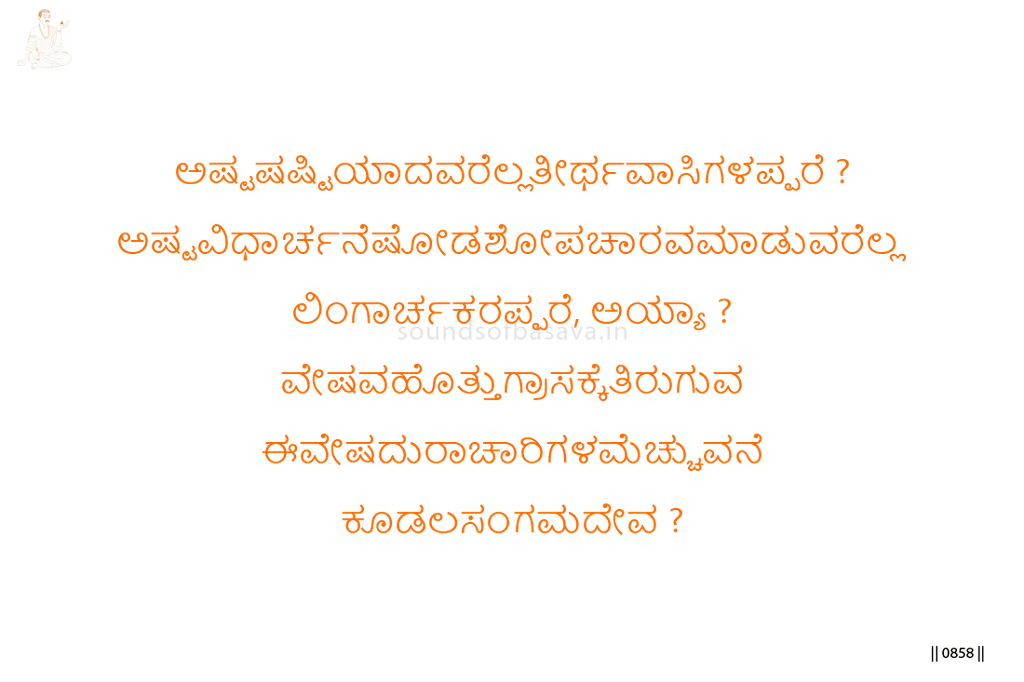
Basavanna questions whether sacred movement, ritual performance, and religious appearance can by themselves become true worship. Those who travel to sacred places are not therefore holy. Those who perform the Eightfold Worship and the Sixteen Offerings are not therefore true worshippers of the Linga. The outer act must not be mistaken for inward realization.
The vachana is not a rejection of pilgrimage, worship, or sacred observance. It is a correction of false confidence in them. A practice becomes truthful only when it is joined to awakened awareness, right conduct, and inward relation to Kudalasangama Deva.
The sharpest image is the religious garb worn for the sake of food. Here sacred appearance becomes livelihood, disguise, or display. Basavanna names such people as corrupt in conduct. The problem is not the garment itself, but the split between appearance and life.
Thus the vachana demands integrity. What is worn outside must be true within. What is performed before others must arise from what is lived before the Linga. Without this unity, worship remains appearance, and appearance does not please Kudalasangama Deva.
Imagery & Symbolic Relevance
The first image is pilgrimage. Basavanna asks whether all who go to sacred places are truly dwellers in holiness. The question exposes the difference between physical movement and spiritual abiding. One may reach a holy place and yet remain inwardly unchanged.
The second image is ritual worship. The Eightfold Worship and Sixteen Offerings represent established and respected forms of worship. Basavanna does not deny their place. He asks whether those who perform them are necessarily true Linga-worshippers. Correct action without inward realization remains incomplete.
The third image is religious garb. This is the strongest image in the vachana. A person may wear the marks of holiness while living for the stomach. The sacred form then becomes a means of livelihood, recognition, or advantage. It no longer reveals truth; it conceals misconduct.
The word “misconduct” is decisive. Basavanna does not measure worship by costume, journey, or ritual completion. He measures it by conduct. If conduct contradicts appearance, the appearance becomes false.
The final question—whether Kudalasangama Deva approves such disguise—governs the whole vachana. The Lord is not deceived by sacred signs. He sees whether worship has become life.
Lingayoga
In Lingayoga, this vachana teaches that outer practice must become inwardly alive. Pilgrimage must become inner movement toward truth. Worship must become Linga-awareness. Sacred offerings must arise from sincerity. Garb must not hide divided conduct.
For Sharana Sthala, the practice-point is direct: do not let religious form replace realization. The Sharana is not known by travel, ritual correctness, or dress. The Sharana is known by the unity of inner state, conduct, and devotion before Kudalasangama Deva.
Achara is central here. Without truthful conduct, worship loses its life. Kayaka too must remain honest; sacred identity must not become a means of bodily maintenance or social advantage. Dasoha cannot arise from disguise. It arises only when the self has become transparent before Linga.
Editorial Commentary
The references to sacred places, Eightfold Worship, Sixteen Offerings, and religious garb should be retained as source-given images. Basavanna is not dismissing these forms. He is refusing to let them stand as substitutes for inward truth and right conduct.
Related Vachana
Supporting Vachana
Pranalingi Sthala Vachana 592 — The Seed and the Soil
Pranalingi Vachana 592 supports this teaching by showing that sacred words and ritual recitations remain barren when living inward contact is absent. There, even while Prana-Linga Prasada is before them, the karmis continue reciting the names of the pranas, yet speech alone does not prove realization. This prepares Vachana 1027 directly. In Vachana 592, sacred utterance without living contact remains barren; in Vachana 1027, pilgrimage, ritual worship, and sacred garb without truthful conduct fail to become real worship.
Advancing Vachana
Aikya Sthala Vachana 1235 — The Symphony of the Integrated Self
Aikya Vachana 1235 advances this teaching by joining speech and conduct completely. It says that conduct must reveal the beauty of speech, and speech must reveal the beauty of conduct, honoring those who are complete without inner division. This is the natural Aikya fulfillment of Vachana 1027. In Sharana Vachana 1027, Basavanna rejects religious appearance when conduct is corrupt; in Aikya Vachana 1235, speech and conduct no longer stand apart, and the divided self hidden beneath sacred appearance has disappeared before Kudalasangama Deva.
