

Summary
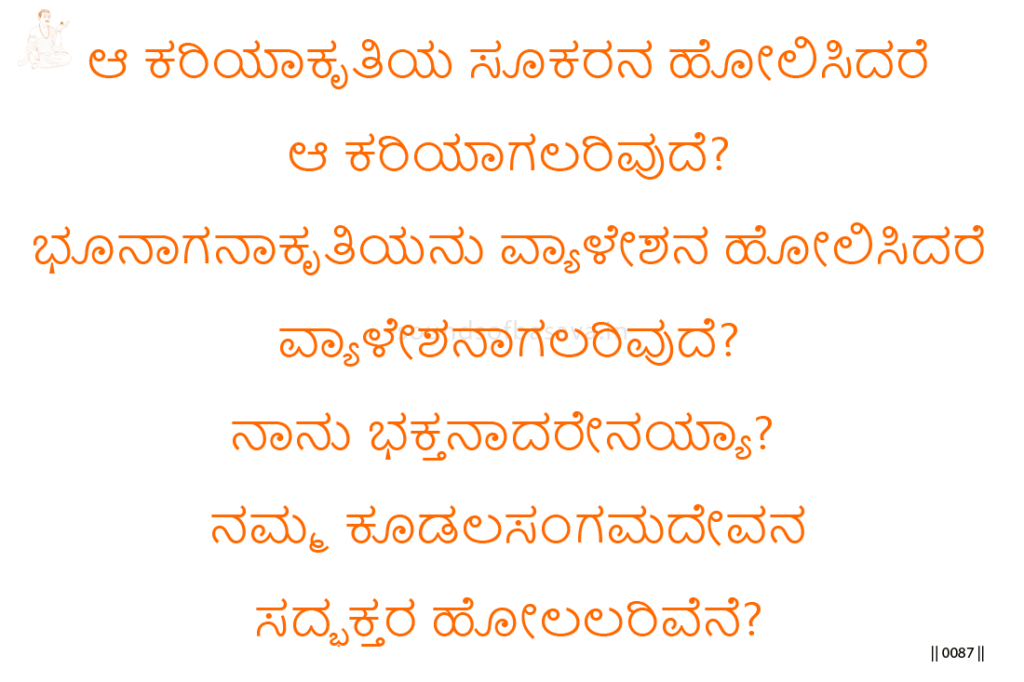
In this vachana, Basavanna questions the value of resemblance without reality.
If a lesser creature is compared to an elephant, does it become an elephant? If an earth-formed shape resembles a serpent, does it become the serpent itself?
He then turns the same question toward himself. Even if he is called a bhakta, can he truly compare himself with the good devotees of Kudalasangama Deva?
The vachana teaches that likeness, association, and name do not become realization. The seeker must not be satisfied with appearing like a devotee; devotion must become inwardly true.
Imagery & Symbolic Relevance
The elephant represents true strength, stature, and living power.
A lesser creature may be compared to an elephant in shape or speech, but comparison does not give it the elephant’s nature. The image separates appearance from essence.
The serpent image deepens the same teaching. An earth-formed shape may resemble a serpent, but it does not possess the serpent’s life, movement, or force.
Both images expose the poverty of imitation. Something may look like the real thing and still remain without its living quality.
Basavanna applies this to bhakti. A person may be called a devotee, stand near devotees, or resemble the external form of devotion. Yet that does not make him equal to the true bhaktas of Kudalasangama Deva.
The final question is an act of humility. Basavanna refuses to claim equality where realization has not yet become complete.
Lingayoga
In Lingayoga, the Anga must move from resemblance to realization.
Outer form may resemble devotion: worship, marks, speech, conduct, and association with Sharanas. But these do not become bhakti unless awareness is awakened within.
The Linga cannot be approached through imitation alone. The seeker must become inwardly aligned, steady, and truthful.
Practice matures when likeness gives way to living contact, and the name “bhakta” becomes supported by actual realization.
Editorial Commentary
This vachana tests spiritual resemblance.
Basavanna shows that the devotee must not borrow the appearance of the Sharanas without becoming inwardly transformed.
Related Vachana
Supporting Vachana
Vachana 329 — The Path of Humble Steps
Vachana 329 asks whether the goat can claim the same measure as the elephant on the path. Vachana 330 continues by showing that resemblance to greatness does not become greatness itself.
Advancing Vachana
Maheshwara Vachana 405 — The Burn Before the Fire
Vachana 330 questions whether one called a bhakta can truly compare with Kudalasangama Deva’s good devotees. Maheshwara Vachana 405 advances this into the living altar, where devotion must become inwardly real and continuously present before Kudalasangama Deva.
