

Summary
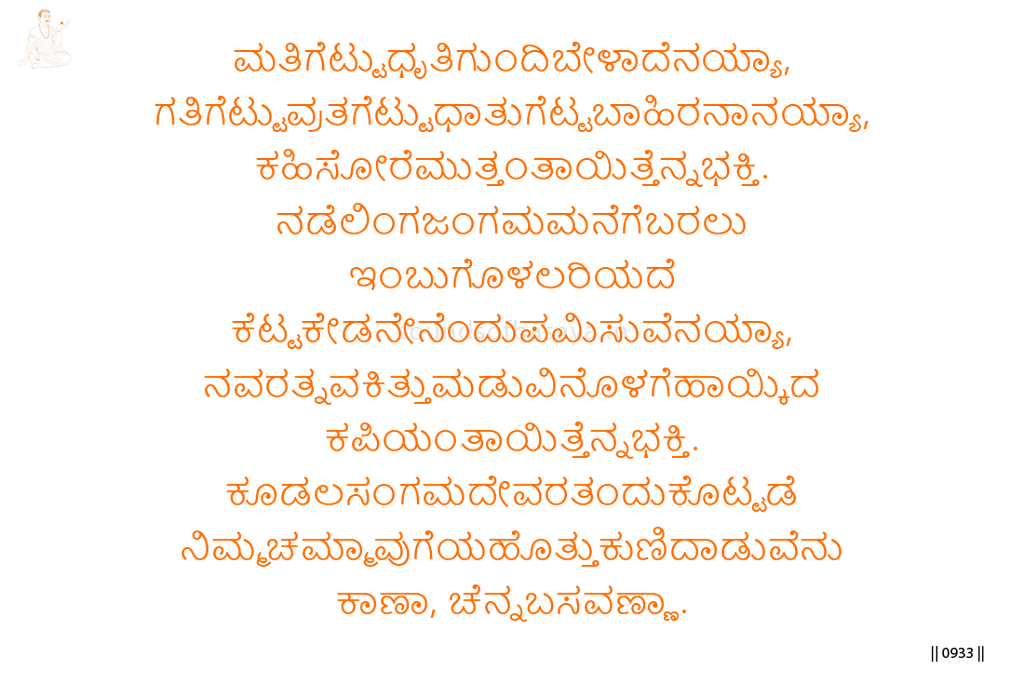
Basavanna confesses a fall that came not from lack of grace, but from failing to preserve and honour what had already been received. Understanding became clouded, firmness weakened, discipline broke, and inner strength faded. His devotion, though ripened, turned bitter.
The heart of the vachana is the failure to receive the Walking Linga, the Jangama, when he came to the house. Basavanna did not know how to welcome him with love. The grace placed in his hands became like a precious jewel thrown into the mud by a monkey. Yet the vachana ends in hope: if Kudala Sangama Deva restores what He had once bestowed, Basavanna will bear Chennabasavanna’s sandals upon his head and dance in surrender.
Imagery & Symbolic Relevance
The first image is understanding clouded and firmness weakened. Basavanna begins with inward collapse. The failure is not external first; clarity, steadiness, and inner balance have been disturbed.
The second image is the loss of state, discipline, and strength. Basavanna names the fall in stages. His true condition has been lost, his vow has weakened, and his inner power has faded. The seeker becomes spiritually impoverished when the inward supports of devotion fail.
The third image is devotion like a ripe fruit turned bitter. Ripening should have brought sweetness. The tragedy is that the devotion had matured, but its fruit became spoiled. This shows the sorrow of grace received but not rightly preserved.
The fourth image is the Walking Linga, the Jangama, coming to the house. The Divine did not remain distant. The living presence came near. But Basavanna confesses that he did not know how to receive that presence with love.
The fifth image is the grievous wrong of not knowing how to welcome. The failure is not merely social discourtesy. It is the failure to recognize and honour Jangama as the living presence through which Linga comes.
The sixth image is the monkey throwing the Navaratna jewel into the mud. The jewel is precious grace already received. The monkey is the restless, undiscerning mind that does not know value. The mud is the condition into which grace is wasted when discernment is lost.
The final image is bearing Chennabasavanna’s sandals on the head and dancing. Basavanna does not ask merely to recover status. He asks that what Kudala Sangama Deva once gave may be restored, and he vows to respond with humility, reverence, and grateful surrender before Chennabasavanna.
Lingayoga
In Lingayoga, this vachana teaches that receiving grace is not enough; one must become capable of preserving and honouring it. The Jangama may come to the house, but the seeker must know how to receive him with love.
For Sharana Sthala, the practice-point is direct: do not squander the jewel already given. Recognize the Walking Linga when he comes. If devotion has turned bitter through negligence, return through confession, humility, and surrender at the sandals of the realized Sharana.
Editorial Commentary
This vachana should not be read as despair. Basavanna’s confession is itself the beginning of restoration. The fall is severe, but it is named honestly before Chennabasavanna and Kudala Sangama Deva. The final vow shows that grace may be recovered through humility and renewed reverence.
Related Vachana
Supporting Vachana
Pranalingi Sthala Vachana 963 — Body, Mind, and Being as the Vessels of Linga
Pranalingi Vachana 963 supports this teaching by showing that body, mind, and bhava must become fit vessels for receiving Linga. There, Bhakti becomes the vessel capable of sacred receiving. This prepares Vachana 1301 directly. In Vachana 963, the seeker is taught how to become fit to receive; in Vachana 1301, Basavanna laments that when the Walking Linga came to the house, he did not know how to receive him with love.
Advancing Vachana
Aikya Sthala Vachana 1303 — The Easy Way Shown by Allama
Aikya Vachana 1303 advances this teaching by showing the fulfilled state where the failure of reception has been overcome. In Sharana Vachana 1301, the Jangama comes to the house, but Basavanna does not know how to receive him. In Aikya Vachana 1303, mind, body, and awareness themselves become the sacred dwelling of the Divine. The movement advances from failed welcome to uninterrupted inner worship, where nothing is forgotten and the Lord is continuously held within.
