

Summary
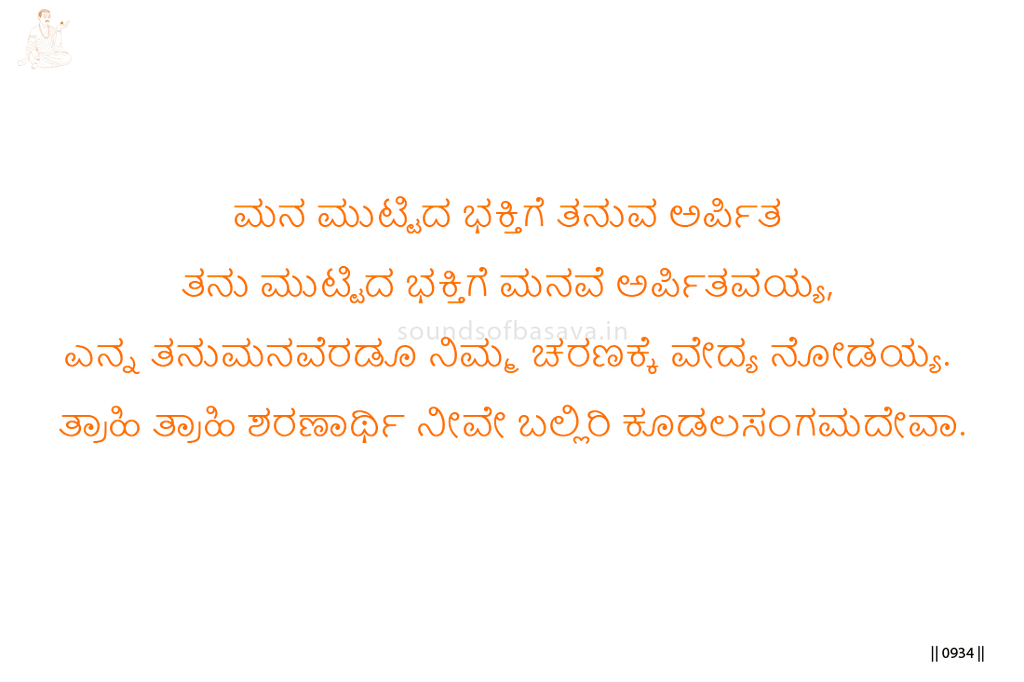
Basavanna speaks from the state of complete offering. When devotion touches the mind, the body is offered; when devotion touches the body, the mind is offered. The surrender is not partial. Inner feeling and outward life move together toward Kudala Sangama Deva.
He then places both body and mind before the Lord’s feet. Nothing is hidden, withheld, or claimed as private. The repeated cry, “Save me, save me,” becomes the voice of one who has taken refuge. The final trust is simple: Kudala Sangama Deva alone knows the truth of the offering.
Imagery & Symbolic Relevance
The first image is devotion touching the mind. When devotion reaches the mind, the body cannot remain separate. Thought, intention, and inward feeling must become embodied offering.
The second image is devotion touching the body. When devotion reaches the body, the mind too must be offered. Outer action without inward surrender is incomplete. The body and mind answer one another in devotion.
The third image is body and mind together placed before the Lord’s feet. Basavanna does not offer one while holding back the other. Both stand revealed at the feet of Kudala Sangama Deva. The feet become the place where the whole being is surrendered.
The fourth image is the cry, “Save me, save me.” This is not casual prayer. It is the cry of one who has no separate protection left after offering body and mind.
The fifth image is seeking refuge. Basavanna does not merely ask for help from a distance. He declares himself a refuge-seeker. The offering of body and mind becomes complete only as Sharana.
The final image is “You alone know.” Basavanna does not claim to know the worth of his own surrender. He leaves the truth of the offering to Kudala Sangama Deva alone.
Lingayoga
In Lingayoga, this vachana teaches that devotion must touch the whole being. Mind without body remains incomplete; body without mind remains incomplete. True offering joins both.
For Sharana Sthala, the practice-point is direct: offer both body and mind at the feet of Kudala Sangama Deva. Cry for protection, enter refuge, and surrender even the judgment of one’s own offering to the Lord who alone knows.
Editorial Commentary
The offering of body and mind should not be read as two separate acts. Basavanna presents a reciprocal surrender. When devotion truly touches one, the other follows. The final emphasis is not self-assurance but refuge: only Kudala Sangama Deva knows the truth of the surrender.
Related Vachana
Supporting Vachana
Pranalingi Sthala Vachana 963 — Body, Mind, and Being as the Vessels of Linga
Pranalingi Vachana 963 supports this teaching by showing body, mind, and bhava as vessels fit for Linga at their proper levels, with Bhakti as the vessel of sacred receiving. This prepares Vachana 1304 directly. In Vachana 963, body, mind, and inner being become fit vessels through Bhakti; in Vachana 1304, when devotion touches body and mind, both are offered at the feet of Kudala Sangama Deva.
Advancing Vachana
Aikya Sthala Vachana 1226 — The Final Offering into Purity
Aikya Vachana 1226 advances this teaching by carrying offering to its complete fulfilment. There, wealth, body, mind, bhava, nirbhava, and finally the whole self are offered, and through Chennabasavanna’s grace the seeker becomes pure in union with Kudala Sangama Deva. In Sharana Vachana 1304, body and mind are laid at the Lord’s feet in refuge. In Aikya Vachana 1226, that refuge matures into total self-offering and purity through complete merger.
