

Summary
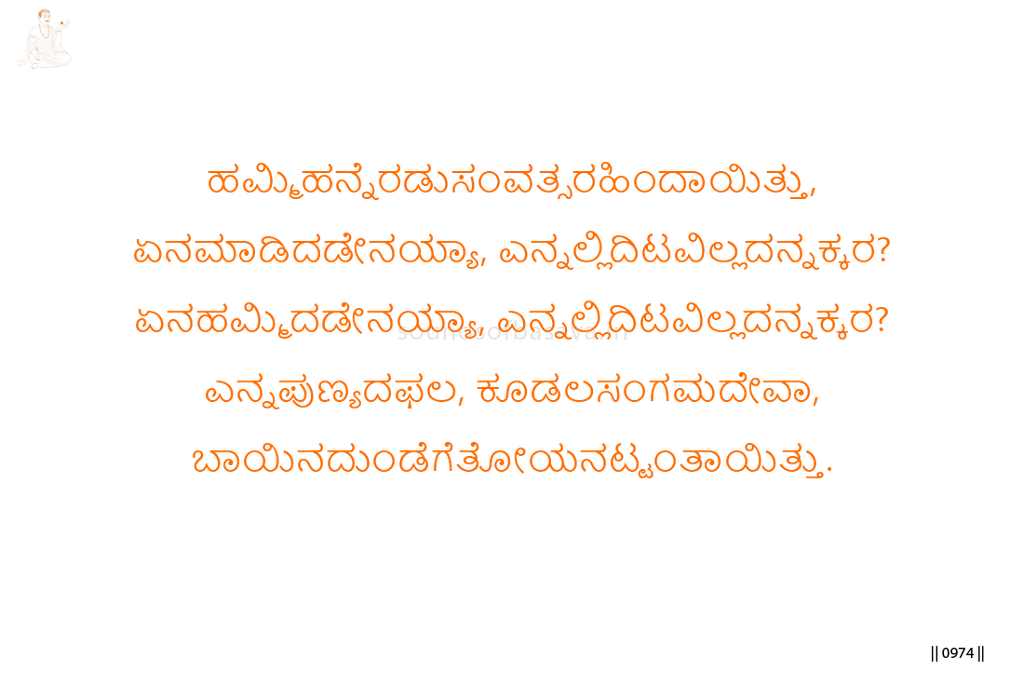
Basavanna looks back upon twelve years of learning and effort and asks what they truly amount to if truth has not become established within him. The number of years does not itself prove realization. Study, effort, and accumulated discipline must be measured by inward firmness.
He repeats the question to make the test unavoidable: what has really been gained if that firmness is absent? Yet the vachana does not end in dismissal. The fruit of his merit becomes like moisture entering a compact mass. What was accumulated does not remain merely external; before Kudalasangama Deva, it begins to soak inwardly and permeate the being from within.
Imagery & Symbolic Relevance
The first image is twelve years passing. Basavanna does not treat duration as fulfillment. A long period of study or effort may pass, but time alone does not establish truth.
The second image is the question, “What have I done?” This question removes self-satisfaction. Basavanna does not allow himself to rest in the fact that he has labored and learned.
The third image is truth or firmness not being established within. This is the central measure. Learning must become inner steadiness; otherwise, it has not reached its true purpose.
The fourth image repeats the same question. The repetition shows that the issue cannot be avoided. Achievement must be tested again and again by inward establishment.
The fifth image is the fruit of merit. Basavanna does not deny that merit has borne fruit. But he examines what kind of fruit it has become.
The final image is moisture entering a compact mass. Moisture does not remain on the surface; it slowly soaks inward. The image shows the quiet inward permeation of accumulated merit. Its value lies not in outward claim, but in the way it enters and changes the inner substance before Kudalasangama Deva.
Lingayoga
In Lingayoga, this vachana teaches that learning must become inward establishment. The seeker may study, practice, and gather merit over time, but the real question is whether truth has become firm within.
For Sharana Sthala, the practice-point is self-examination without self-condemnation. Do not measure the path by years, effort, or learning alone. Let the fruit of merit soak inward, until what has been received becomes steady awareness, conduct, and inner firmness before Kudalasangama Deva.
Editorial Commentary
This vachana should not be read as rejecting learning or merit. Basavanna questions their incompleteness when truth has not become established within. The final image prevents a negative reading: the fruit of merit still has value when it permeates the being inwardly. The issue is not accumulation, but assimilation.
Related Vachana
Supporting Vachana
Pranalingi Sthala Vachana 979 — Without Experience, Nothing Ripens
Pranalingi Vachana 979 supports this teaching by placing Anubhava at the center of spiritual life. There, Bhakti without Anubhava does not truly arrive, Linga without Anubhava does not reach Samarasasukha, Prasada without Anubhava does not give transforming effect, and without Anubhava nothing can be rightly known. This prepares Vachana 1396 directly. In Vachana 979, sacred realities must ripen into lived experience; in Vachana 1396, twelve years of learning and the fruit of merit must become inwardly established truth rather than remaining external accumulation.
Advancing Vachana
Aikya Sthala Vachana 1398 — Beyond All Lineage and Comparison
Aikya Vachana 1398 advances this teaching by carrying the movement from learning into direct recognition. In Sharana Vachana 1396, Basavanna questions inherited learning and accumulated merit unless truth becomes established within. In Aikya Vachana 1398, even sacred names, divine relationships, and theological formulations are examined and transcended, so that the seeker may behold Kudalasangama Deva as the unborn and incomparable Reality. Thus the Sharana-stage concern for inward establishment advances into Aikya as direct recognition beyond conceptual dependence.
