
Summary
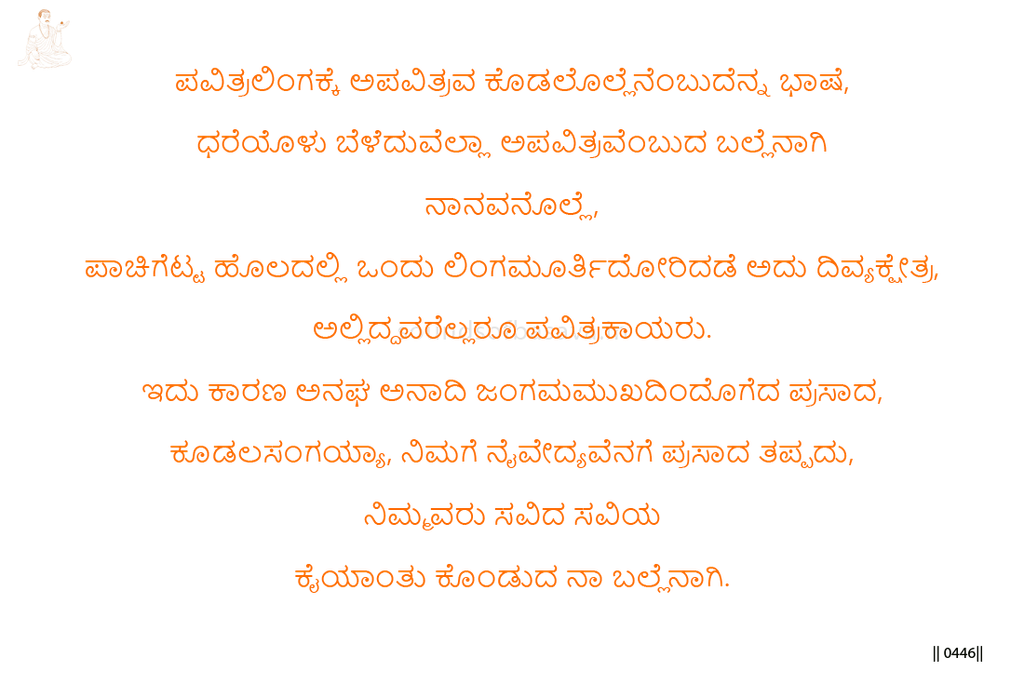
In this vachana, Basavanna begins with a vow: he will not offer the impure to the sacred Linga.
He says he knows that what grows in the earth carries impurity, and therefore he will not offer it as it is. Yet he immediately gives the correcting insight: if a Linga form appears even in a spoiled field, that place becomes a divine kshetra, and those who dwell there become sacred-bodied.
The teaching therefore does not end in rejection. The presence of Linga transforms the field in which it appears.
For this reason, Basavanna says that the Prasada received through the mouth of the stainless and beginningless Jangama becomes Naivedya to Kudalasangama Deva and Prasada to him. This exchange does not fail.
He closes with certainty: what Kudalasangama Deva’s own people have tasted and received through their hands is accepted by Kudalasangama Deva.
Imagery & Symbolic Relevance
The first image is the sacred Linga and the impure offering. Basavanna refuses to offer what is unfit to Linga. The concern is not social purity alone, but sacred fitness before Linga.
The second image is what grows in the earth. Basavanna says that what arises from the earth carries impurity when taken by itself. Therefore it cannot be offered merely because it exists or is available.
The spoiled field is the turning image. Even if the field is unclean or overgrown, if a Linga form appears there, the place becomes a divine kshetra. The field is not made sacred by its own condition; it is made sacred by the presence of Linga.
Those who dwell there become sacred-bodied. This shows that Linga does not merely stand outside the field. Its presence changes the status of the place and those connected with it.
The Prasada from the mouth of Jangama gives the second movement of the vachana. What comes through the stainless, beginningless Jangama is not treated as ordinary food. It becomes Naivedya for Kudalasangama Deva and Prasada for the receiver.
Naivedya and Prasada are therefore joined. What is rightly received through Jangama becomes fit for offering to the Lord, and what belongs to the Lord returns as Prasada.
Lingayoga
In Lingayoga, this vachana teaches transformation through Linga, not rejection of life.
The seeker does not first become pure by his own independent power and then approach Linga. Rather, when Linga is established, the field that was unfit becomes sacredly reoriented.
For Prasadi Sthala, the point is exact: Prasada received through Jangama is not ordinary consumption. It becomes the proper movement between Jangama, Naivedya, Linga, and Prasada before Kudalasangama Deva.
Editorial Commentary
The line about the spoiled field is central. Basavanna is not leaving the field in impurity; he says that when Linga appears there, it becomes a divine kshetra.
This should be read as a Lingayoga principle: sacredness arises through the presence of Linga and the living relation with Jangama. The body or field may carry impurity when taken by itself, but Linga transforms its status.
The phrase “Jangama-mukha” should also be retained. The Prasada that comes through the mouth of Jangama becomes Naivedya to Kudalasangama Deva and Prasada to the receiver.
Related Vachana
Supporting Vachana
Maheshwara Sthala Vachana 421 — Water the Root, and the Tree Blossoms
Maheshwara Vachana 421 supports this vachana by teaching that Jangama is the mouth of Linga and that offering must reach the living point of reception.
In Vachana 1266, the Prasada received through Jangama-mukha becomes Naivedya to Kudalasangama Deva and Prasada to the receiver. Maheshwara Vachana 421 supports this by clarifying why Jangama is central to sacred offering: nourishment given rightly to Jangama reaches Linga.
Advancing Vachana
Pranalingi Sthala Vachana 1062 — Beyond the Offering and the Meal
Pranalingi Vachana 1062 advances this teaching by asking whether offering to Ishtalinga and eating the sacred meal have become Prāṇa-Lingasthala and Prasādasthala within.
In Vachana 1266, Basavanna shows that what comes through Jangama becomes Naivedya and Prasada in the right sacred relation. In Vachana 1062, this advances into Pranalingi clarity: the offering and the meal must not remain outer acts; they must become inwardly realized as Linga and Prasada within the seeker.
