
Summary
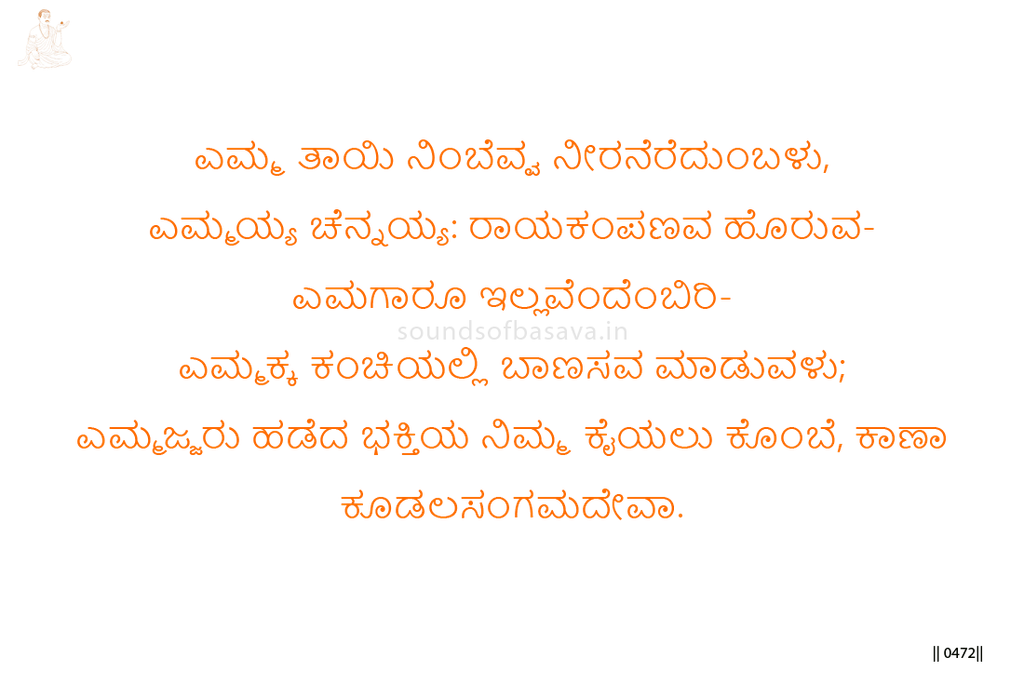
In this vachana, Basavanna begins with the image of the mother lemon plant drawing water from hidden depth. The plant is visible, but its nourishment comes from what cannot be seen. In the same way, life is sustained by a source that outward sight often misses.
He then names Chennayya, who carries grass for the king’s horses. The image is deliberately humble. Outwardly, Chennayya appears as one engaged in ordinary work, but Basavanna sees the realized worth hidden within that life.
The world cries, “There is none for us.” Basavanna answers this despair by pointing to what Kudalasangama Deva has already given. The devotion of the ancient forebears has been placed in the seeker’s own hand. What appears absent is already near; what seems hidden has been made intimate.
Imagery & Symbolic Relevance
The mother lemon plant is the first image. Its life is visible above the ground, but its nourishment comes from hidden water below. Basavanna uses this image to show that what sustains life is not always visible on the surface.
The hidden water points to unseen sustenance. The plant does not create its own nourishment; it receives from depth. Likewise, the seeker’s life is held by a source that may remain unnoticed.
Chennayya carrying grass is the second major image. He is not shown in an exalted outer position, but in simple labor. Basavanna uses this to show that realized life need not appear grand to the world.
The king’s horses make the image more concrete. Chennayya’s work belongs to ordinary service, yet that outer work does not define his inner state. The hidden source can be present within humble action.
The cry, “There is none for us,” shows the condition of those who look only outward. They feel abandoned because they do not recognize the source already sustaining them.
The devotion of the ancient forebears is the next image. Devotion is not treated as lost memory or distant inheritance. It has been carried forward as living transmission.
The hand is the final and central image. Kudalasangama Deva has placed that devotion in the seeker’s hand. The hidden source is therefore not remote; it has become near, touchable, and available for practice.
Lingayoga
In Lingayoga, this vachana teaches recognition of what is already given. The seeker need not search only outwardly for source, guidance, or support.
The hand-held Linga is the practical center of this teaching. The devotion of the ancients is not merely remembered; it is placed in the palm as living access to Kudalasangama Deva.
The vachana also guards against judging by appearance. Chennayya’s humble work does not hide his realization from Basavanna. The seeker must learn to see the hidden source within ordinary life and humble service.
Editorial Commentary
The lemon plant image should be kept close to the teaching of hidden sustenance. Its visible life depends on unseen depth.
Chennayya should not be treated as a decorative name. His presence shows that realization may stand within ordinary labor and may be missed by those who see only social appearance.
The hand is decisive. Basavanna does not leave devotion in the past. The devotion of the ancient forebears has been placed in the seeker’s own hand before Kudalasangama Deva.
Related Vachana
Supporting Vachana
Prasadi Sthala Vachana 905 — Grace Without Distinction
Prasadi Vachana 905 supports this vachana by placing Madara Chennayya within the field of sacred Prasada and Samayachara. There, Guru’s Prasada and Chennayya’s Prasada stand without division, showing that sacred worth is not measured by outward status.
Vachana 352 presents Chennayya in humble work, carrying grass for the king’s horses, while the hidden source and inherited devotion remain unseen by the world. Vachana 905 supports this by showing that Chennayya’s spiritual standing is recognized through Prasada and sacred conduct before Kudalasangama Deva.
Advancing Vachana
Sharana Sthala Vachana 353 — Lifted by the Sharanas
Sharana Vachana 353 advances this teaching by showing what follows when the hidden gift in the hand becomes living companionship. In Vachana 352, the world says, “There is none for us,” but Basavanna answers that Kudalasangama Deva has placed the devotion of the ancients in the seeker’s hand.
In Vachana 353, that loneliness is further corrected through Kakkayya and Chennayya, who lift the seeker and draw him near with affection. Thus the Pranalingi recognition of hidden source and hand-given devotion advances into Sharana Sthala as lived support through realized Sharanas.
