

Summary
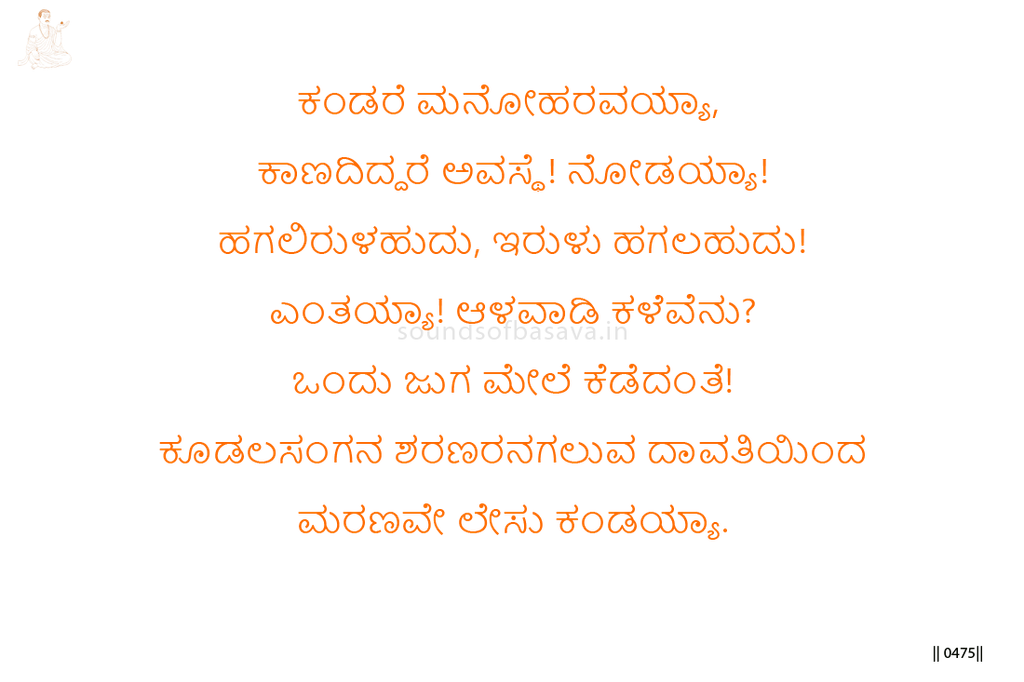
In this vachana, Basavanna contrasts seeing and not seeing. When the presence is seen, it is beautiful and heart-filling. When it is not seen, the inner condition becomes difficult to bear.
He then gives the images of reversal and dislocation. Day becomes night, and night becomes day. The ordinary order of experience is overturned. A single moment feels as though an age has passed.
The final declaration gives the force of the vachana. Separation from the Sharanas of Kudalasangama is worse than death. Basavanna measures life not by bodily continuation, but by nearness to the living presence of the Lord’s Sharanas.
Imagery & Symbolic Relevance
The first image is seeing. When the presence is seen, it is manohara, deeply pleasing and inwardly beautiful. Seeing here marks contact with what gives life its right orientation.
The second image is not seeing. When that seeing is absent, Basavanna asks us to look at the condition that follows. Absence is not neutral; it produces disturbance.
Day becoming night shows the loss of clarity. What should be bright becomes dark. What should guide becomes uncertain.
Night becoming day shows further inversion. The inner order is confused, and the seeker can no longer rest in a stable measure of experience.
The question, “How can I describe this state?” shows the inadequacy of ordinary language. The condition of separation cannot be easily explained; it is known through its anguish.
The image of an age passing in a moment shows the weight of separation. Time itself becomes heavy when nearness to the Sharanas is lost.
The final image is death as preferable to separation. This does not glorify death. It shows the severity of spiritual separation. For Basavanna, life without the Sharanas of Kudalasangama has lost the living ground that makes life bearable.
Lingayoga
In Lingayoga, this vachana teaches the necessity of continuous nearness to realized presence. The seeker is not sustained by isolated effort alone. The Sharanas become the living field in which remembrance, clarity, and inward steadiness are preserved.
The practice-point is vigilance against separation. When the seeker loses contact with Sharana presence, clarity becomes confusion and time itself becomes burden. Remaining near the Sharanas of Kudalasangama is therefore not optional support; it is life-sustaining alignment.
Editorial Commentary
The contrast between seeing and not seeing should be kept central. Basavanna does not begin with doctrine; he begins with direct change in inner condition.
The day-night reversal should not be treated as decorative imagery. It shows that separation overturns the seeker’s inward order.
Basavanna is saying that separation from Kudalasangama’s Sharanas is more unbearable than death because such separation cuts the seeker away from the living field of remembrance.
Related Vachana
Supporting Vachana
Prasadi Sthala Vachana 630 — When Remembrance Dies
Prasadi Vachana 630 supports this vachana by teaching that death-like ruin is not only an outer event. There, wrong seeing, wrong speech, and forgetting the remembrance of Kudalasangama Deva are identified as Māri, a condition of inner destruction.
Vachana 371 carries this same truth into the anguish of Sharana-separation. When seeing is lost, day becomes night, night becomes day, and one moment feels like an age. Thus the Prasadi warning that forgetting remembrance is death-like supports the Pranalingi declaration that separation from the Sharanas of Kudalasangama is worse than death.
Advancing Vachana
Sharana Sthala Vachana 404 — The Fragility of Clarity
Sharana Vachana 404 advances this teaching by showing the next danger after seeing. In Vachana 371, not seeing the Sharanas causes unbearable inversion and separation. In Vachana 404, when the Sharanas come, the mind believes and rejoices; yet if delusion and doubt arise again, the seeker is broken.
Thus the Pranalingi anguish over separation advances into Sharana Sthala as the need to guard clarity after contact with realized presence. Nearness must become stable, because even after Anga and Linga come together, renewed doubt can undo the seeker before Kudalasangama Deva.
