

Summary
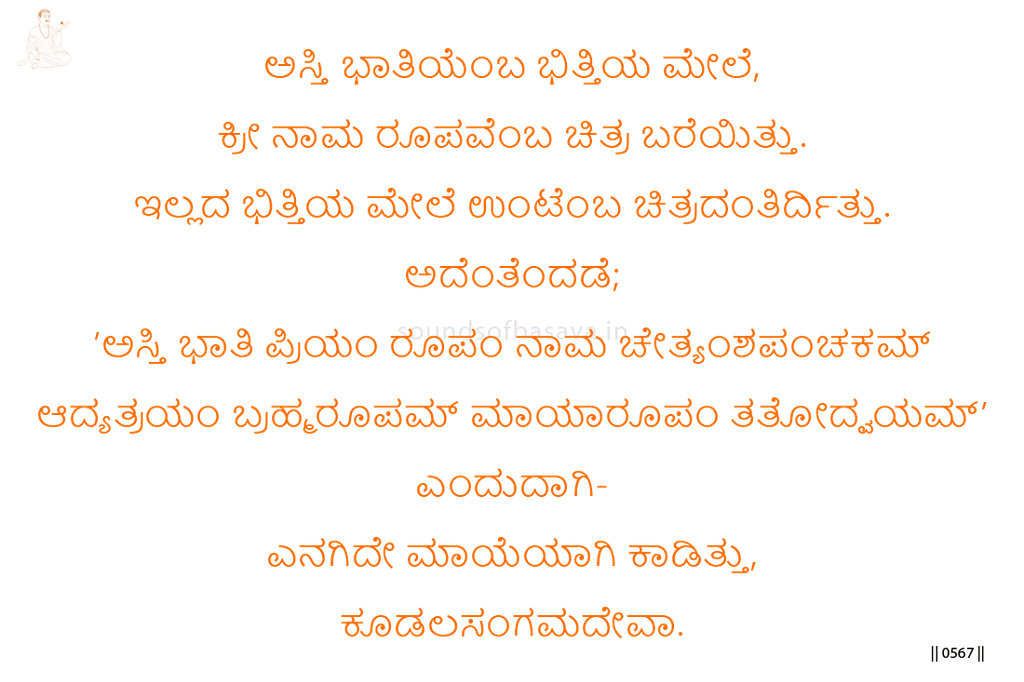
In this vachana, Basavanna explains Māyā through the image of a painting upon a wall. The wall is Asti-Bhāti. Asti means being, the truth that something is. Bhāti means shining, the self-revealing awareness by which anything is known. Together, Asti and Bhāti form the supporting ground.
Upon this wall appears the picture called Nāma-Rūpa, name and form. This picture includes the world, the body, identity, relationships, and the seeker’s own sense of separate existence. These appear for a time, like a painting upon a wall.
Basavanna then gives the deeper warning. Upon that which has no real wall, another picture appears, declaring, “it exists.” This means that the temporary appearance begins to claim independent reality. The embodied seeker, the world, and their connections appear dependent and passing, but Māyā makes them seem self-standing, solid, and real in themselves.
This false claim bewildered Basavanna as Māyā. The teaching is therefore not that appearance is absent, but that appearance becomes delusive when it is mistaken for independent reality. The seeker must see the picture clearly without forgetting the wall that supports it.
Imagery & Symbolic Relevance
The first image is the wall of Asti-Bhāti. A wall supports a painting. In the same way, being and self-revealing awareness support all appearance. Without this ground, no name, form, body, identity, or relationship could appear.
The second image is the picture of Nāma-Rūpa. Nāma means name, and Rūpa means form. Everything that can be named, seen, thought, possessed, feared, desired, or called “mine” belongs to this painted field of appearance. The seeker’s own embodied identity is also part of this picture.
The third image is the temporary nature of the picture. A painting appears upon the wall, but it is not the wall itself. Likewise, the body, personality, possessions, relations, and worldly connections appear for a time. They do not possess independent permanence.
The fourth image is the picture appearing where there is no wall. This is the deeper deception. Name and form first appear upon the support of Asti-Bhāti, but then they behave as though they have their own separate ground. The dependent picture claims to stand by itself.
The fifth image is the claim “it exists.” This is not true Asti, the being of the supporting ground. It is the false claim of separate existence made by appearance. When the seeker takes the temporary body, identity, and world as independently real, Māyā begins to bind the mind.
The final image is Basavanna’s bewilderment before Māyā. Māyā here is not merely the existence of the visible world. It is the engulfing power by which the seeker forgets the ground and becomes absorbed in the painted surface as though it were the whole truth.
Lingayoga
In Lingayoga, this vachana teaches correction of vision. The seeker must learn to see the difference between the supporting ground and what appears upon it.
For Pranalingi Sthala, the point is precise. Awareness must not be carried away by Nāma-Rūpa. The forms of life, body, world, and thought appear, but they do not stand independently. The seeker himself, as an embodied and relational identity, is part of the temporary picture.
The practice-point is clear: do not reject the picture, but do not mistake it for the wall. Let the gaze become steady enough to see appearance as dependent. When the seeker remembers Asti-Bhāti, Māyā loses its power to make the temporary seem absolute.
Editorial Commentary
The key terms should remain clear. Asti means being or “it is.” Bhāti means shining or self-revealing awareness. Nāma-Rūpa means name and form, the field of visible and thinkable appearance. Māyā is the bewilderment by which dependent and temporary appearance is mistaken for independent reality.
The wall-image is central. Basavanna does not say that the picture does not appear. He shows that the picture has no independent standing apart from the wall. This includes the seeker’s own bodily identity and worldly connections. They appear, function, and relate for a time, but they are not self-standing. Māyā engulfs the seeker by making this temporary appearance seem permanent, independent, and ultimately real.
Related Vachana
Supporting Vachana
Maheshwara Sthala Vachana 90 — The Mirror of the Beholder
Maheshwara Vachana 90 supports this teaching by showing that the distortion lies in the condition of seeing. One person calls the same thing milk; another calls it liquor. Reality itself is not divided, but perception becomes distorted according to the state of the beholder.
Vachana 1029 carries this concern into Pranalingi Sthala. Here, the distortion is subtler: name and form appear upon the wall of Asti-Bhāti, but Māyā makes them seem independently real. What Maheshwara Vachana 90 presents as distorted seeing becomes, here, the deeper bewilderment caused by Nāma-Rūpa.
Advancing Vachana
Sharana Sthala Vachana 582 — Beyond All Claims and Marks
Sharana Vachana 582 advances this teaching by dissolving the authority of names, marks, caste, ritual claims, and borrowed declarations. It asks whether name, sign, status, or claim can make one real, and shows that truth stands before all such constructed identities.
In Vachana 1029, Nāma-Rūpa appears like a painting upon the wall of Asti-Bhāti, and Māyā begins when that dependent appearance claims independent reality. In Vachana 582, this matures into Sharana Sthala as freedom from all false identity. The painted forms of name, mark, caste, claim, and status no longer bind the Sharana, because the Real is known before all divisions in Kudalasangama Deva.
