

Summary
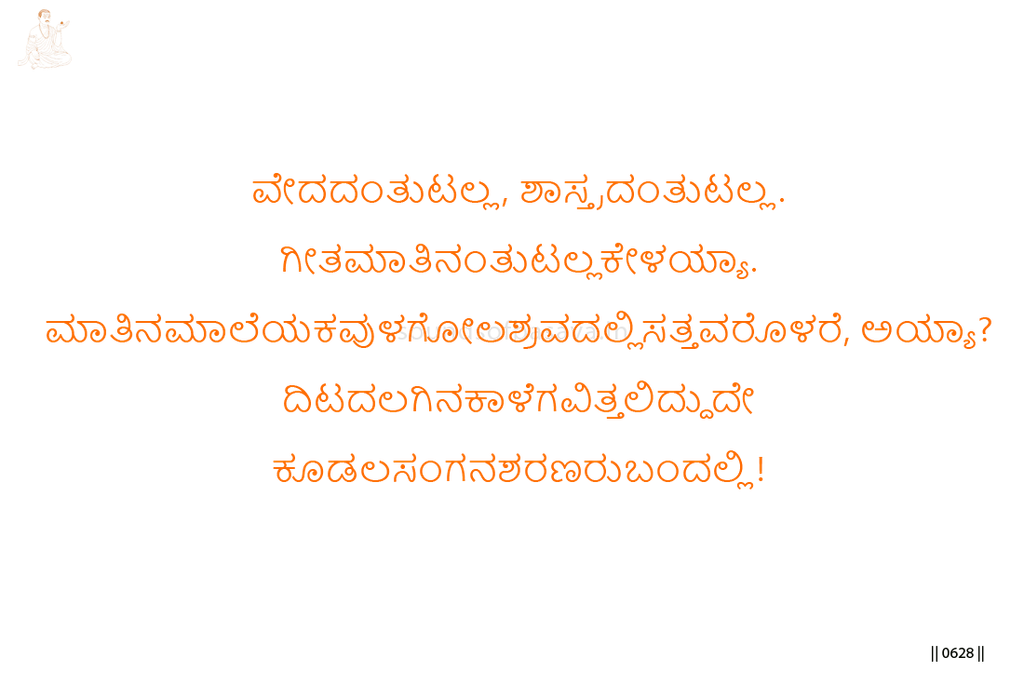
In this vachana, Basavanna says that truth is not found merely in the Veda, nor merely in the Shastra, nor merely in the spoken word of the Gita. Sacred words may be heard, recited, measured, and repeated, but if they remain only as speech, they do not become living truth.
Words belong to the one who utters them. When they do not become realization, they fade with the speaker. Basavanna is not rejecting sacred teaching; he is rejecting dependence on words that have not become lived seeing.
The decisive turn comes when Kudalasangama’s Sharanas arrive. In their presence, truth is no longer merely quoted, heard, or explained. It stands firm as lived reality. The Sharana does not only speak truth; the Sharana embodies it.
Imagery & Symbolic Relevance
The Veda is the first image of sacred authority. Basavanna says truth is not found in it merely as text, recitation, or inherited sanctity. The Veda may point, but pointing is not the same as realization.
The Shastra is the second image. It represents teaching, doctrine, structure, and explanation. Basavanna questions its sufficiency when it remains outside lived transformation.
The Gita-word is the third image. It stands for revered spiritual speech. Even a noble utterance does not complete the path if it remains only in the ear and memory.
The movement of word into hearing is important. Teaching may enter the ear, but hearing alone does not transform. The Kannada line should therefore be read carefully: Basavanna’s concern is not sound itself, but speech that remains at the level of transmission.
The fading of words with the speaker gives the vachana its warning. Spoken teaching is time-bound when it is not realized. What is borrowed from another’s mouth cannot stand as one’s own truth unless it is lived.
The arrival of Kudalasangama’s Sharanas forms the final image. The Sharana is living proof. When the Sharana comes, truth is not dependent on quotation or argument. It is seen in conduct, presence, and realized life.
Together, the images teach the difference between heard truth and embodied truth. Veda, Shastra, and Gita-speech may guide, but the living Sharana reveals what has become firm.
Lingayoga
In Lingayoga, this vachana clarifies that hearing must become realization. Sacred words have value only when they lead the Anga into direct relation with Linga and living recognition through Jangama.
The practice-point is direct: do not stop with reading, hearing, or repeating. Let the word become conduct. Let what is heard become inward seeing.
For Sharana Sthala, the teaching concerns living embodiment. The Sharana is not defined by speech about truth, but by truth that has become life. In the presence of such Sharanas, the seeker learns the difference between verbal knowledge and realized steadiness before Kudalasangama Deva.
Editorial Commentary
This vachana should not be read as contempt for Veda, Shastra, or Gita. Basavanna’s correction is more exact: sacred speech does not suffice when it remains only as speech. The final authority in this vachana is the lived presence of Kudalasangama’s Sharanas, where truth stands firm beyond recitation.
Related Vachana
Supporting Vachana
Pranalingi Sthala Vachana 748 — The Mirror of Seeing
Pranalingi Vachana 748 supports this teaching by bringing philosophical proof, scriptural declaration, and direct seeing before Kudalasangama Deva. It shows that proof and sacred statement must finally yield to seeing. Vachana 209 carries the same concern through Veda, Shastra, and Gita-speech: what remains only as word does not stand. When Kudalasangama’s Sharanas arrive, truth becomes visible as lived realization.
Advancing Vachana
Aikya Sthala Vachana 955 — The Self-Luminous Beyond All Acts
Aikya Vachana 955 advances this teaching by carrying it beyond Veda, thought, action, gain, loss, giving, and taking. In Vachana 209, Basavanna turns from sacred word to the living truth embodied by the Sharanas. In Aikya Vachana 955, that movement reaches the self-luminous state where Kudalasangama Deva is not dependent on word, proof, or category. Thus the Sharana-stage recognition of lived truth advances into Aikya as direct radiance beyond all verbal and conceptual support.
