

Summary
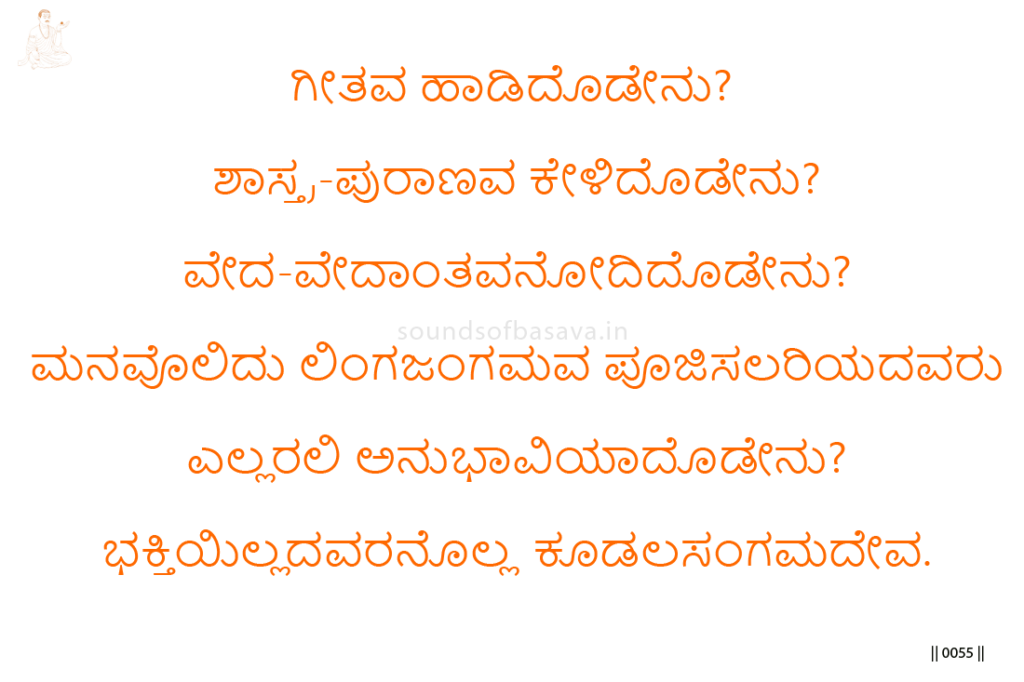
In this vachana, Basavanna asks what is gained by singing, hearing śāstra and purāṇa, or studying Veda and Vedanta.
These may bring religious learning and public regard, but they are incomplete if the heart does not know how to worship Linga and Jangama.
Kudalasangama Deva does not accept the one without bhakti. Knowledge must become devotion, and devotion must become lived worship.
Imagery & Symbolic Relevance
Singing represents religious expression through the voice. It may sound sacred, yet sound alone is not realization.
Śāstra and purāṇa represent sacred hearing and inherited tradition. They give instruction, story, and memory, but they must enter the heart.
Veda and Vedanta represent the highest scriptural study. Basavanna includes them to show that even refined knowledge is insufficient when it remains separate from devotion.
The worship of Linga and Jangama is the center of the vachana. Linga is the sacred presence; Jangama is the living presence. Both must be worshipped with an inwardly moved mind.
The learned person may be called wise among others. But before Kudalasangama Deva, wisdom without bhakti does not reach completion.
Lingayoga
In Lingayoga, knowledge must become practice.
The voice that sings, the ear that hears, and the mind that studies must all be gathered toward Linga-Jangama worship.
If learning remains in memory alone, the Anga is not transformed. The heart must become fit for devotion.
Practice matures when study, song, and hearing become living bhakti before Kudalasangama Deva.
Editorial Commentary
This vachana separates sacred learning from spiritual fulfillment.
Basavanna does not reject scripture; he refuses learning that does not ripen into worship.
Related Vachana
Supporting Vachana
Vachana 186 — Miner of the Heart
Vachana 186 teaches that Linga is to be recognized within Jangama through trust. Vachana 188 continues by showing that learning is barren if it does not become worship of Linga and Jangama.
Advancing Vachana
Maheshwara Vachana 85 — The Linga in the Palm, the Animal Within
The empty learning criticized in Vachana 188 advances into the mirror of the self in Maheshwara Vachana 85. What appears here as knowledge without bhakti must become inward seeing and lived recognition before Kudalasangama Deva.
